

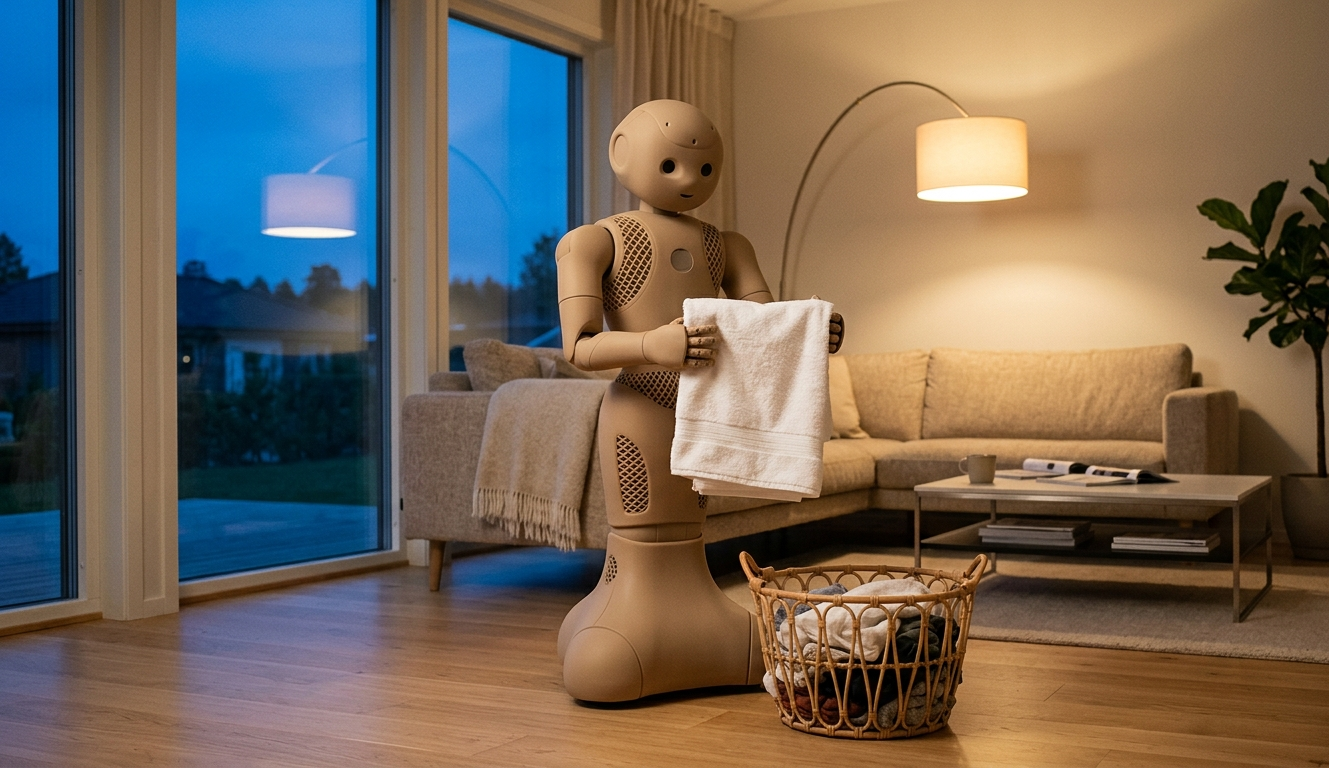
For decades, the humanoid robot living in your house was a science-fiction promise. In late 2025, that promise got a price tag. 1X Technologies, a Norwegian-American robotics company backed by OpenAI, opened pre-orders for the 1X NEO humanoid robot — a 30-kilogram machine built to fold laundry, tidy rooms, and hold a conversation in your living room. It sold out its first year of production in five days.
But the more interesting story isn’t the sales number. It’s what’s actually happening inside NEO when it does a chore — and how much of that “AI” is, today, a person in another building wearing a VR headset.
Table of Contents
The Home Problem NEO Is Trying to Solve
Household labor — cleaning, tidying, caregiving, the small physical tasks that eat up time — has resisted automation longer than almost any other category. Robot vacuums solved one narrow slice of it. Smart speakers solved information retrieval. Nothing solved general physical help: the robot that can pick up a specific sock, water a specific plant, or keep an aging parent company between visits.
1X is betting that the home, not the factory, is actually the easier place to solve this. Warehouses demand near-perfect reliability at industrial speed. A home robot can be slower, can ask for help, and can improve gradually while still being useful on day one.
What Is 1X NEO?
NEO is a bipedal humanoid robot developed by 1X Technologies, formerly known as Halodi Robotics. The current consumer version follows two earlier prototypes — NEO Beta, introduced in August 2024, and NEO Gamma, introduced in February 2025. Consumer pre-orders for the production NEO opened on October 28, 2025, with 1X reporting it sold out its entire first-year production allotment of over 10,000 units within five days.
As of the most recent verified reporting in mid-2026, 1X had begun full-scale manufacturing at a new factory in Hayward, California — described by the company as the first vertically integrated humanoid robot factory in the United States — but no independent source had yet confirmed an actual customer delivery. 1X’s own materials continue to describe first shipments in the future tense.
How It Works: The Hardware
NEO is built specifically to operate safely around people, which shows up in nearly every design choice.
| Spec | Detail |
|---|---|
| Height / Weight | 168 cm (5’6″) / ~30 kg (66 lb) |
| Lift / Carry capacity | Up to 70 kg lift, 25 kg carry (some secondary sources cite 68 kg lift — figures vary slightly by source) |
| Hands | 22 degrees of freedom per hand (44 total) |
| Cameras | Dual 8.85-megapixel stereo fisheye cameras, 90 Hz |
| Microphones | Four-microphone beamforming array |
| Onboard compute | 1X NEO Cortex, built on NVIDIA Jetson Thor |
| Actuation | Tendon-drive system with high-torque-density motors |
| Exterior | Soft 3D-lattice polymer shell, pinch-free joints |
| Noise level | Rated at approximately 22 dB (near-silent) |
| Battery | 842 Wh pack, roughly 4 hours of active runtime |
| Connectivity | Wi-Fi, Bluetooth, 5G |
Sources: 1X Technologies specifications aggregated via Humanoid.guide, HumanoidHub, and 1x.tech
The tendon-drive actuators and soft outer shell are a deliberate departure from rigid industrial robots — the goal is a machine that can be near children, pets, and furniture without causing injury. The lift-and-carry limits (70 kg / 25 kg) and the 4-hour runtime are honest constraints: this is a robot built for intermittent home chores, not continuous industrial duty.
How AI Is Actually Used
This is the part worth slowing down on, because “AI-powered” gets used loosely in consumer robotics. NEO’s system actually qualifies — but it’s not one AI, it’s three different layers working together.
1. Redwood — the vision-language-action model. This is the AI that turns a spoken instruction (“fold the towels”) into physical movement, combining camera input, language understanding, and whole-body motor control. This is multimodal AI in the technical sense: it fuses vision and language to produce action, not just text.
2. The World Model. 1X describes this as a generative AI system that lets NEO “imagine” the likely outcome of an action before performing it, by generating video predictions of possible futures. The company launched a dedicated research lab for this system in June 2026, positioning it as the long-term path to reducing reliance on human help.
3. Human teleoperation. This is the layer that separates NEO from ordinary automation claims — and the one generating the most scrutiny. For tasks NEO’s AI hasn’t yet mastered, a trained human operator can remotely control the robot’s body via VR headset, seeing through its cameras in real time. 1X calls this “Expert Mode.”
CEO Bernt Børnich has been explicit that this is a deliberate, ongoing hybrid system, not a bridge to be quietly phased out overnight: “Everything I talk about here now happens through a mixture of autonomy and teleoperation… it is going to be a while until there is absolutely no human in the loop ever,” he said in an interview, comparing it to how Waymo’s self-driving cars still occasionally need remote human assistance.
What counts as real AI here, and what doesn’t: Voice recognition, object identification, and the language-to-action translation are genuine AI capabilities. A scheduled robot vacuum following a pre-set path is automation. NEO planning how to grip an unfamiliar object based on camera input is AI. NEO being manually driven by a person in Expert Mode is neither AI nor automation — it’s remote human labor, delivered through a robot body.
Key AI Capabilities — Confirmed and Unconfirmed
Company demonstrations and press reporting confirm NEO performing:
- Folding clothes, clearing trash, putting away dishes, watering plants
- Opening doors, fetching small objects, turning off lights on request
- Vacuuming and basic tidying
- Natural spoken conversation and scheduling
A figure widely repeated in coverage — that NEO operates “60 to 70 percent autonomously” — has circulated across secondary sources but has no confirmed primary source from 1X itself. Readers should treat it as an unverified estimate, not a company-confirmed statistic. 1X has also not published a breakdown of which specific tasks run autonomously versus which rely on Expert Mode at launch, which independent trade press has flagged as a meaningful information gap for prospective buyers.
Real-World Performance: What’s Actually Been Tested
Here’s the most important caveat in this entire article: no independent reviewer has yet tested a production NEO unit. Every hands-on account to date involves pre-production robots.
One data point stands out. A Wall Street Journal hands-on session reportedly found that every household task demonstrated during that visit was being performed via teleoperation, not autonomously. Børnich has pushed back on similar criticism from other reviewers, including tech YouTuber Marques Brownlee, stating that specific portions of 1X’s own launch video labeled as AI-driven were “100% autonomous,” and that the company chose not to promise capabilities it hadn’t already demonstrated.
The gap between these accounts — a journalist observing full teleoperation in one session, and a company insisting other demonstrated segments were truly autonomous — is precisely why independent, production-unit testing will matter so much once NEO actually ships.
Practical Benefits
- Demand is real, even if delivery isn’t yet: Selling out 10,000+ pre-order units in five days signals strong consumer appetite for a home humanoid, regardless of how the autonomy question resolves.
- Designed use cases beyond chores include eldercare support and companionship — an area where even partial, supervised assistance (medication reminders, company, light physical help) could offer real value, similar in spirit to dedicated eldercare devices already in the market.
- Low estimated running cost: 1X states daily electricity use amounts to less than $1 at standard rates — a company claim, not yet independently verified at scale.
Privacy and Security
This is where NEO’s hybrid design creates a real, unresolved tension.
Because Expert Mode allows a remote human operator to see and hear through NEO’s cameras and microphones during a teleoperation session, critics have consistently identified this as the core privacy concern with the product — not hypothetical hacking, but the built-in fact that a stranger’s job may occasionally involve looking around inside your home.
1X’s stated mitigations include:
- Required user consent before any remote-control session
- Visual indicators (light rings) showing when a human operator is active
- The ability to designate “no-go zones” the robot will never enter
- Face-blurring in video feeds, per company claims
- Operator vetting, live supervisory oversight (reported as one manager per eight operators), and audit logs of sessions
These are meaningful stated safeguards — but they are self-reported by 1X and have not been independently audited or verified by a third party as of this writing. Specific technical details, such as encryption standards for video streams or independent security testing results, are not publicly disclosed. Prospective buyers should treat privacy protections as a company claim pending independent verification, not a settled fact.
Limitations
- Not fully autonomous today. Some coverage cites 2028 as 1X’s target for full autonomy; this figure has not been confirmed through a direct, on-the-record company statement and should be treated as a reported projection, not a guarantee.
- Limited runtime. Roughly 4 hours of active use per charge, compared with 8+ hours on industrial humanoids.
- Restricted task scope. NEO is not designed to safely handle open flames, sharp tools, or highly complex physical coordination.
- Undisclosed autonomy split. Buyers currently cannot know, task by task, what will run on-device versus what requires a human operator.
- No confirmed deliveries yet. As of the most recent verified reporting, timelines remain company-stated rather than independently confirmed.
Cost and Availability
| Option | Price | Notes |
|---|---|---|
| Outright purchase | $20,000 | Includes Expert Mode access, software updates; early buyers reportedly get priority delivery |
| Subscription | $499/month | Minimum term details have changed since launch and are no longer listed consistently |
| Deposit | $200 (refundable) | Required to reserve a unit |
Ordering is currently limited to the United States, with international availability planned for 2027. As of the most recent reporting, U.S. deliveries were still described as forthcoming rather than completed, despite full-scale factory production having begun.
Competitors
- Figure 03 (Figure AI) — no public consumer price or pre-order yet; remains partner-focused
- Tesla Optimus — frequently cited as a long-term rival ambition, not yet orderable for home use
- LG CLOiD — demonstrated at CES 2026 performing home chores, not yet commercially available
- The Bot Company — a stealth-mode home robot venture founded by former Cruise co-founder Kyle Vogt
- AGIBOT — a global volume leader in humanoid shipments, though not positioned the same way as a consumer home product
The Future of AI-Powered Homes
NEO is less a finished product than a real-time experiment in how much physical intelligence current AI can actually deliver — and how honestly a company can price and market the gap between what its AI does and what a human still has to do. If 1X’s World Model research succeeds in meaningfully reducing teleoperation over the next few years, NEO could become the clearest evidence yet that general-purpose home robots are commercially viable. If it doesn’t, the “$20,000 robot with a human inside it” critique will be hard to shake.
Conclusion
1X NEO represents a real technical step forward — a multimodal AI system combining vision, language, and physical action in a home robot that people can actually order today. But it is being sold, and reviewed, in the middle of an unresolved question: how much of what NEO does is really its own intelligence, and how much is a person operating it remotely from somewhere else. Until independent reviewers get their hands on a production unit and 1X publishes a clear autonomy breakdown, that question — not the price tag — is the real story.
FAQ
Is the 1X NEO robot actually available to buy right now? You can place a pre-order with a refundable $200 deposit. As of the most recent verified reporting, no independent source had confirmed an actual customer delivery, though 1X began full-scale manufacturing in April 2026.
Does 1X NEO work fully autonomously, or does a human control it? It’s a hybrid. Some tasks run on NEO’s onboard AI; others rely on a remote human operator through “Expert Mode.” 1X has not published an exact breakdown of which is which at launch.
How much does 1X NEO cost, and are there ongoing fees? $20,000 for outright purchase or $499 per month on a subscription, both requiring a $200 refundable deposit to reserve a unit.
Can someone at 1X see inside my home through NEO’s cameras? During an active, consented Expert Mode session, a vetted remote operator can see and hear through NEO’s cameras and microphones. 1X states it uses consent requirements, visual indicators, no-go zones, and face-blurring as safeguards, though these have not been independently audited.
What can NEO actually do today versus what’s still coming? Confirmed demonstrated tasks include folding clothes, tidying, fetching objects, vacuuming, and conversation. Full autonomy across complex tasks like cooking or dishwasher loading is not yet established and may still involve teleoperation.
When will 1X NEO actually ship to customers? 1X has stated deliveries beginning in 2026 for the U.S., with international availability planned for 2027. As of the latest reporting, this remained a company timeline rather than an independently confirmed delivery date.
How does NEO compare to Tesla Optimus and Figure’s robots? NEO is currently the only one of the three with a public consumer price and open pre-order process. Figure and Tesla have not opened equivalent consumer ordering as of this writing.
Sources
- 1X Technologies official specifications (1x.tech)
- The Robot Report — pre-order launch and Hayward factory production coverage
- TechCrunch and eWeek — pricing and pre-order reporting
- Tom’s Guide — privacy concerns and company mitigations
- Humanoids Daily — CEO Bernt Børnich interview transcripts and reviewer response coverage
- GlobeNewswire / Forbes — Hayward, CA factory production milestone
- RoboZaps — delivery status verification tracking (July 2026)