

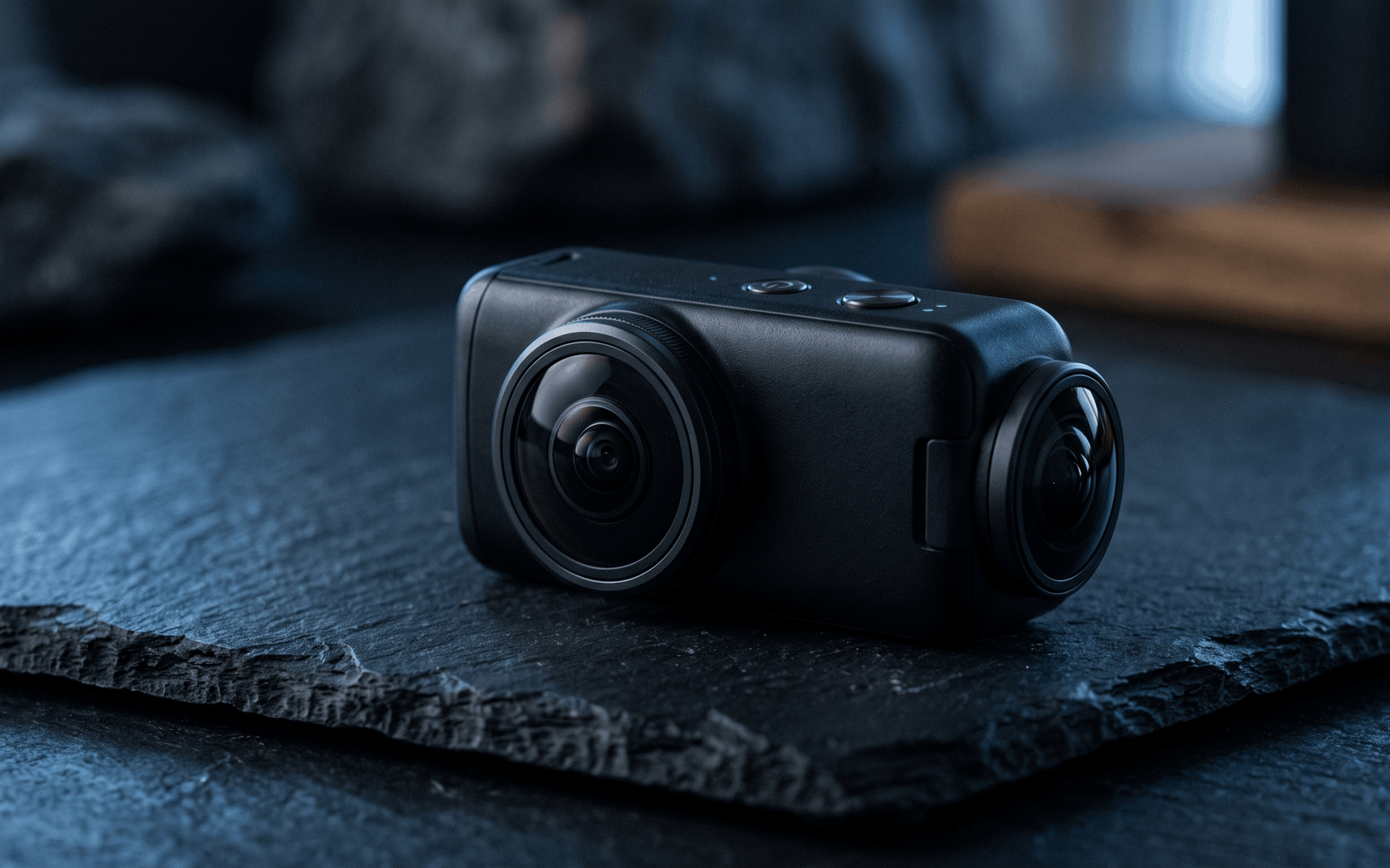
DJI’s newest 360-degree camera launched globally on September 3, 2026, at IFA Berlin, and its headline low-light feature raises a question DJI itself hasn’t answered yet.
The Osmo 360 II is the company’s second standalone 360-degree camera, built around a claimed 14.5-stop dynamic range and native 8K video at 60 frames per second. At the center of that pitch sits AI SuperNight 2.0, an AI-driven noise-reduction system DJI says lets creators capture clean, bright footage in the dark — a scenario that has historically been the weak point of 360-degree cameras, which pack high pixel counts onto sensors too small to gather much light.
That’s a meaningful promise for anyone shooting motorcycle rides at night, dim interiors, or dusk hikes. It’s also, so far, a promise without a technical explanation. DJI has not published a whitepaper, technical blog post, or architecture breakdown describing how SuperNight 2.0 actually processes an image. Independent technical outlets that reviewed the camera confirm the same gap. This piece lays out exactly what’s confirmed, what’s reviewer impression, and what remains genuinely unknown — because those are three different things, and DJI’s marketing tends to blur them.
Table of Contents
What Is the Osmo 360 II, and What Is AI SuperNight 2.0?
The Osmo 360 II replaces DJI’s original Osmo 360 from July 2025. It launched in China on August 13, 2026, and went on sale globally — outside the United States — following the September 3 IFA announcement, with European and UK retail availability starting September 15.
The camera’s core imaging system is a dual 1/1.1-inch square CMOS sensor design, which DJI describes as the industry’s first square HDR image sensor that keeps the same 360-degree field of view as a traditional rectangular one while increasing sensor utilization by roughly 25 percent. Paired with large 2.4-micron pixels and f/1.9 lenses — both unchanged from the previous generation — the setup produces what DJI calls 14.5 stops of dynamic range, up from 13.5 stops on the original Osmo 360, along with native 8K video at 60fps, up from 50fps.
AI SuperNight 2.0 is layered on top of that hardware as a noise-reduction algorithm. DJI’s official language ties it directly to the dynamic-range and low-light claims but stops there: it describes what the feature is supposed to achieve, not how.
How AI SuperNight 2.0 Is Supposed to Work
This is the part of the story where the evidence runs out. DJI’s press materials name the feature and its stated goal — clean, bright low-light 360-degree shots — but include no explanation of the underlying method. There’s no indication of whether it relies on stacking multiple exposures over time, a trained neural network trained to remove noise patterns, dedicated image-processing silicon, or some mix of those approaches.
Independent technical publication CineD, which reviewed the camera at launch, made the same observation directly: DJI’s press material contains no detail on how the algorithm works, at what resolutions and frame rates it operates, or how much motion smearing it might introduce during fast action — leaving it as a feature that can only be judged by its output, not compared against any published specification.
That absence matters because the camera’s optics haven’t changed. The sensor size, pixel size, and aperture are identical to the original Osmo 360. If low-light images genuinely look better this generation, the improvement has to be coming from processing rather than from gathering more physical light — which is exactly the kind of claim that benefits from documentation, and exactly the kind DJI hasn’t provided.
What Independent Reviewers Actually Saw
In the absence of a technical spec sheet, hands-on testing is the next best evidence — with the caveat that it’s qualitative, not measured.
One independent test found that SuperNight 2.0 operates at up to 8K and 6K resolution at 60fps, meaning DJI’s night mode doesn’t force users to drop frame rate to get a low-light boost — a practical advantage for shooting people or vehicles after dark, where subjects rarely hold still.
Broader reviews were positive about real-world results. TechRadar’s assessment concluded that while the Osmo 360 II isn’t a transformative leap in outright image quality, it’s an excellent 360 camera that gives both the GoPro Max 2 and the Insta360 X6 a serious run for their money, particularly after dark. That’s a meaningful data point — but it’s a subjective verdict from watching footage, not a controlled lab comparison with numbers attached.
How Does It Compare to Insta360 and GoPro?
The Osmo 360 II arrived weeks after Insta360’s X6, and DJI is positioning its camera as a direct, cheaper rival. On paper, the Osmo 360 II’s 8K/60fps ceiling beats the X6’s 8K/50fps limit — a genuine, DJI-confirmed spec advantage.
But frame rate isn’t the same as low-light image quality, and here the picture is murkier. One hands-on review from Digital Camera World, comparing the Osmo 360 II against the Insta360 X6, found DJI’s on-camera AI software less extensive than Insta360’s, and said it wasn’t enough to pull the reviewer away from the X6’s newer AI tools. That’s a direct, if informal, comparison — and it cuts against a simple “DJI wins” narrative.
No independent outlet has published a controlled, side-by-side low-light benchmark — matched lighting conditions, measured noise levels, identical framing — between AI SuperNight 2.0 and any competing system, including Insta360’s low-light modes. Until that kind of test exists, any claim that one system definitively outperforms the other is an opinion, not a measurement. As for Kandao, no comparison data or independent testing against the Osmo 360 II turned up in available coverage.
| DJI Osmo 360 II | Insta360 X6 | GoPro Max 2 | |
|---|---|---|---|
| Max 360° video | 8K/60fps | 8K/50fps | Not independently confirmed here |
| Dynamic range (claimed) | 14.5 stops | Not publicly disclosed here | Not publicly disclosed here |
| Low-light AI feature | AI SuperNight 2.0 (mechanism undisclosed) | Newer on-camera AI tools, described by one reviewer as more extensive | Not compared in available coverage |
| Lenses | User-replaceable | Not addressed here | Not addressed here |
| US availability | Not available | Not addressed in research | Not addressed in research |
Table reflects only figures confirmed in official DJI materials and cited independent reviews; blank comparisons reflect a genuine lack of published data, not equivalence.
Spotlight Follow and the DaVinci Resolve Workflow
Two other AI-branded features are worth separating out, because they’re often mentioned in the same breath as SuperNight 2.0 despite doing entirely different jobs.
Spotlight Follow is DJI’s subject-tracking mode, designed to keep a person centered in frame as the camera rotates, without manual reframing later. It’s limited to 4K at 30fps or 2.7K at 30fps, and one hands-on reviewer found it crops too tightly into the footage, leaving the final tracked video looking soft — a real limitation for anyone hoping to use it for crisp, fast-moving action footage.
On the editing side, DJI has built a plugin for importing 360-degree footage into DaVinci Resolve, aimed at professional colorists. But one detailed hands-on account found that files still have to pass through DJI Studio first — the Resolve plugin ingests DJI Studio’s processed exports rather than raw camera files, meaning creators still have to commit to framing decisions before the footage ever reaches Resolve. It streamlines an existing step rather than replacing it.
Availability, Pricing, and What’s Still Unknown
The Osmo 360 II is not sold in the United States, continuing a pattern seen with other recent DJI hardware releases. In Europe, it launched at €589 for the Standard Combo and €739 for the Adventure Combo, with UK pricing at £509 and £639 respectively, and a September 15, 2026 shipping date. That’s roughly a 24 percent price increase in Europe over the original Osmo 360’s 2025 UK launch price — a steeper jump than the roughly 10 percent increase DJI applied in China for the same generational update.
Some practical details remain inconsistent across sources. Replacement lens pricing, for instance, has been reported as €39 in one outlet and AUD$49 in another — figures that may reflect different currencies or bundle contents but haven’t been reconciled into a single confirmed global price. One UK outlet also listed a November 2, 2026 launch date that conflicts with the September dates confirmed elsewhere; that discrepancy hasn’t been resolved and shouldn’t be treated as settled.
The biggest unknown, though, remains the one the camera was built to answer: what AI SuperNight 2.0 is actually doing under the hood. Until DJI publishes technical detail, or an independent lab runs a controlled comparison, that question stays open.
What This Means Now
The Osmo 360 II is a real, shipping product with a genuine hardware upgrade — faster frame rates, wider dynamic range, replaceable lenses — and reviewers generally like what they see in low light. That’s worth taking seriously if you’re deciding between this and an Insta360 X6.
What isn’t yet available is proof, in the technical sense, that AI SuperNight 2.0 represents a meaningfully different approach from ordinary noise reduction, or that it beats rival systems by any measurable margin. Right now, the evidence is: DJI’s outcome-focused marketing language, positive but informal hands-on impressions, and a documented absence of technical disclosure. Buyers evaluating the camera for night or indoor work should weigh reviewed footage rather than the “AI SuperNight 2.0” name itself, and watch for independent lab testing or a DJI technical disclosure that could settle the comparison question more precisely.
FAQ
What is AI SuperNight 2.0 on the DJI Osmo 360 II? It’s DJI’s AI-based noise-reduction system for low-light 360-degree footage, introduced alongside the Osmo 360 II’s 14.5-stop dynamic range claim. DJI has not disclosed how it technically works.
How does AI SuperNight 2.0 differ from standard noise reduction? This isn’t publicly known. DJI hasn’t published technical documentation explaining its method, and no independent source has determined it either.
Does AI SuperNight 2.0 work at all resolutions, or only 8K? Independent testing found it operates at up to 8K and 6K at 60fps without a frame-rate penalty, though DJI itself hasn’t published a full resolution/frame-rate specification for the feature.
Is the Osmo 360 II better than the Insta360 X6 in low light? There’s no controlled benchmark comparing the two. Reviewer impressions are mixed: some found the Osmo 360 II competitive with the X6 in the dark, while another described DJI’s overall AI toolset as less extensive than Insta360’s.
Can I use the Osmo 360 II with DaVinci Resolve natively? Not directly. DJI’s Resolve plugin imports footage that has already been processed and exported through DJI Studio, rather than accepting raw camera files.
How reliable is Spotlight Follow for action sports? It’s capped at 4K/30fps or 2.7K/30fps, and one independent review found it crops in too tightly, softening the final tracked video.
Is the DJI Osmo 360 II available in the United States? No. As of launch, it is sold in China, Europe, the UK, and other markets, but not in the US.