

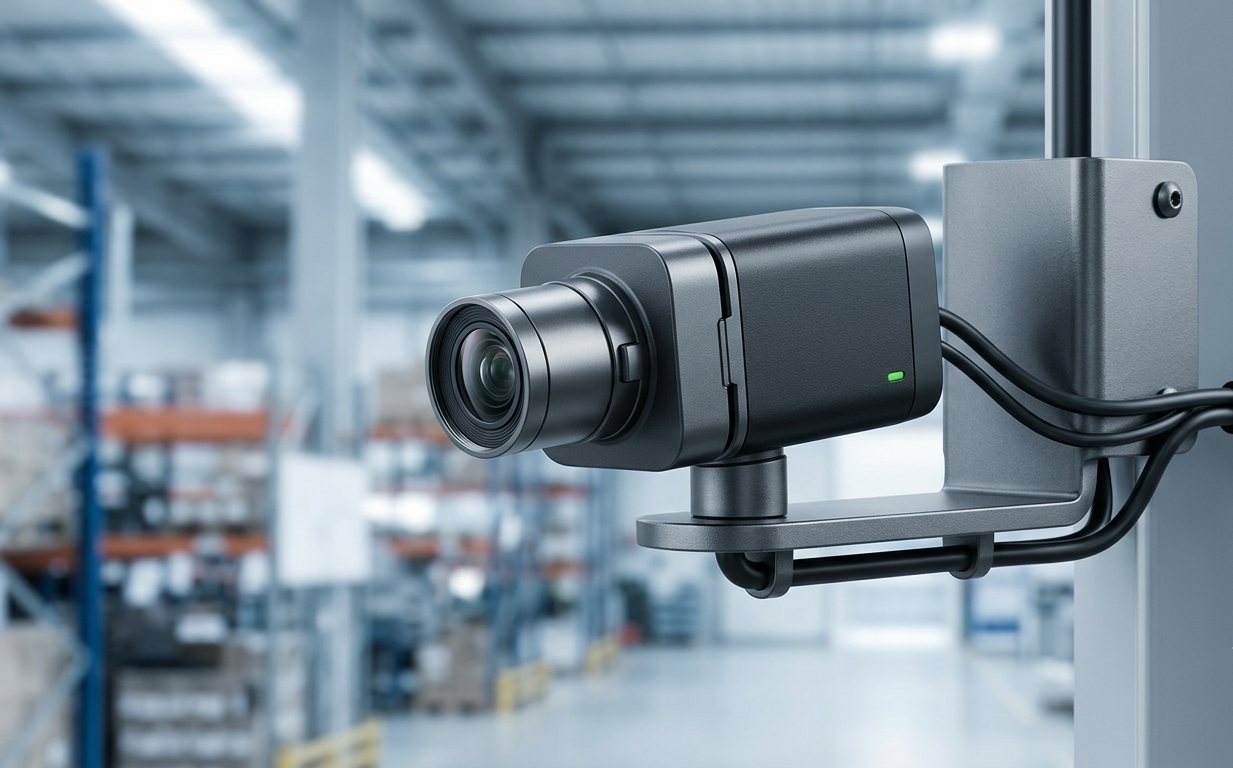
EverFocus Electronics Corp, a Taiwan-based maker of industrial cameras and computing hardware, launched the PHX-N1000 Series edge AI camera on May 15, 2025. The camera pairs NVIDIA’s Jetson Orin processors with a swappable-lens design the company calls LENSCORE, aiming it at factories, warehouses, retail floors, and security installations.
The launch itself is straightforward. What makes it worth untangling is how it later resurfaced: a Coherent Market Insights report on the computer vision market cited the EverFocus launch as an example of hardware-segment growth, and an automated headline built from that report described it as “Coherent Market Insights Launches New AI Healthcare Technology.” Neither part of that headline holds up. Coherent Market Insights didn’t launch anything — it’s a market-research firm that referenced someone else’s product. And EverFocus doesn’t market the PHX-N1000 for healthcare at all. Here’s what the camera actually is.
Table of Contents
What Happened
EverFocus announced the PHX-N1000 Series in a press release dated May 15, 2025, from Taipei, describing it as an addition to the company’s Advanced Vision AI product line. The announcement was picked up the same week by at least one industry trade site, and EverFocus has continued to promote the product since, including through a 2026 Taiwan Excellence Award.
The confusion traces back to how the product later appeared in unrelated coverage. A Coherent Market Insights report on the global computer vision market — updated in August 2026 — mentioned the May 2025 EverFocus launch as one supporting example in its discussion of hardware demand. That’s a legitimate, if minor, citation. But when that report page was scraped and turned into a news-style headline, the framing conflated the market-research firm with the product’s actual manufacturer and, separately, imported a “healthcare” label from a different part of the same report that had nothing to do with EverFocus. Both errors are worth correcting up front, because they’re the reason this story needed a second look.
Why It Matters
The PHX-N1000 is a useful, concrete example of a broader shift in computer vision: moving AI processing from the cloud onto the camera itself. Instead of streaming raw video to a remote server for analysis, an edge AI camera processes images locally, on board. That approach can cut latency, reduce bandwidth costs, and keep more visual data from leaving the device — all relevant considerations for industrial and security deployments where speed and data handling matter.
Coherent Market Insights, in its computer vision market report, projects the global computer vision market growing from roughly $28 billion in 2026 to $101 billion by 2033, with hardware — including smart cameras and edge AI devices — expected to account for about 57% of market share in 2026. Those numbers are the firm’s own commercial forecast, not independently audited figures, and should be read as one analyst’s estimate of where the market is headed rather than a settled fact.
What the PHX-N1000 Is
At its core, the PHX-N1000 is a camera built around NVIDIA’s Jetson Orin NX or Orin Nano system-on-module — the same processor family used in a range of industrial and robotics hardware. EverFocus describes it as the “world’s first” high-performance edge AI camera with interchangeable lens modules. That claim comes from the company itself; no independent testing or third-party comparison confirming it as a category first was found.
Company Claims vs. Independently Verified Facts
| Claim | Status |
|---|---|
| “World’s first” interchangeable-lens edge AI camera | Company claim — not independently confirmed |
| Up to 100 TOPS AI performance | Company-stated; consistent with NVIDIA’s published Jetson Orin NX chip specs, but not independently benchmarked on the finished camera |
| LENSCORE lens system is patented | Company claim |
| Launch date, manufacturer, core specs | Independently corroborated via EverFocus’s press release and trade-press republication |
| Healthcare application | No supporting evidence found — contradicted by EverFocus’s own stated use cases |
Key Technical Specifications
Based on EverFocus’s own product materials, the PHX-N1000’s specifications are:
| Spec | Detail |
|---|---|
| Compute platform | NVIDIA Jetson Orin NX or Orin Nano |
| AI performance | Up to 100 TOPS (company-stated) |
| Memory | Up to 16GB LPDDR5 |
| Connectivity | PoE, Wi-Fi, RS-485, alarm I/O, USB |
| Operating range | -20°C to 70°C |
| Software | Ubuntu 20.04 with NVIDIA JetPack 6.0 SDK |
| Bundled AI examples | Intersection detection, flame/smoke detection, facial expression and crowd counting |
| Image sensor | Not publicly disclosed |
The 100 TOPS figure lines up with NVIDIA’s published performance ceiling for the Jetson Orin NX platform in general, but that’s a chip-level specification, not an independent benchmark of the finished PHX-N1000 camera. One notable gap: EverFocus has not publicly disclosed the specific image sensor model or resolution used in the PHX-N1000. (A related but different EverFocus product, the PHX-N2000, uses a Sony sensor — that spec applies to that separate model, not this one.)
LENSCORE: The Interchangeable-Lens System
The feature EverFocus emphasizes most is LENSCORE, a lens-mounting system it describes as patented. It lets users swap between telephoto, wide-angle, fixed-focus, zoom, HDR, and WDR lenses without redeveloping the camera hardware. EverFocus says the design also separates the lens and processor in a way that improves heat dissipation, supporting operation across a wide temperature range.
The pitch is straightforward: instead of buying a different camera for each lighting or distance requirement, a business can change lenses in the field. Whether that translates into the cost and time savings EverFocus claims hasn’t been independently tested.
Intended Use Cases
EverFocus positions the PHX-N1000 for a specific set of environments, not medical or clinical settings. The company’s own materials list:
- Smart factories and workplaces — real-time recognition on assembly lines or robotic arms, and verification of safety equipment
- Retail and proof-of-concept deployments — analyzing customer behavior and supporting store automation
- Smart warehouses — integrating with automated guided vehicles, tracking inventory, and monitoring stock
EverFocus describes itself more broadly as a provider of security, commercial-vehicle, and embedded systems technology, but the company’s PHX-N1000-specific materials name only the three use cases above. Healthcare does not appear anywhere in EverFocus’s positioning of this product — which is the central point the original aggregated headline got wrong.
Current Status and Availability
The PHX-N1000 is listed on EverFocus’s global and U.S. product pages, and it remained active in the company’s lineup well over a year after launch — evidenced by the 2026 Taiwan Excellence Award, which recognized the product for innovation, design, and quality. That award is a reasonable signal that the camera is still a live part of EverFocus’s business, not a product that quietly disappeared.
That said, the U.S. product page lists the camera as “PHX-N1000 (prelim.),” meaning the specifications shown there are marked preliminary. It’s unclear whether this reflects a regional rollout still in progress or simply an unrevised listing. EverFocus sells through an inquiry-based B2B system rather than public retail channels, and no pricing information is publicly available.
Competitive Landscape
EverFocus operates in a computer vision and security hardware market that includes much larger, more established players — Hikvision, Dahua Technology, Axis Communications, Bosch Security Systems, and Hanwha Vision among them. These companies compete broadly in smart cameras and video surveillance, but none was found to offer a direct, publicly documented equivalent to the PHX-N1000’s specific interchangeable-lens, Jetson Orin-based design.
A somewhat closer reference point comes from a different corner of the market: Cognex’s In-Sight 3900, an industrial vision system launched in 2026 that runs on Qualcomm’s Dragonwing platform rather than NVIDIA hardware, and is aimed more squarely at manufacturing inspection than general security. It illustrates that multiple chip platforms are competing for the same edge-AI-camera space, even though it isn’t a head-to-head match with the PHX-N1000. No primary source was found directly comparing EverFocus’s camera to any of these competitors on specs, performance, or price.
Limitations and Open Questions
Several details about the PHX-N1000 remain undisclosed or unverified:
- No independent lab testing, benchmark, or hands-on review of the camera was found
- Pricing has not been publicly released
- The exact image sensor and resolution are not disclosed
- No named customer deployments or case studies have been published
- U.S. specifications are still marked preliminary
None of this means the product doesn’t work as described — only that, at this point, the available record consists primarily of EverFocus’s own claims rather than outside verification.
Latest Development
The most recent confirmed update on the PHX-N1000 is its 2026 Taiwan Excellence Award, which EverFocus announced as recognition for innovation, R&D, design, quality, and marketing. Beyond that recognition, no newer product revision, pricing announcement, or deployment news has surfaced.
| Date | Event |
|---|---|
| May 15, 2025 | EverFocus launches the PHX-N1000 Series |
| May 18, 2025 | Trade press republishes the launch announcement |
| 2026 | PHX-N1000 wins the Taiwan Excellence Award |
| August 2026 | Coherent Market Insights cites the launch in its computer vision market report |
FAQ
Who makes the EverFocus PHX-N1000? EverFocus Electronics Corp, a Taiwan-based manufacturer of industrial cameras, computing hardware, and AIoT products, founded in 1995.
When was the PHX-N1000 launched? EverFocus announced the launch on May 15, 2025, from Taipei.
What is LENSCORE technology? It’s EverFocus’s plug-and-play interchangeable lens system, letting users swap between telephoto, wide-angle, fixed-focus, zoom, HDR, and WDR lenses on the same camera body without hardware redevelopment.
Is the PHX-N1000 designed for healthcare applications? No. EverFocus markets it for smart factories, retail, warehouses, security, and transportation — healthcare is not listed among its stated use cases.
What processor does the PHX-N1000 use? NVIDIA’s Jetson Orin NX or Orin Nano, which EverFocus says delivers up to 100 TOPS of AI processing performance.
Is the PHX-N1000 available to buy now? It’s listed on EverFocus’s global and U.S. product pages, and the company sells through an inquiry-based B2B process. No public pricing has been disclosed, and the U.S. listing is still marked preliminary.
Is EverFocus’s “world’s first” claim independently verified? No. It’s a claim made by EverFocus and repeated in award materials; no independent source was found confirming or disputing it.
What This Means Now
The PHX-N1000 is a real, still-active product from an established industrial camera maker, built on a widely used AI computing platform and aimed at practical, non-medical applications. The interesting part of this story isn’t really the camera — it’s how a routine product launch, filtered through a market report and then an automated headline, ended up mislabeled as a healthcare technology announcement from a research firm that never built anything.
What remains genuinely uncertain is how the camera performs against that specification sheet in practice, what it costs, and how it stacks up against competitors — none of which has been independently documented yet. Anyone evaluating it for a real deployment would want pricing details and, ideally, some independent performance data before treating EverFocus’s own figures as the full picture. For now, the safest read is the narrow one: a modular, NVIDIA-powered industrial camera, launched in mid-2025, still on the market as of its 2026 award, with the rest to be confirmed.