

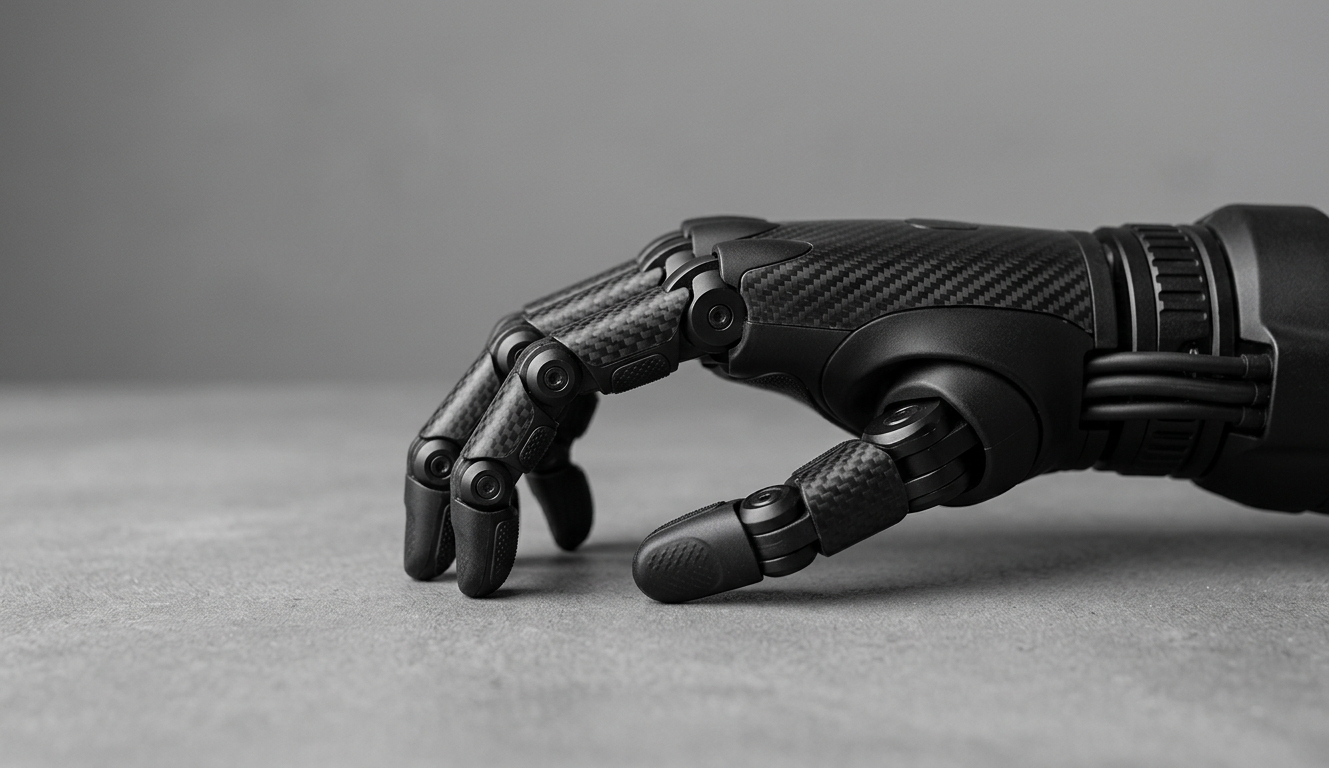
A bionic hand built to help amputees regain touch and control is now doing something its designers didn’t originally set out to do: teaching industrial robots how to grip. The Ability Hand, made by the San Diego-based startup PSYONIC, has been commercially available since 2021 and has become one of the more closely watched devices in assistive technology. In 2026, it became something else too — a live source of human movement data for two of the biggest names in robotics, NVIDIA and ABB. That combination of stories, medical device and AI infrastructure, is worth understanding in detail.
Table of Contents
The Problem It Solves
Most people who lose a hand face a frustrating trade-off. Traditional prosthetic hands are mechanically capable but numb — they open and close on command, but they give the wearer no sense of how hard they’re gripping or what they’re touching. That absence of feedback is a major reason many prosthetic users report abandoning their devices or relying on vision alone to avoid crushing a paper cup or dropping an egg.
The Ability Hand was designed specifically for people with below-elbow (transradial) amputations who need not just movement, but information — a way to feel pressure and adjust grip in real time, the way a biological hand does automatically.
What the Device Is
PSYONIC was founded in 2015 by Dr. Aadeel Akhtar, whose interest in affordable prosthetics traces back to a childhood encounter in Pakistan with a girl who couldn’t afford a leg prosthesis and used a tree branch as a crutch instead. After roughly seven years and nine prototype iterations, PSYONIC released the Ability Hand in September 2021.
The device comes in two configurations: a self-contained “Power Switch” version with its own battery and USB-C charging port, and a “Button” version designed to draw power from an external component such as a powered elbow. PSYONIC also sells a separate research-grade version of the same hand to robotics labs and companies — a detail that becomes important later in this story.
As of 2026, the Ability Hand is commercially available across the United States, and PSYONIC reports it is used by more than 300 patients.
How It Works
Underneath the silicone and carbon-fiber shell, the Ability Hand runs on a fairly straightforward sensing loop:
- EMG sensors in the prosthetic socket detect electrical signals generated by the muscles remaining in the user’s residual limb.
- An onboard EMG processing board interprets those signals and translates them into commands for the hand’s motors.
- Fingertip pressure sensors measure how hard each finger is pressing against an object.
- A haptic motor vibrates against the user’s skin to relay that pressure information back — the closest the device comes to restoring a sense of touch.
- The whole system communicates with a companion smartphone app over Bluetooth Low Energy, used for calibration and firmware updates rather than real-time control.
The hand weighs 470 grams — about 20% lighter than an average human hand — and is built with flexible rubber and silicone fingers rather than rigid materials, a design choice PSYONIC says helps the hand survive impacts that would break more conventional prosthetics. It charges fully via USB-C in about an hour and is rated to last a full day on a single charge, according to the company.
How AI Is Used
This is where it’s worth being precise, because “AI” gets applied loosely across the prosthetics industry.
The Ability Hand does not use generative AI, computer vision, or voice recognition. What it uses is machine learning–based pattern classification: software trained to recognize patterns in the noisy electrical signals produced by muscle contractions, and to translate those patterns into specific grip commands. When a user tenses a particular combination of forearm muscles, the system has to distinguish that from dozens of other possible muscle patterns and decide, in a fraction of a second, which grip the user intends.
That’s a meaningfully different task from ordinary automation. A simple automated prosthetic executes one fixed response to one fixed trigger — squeeze this way, hand closes. The Ability Hand’s system has to interpret ambiguous biological signals and predict intent, then adjust the response based on real-time pressure feedback from the fingertip sensors. That combination — interpreting noisy input and closing a feedback loop with the user — is the standard definition of predictive AI applied to a control problem, not scripted automation.
It’s also worth noting that the Ability Hand is compatible with third-party EMG pattern-recognition systems, such as Coapt’s Gen2 platform. That means in some configurations, the actual signal-classification “brain” controlling the hand may come from a different company entirely, with PSYONIC’s hardware simply executing the resulting commands.
Where the AI runs: Based on available technical documentation, signal classification and grip execution happen on-device, on the hand’s onboard processor — plausible given PSYONIC’s company-reported closing speed of roughly 200 milliseconds, a figure that has not been independently benchmarked in sources reviewed for this article. The smartphone app handles configuration and calibration rather than real-time control. Whether usage data is also sent to PSYONIC’s servers for further model training is not publicly disclosed.
Key AI Capabilities
| Capability | What it does | AI or automation? |
|---|---|---|
| EMG signal classification | Reads muscle-signal patterns and predicts intended grip | AI (pattern recognition) |
| Grip execution | Moves fingers/thumb into classified grip position | Mechanical automation, AI-triggered |
| Touch/pressure sensing | Measures fingertip contact force | Sensor-based (not itself AI) |
| Haptic feedback | Converts pressure data into vibration intensity | Automated response to sensor data |
| Grip customization | Lets users/clinicians build and save custom grip profiles via app | User-configured, not autonomous learning |
Real-World Performance
Independent technology outlets, including IEEE Spectrum, Popular Mechanics, and Newsweek, have covered the Ability Hand favorably, and PSYONIC’s founder has publicly demonstrated its durability, including arm-wrestling a national paratriathlon champion on camera. These are useful signals of interest and physical robustness, but they are demonstrations, not controlled studies.
More telling is institutional adoption: the hand is reportedly used by research groups at NASA, Meta, Apptronik, MIT, and Sanctuary AI, as well as university labs including Georgia Tech, UIUC, and Northwestern. That reflects genuine interest in the hand as a research and robotics platform.
What’s missing, based on available research, is an independent, peer-reviewed clinical study measuring grip-classification accuracy, task-completion performance, or long-term reliability against a benchmark. Figures like the device’s speed claims and haptic sensitivity are, at this point, primarily company-reported rather than independently verified.
Practical Benefits
- Touch feedback is a functional category most competing commercial hands don’t offer at all.
- FDA registration and Medicare coverage in the U.S. typically extends eligibility to many private insurance plans as well.
- Durability design (flexible fingers, water resistance) targets a common failure point in rigid prosthetics.
- Cross-platform compatibility with existing third-party control systems reduces switching friction for clinicians and patients already using other EMG platforms.
Privacy and Security
The Ability Hand has no camera or microphone, which limits its privacy exposure compared with many consumer AI devices. Its main digital surface is the companion mobile app, used for calibration and updates.
According to the app’s App Store privacy disclosure, PSYONIC states that some data not linked to a user’s identity may be collected — though Apple notes this information is self-reported by the developer and not independently verified.
Broader context matters here: cybersecurity researchers at Kaspersky Lab previously identified vulnerabilities — including an insecure HTTP connection and insufficient input validation — in the cloud software of a different company’s bionic hand (Motorica), illustrating that connected prosthetics as a category carry real security risk. No independent security audit specific to PSYONIC’s systems was found in available research.
A newer question, unresolved in public materials, is how PSYONIC handles the movement and grip-force data it is now sharing with robotics partners NVIDIA and ABB as part of its 2026 collaboration — including what anonymization or consent framework applies when patient-generated data is repurposed to train industrial robots.
Limitations
- EMG control quality depends on the strength and consistency of a user’s residual muscle signals; results vary by individual.
- Feedback is vibrotactile, not true nerve-level sensation — an approximation of touch rather than restored sensation.
- Daily battery charging is required.
- Independent performance data (accuracy, error rates, long-term durability) is limited.
- Some published sources describe the device as “FDA-registered,” while others say “FDA-cleared” — these are legally distinct regulatory statuses, and this article cannot confirm with certainty which applies without checking the FDA’s database directly.
Cost and Availability
Reported pricing varies significantly across sources and years, from roughly $15,500 retail to a broader cited range of $25,000–$50,000. Given this inconsistency, readers should treat exact pricing as unconfirmed and verify current figures directly with PSYONIC. The device is Medicare-covered and available nationwide in the U.S.; availability outside the U.S. is not publicly disclosed in the sources reviewed for this article.
Competitors
| Device | Company/Country | Notable feature | Approx. price |
|---|---|---|---|
| Michelangelo Hand | Ottobock (Germany) | Seven grip patterns, established market leader | $60,000–$70,000 |
| i-Limb Quantum | Össur (Iceland) | Longtime multi-articulating benchmark | Not disclosed |
| Vincent Evolution | Vincent Systems (Germany) | One of few hands with powered wrist articulation | Not disclosed |
| Hero Arm | Open Bionics (UK) | 3D-printed, clinically approved, lower-cost | Lower cost than most competitors |
| Ability Hand | PSYONIC (USA) | Touch-sensing feedback, fastest closing speed (company claim) | ~$15,500–$50,000 (varies by source) |
The Future of AI-Powered Prosthetics
The Ability Hand’s 2026 partnership with NVIDIA and ABB Robotics signals a broader shift: prosthetics companies sit on something the robotics industry badly needs — real human dexterity data collected during ordinary daily tasks. PSYONIC’s approach uses the same hand hardware on humans and robots to capture contact, grip force, and motion data that can train robotic manipulation systems, potentially shortcutting some of the “sim-to-real” gap that has slowed physical AI development.
Separately, research groups elsewhere are pushing sensory feedback further still — including intracortical stimulation research from the University of Chicago, University of Pittsburgh, Northwestern, and Case Western Reserve, which aims to deliver touch sensations directly through the nervous system rather than through skin vibration. Whether that kind of direct neural feedback eventually reaches commercial devices like the Ability Hand remains an open, multi-year question.
Conclusion
The Ability Hand is a verifiable example of applied AI improving a medical device: machine learning is used specifically to interpret ambiguous biological signals and to close a feedback loop with the user, rather than to execute a single scripted response. Its adoption by hundreds of patients and dozens of research labs is well documented. What remains less clear are its exact performance numbers, its precise current regulatory classification, and the data-privacy practices governing its new robotics partnership — all worth watching as the device’s role expands from assistive tool to AI training platform.
FAQ
What makes the Ability Hand different from other bionic hands? It combines AI-based muscle-signal interpretation with fingertip touch sensing, giving users pressure feedback that most competing hands don’t offer.
How does AI control the Ability Hand’s movements? Machine learning software classifies patterns in electrical muscle signals (EMG) and translates them into specific grip commands in real time.
Does the Ability Hand let users feel what they’re touching? It provides vibrotactile feedback — vibration that indicates pressure and contact — rather than direct nerve sensation.
Is the Ability Hand covered by insurance? It is Medicare-covered in the U.S., which typically extends eligibility to many private insurers as well.
How much does the PSYONIC Ability Hand cost? Reported figures vary widely across sources (roughly $15,500 to $50,000), so exact current pricing should be confirmed directly with PSYONIC.
Why is PSYONIC sharing prosthetic data with robotics companies like NVIDIA and ABB? The company says real-world grip and motion data from human users can help train industrial robots to handle delicate or irregular objects more effectively than simulation alone.
Is the Ability Hand safe from hacking or data misuse? No independent security audit specific to the Ability Hand was found. Cybersecurity researchers have previously identified vulnerabilities in a different company’s connected bionic hand software, underscoring that the broader category carries real risk.
Sources
- IEEE Spectrum — “Bionic Hand Gives Amputees Sense of Touch”
- The Robot Report — PSYONIC/ABB Robotics collaboration
- Forbes — PSYONIC, NVIDIA, and ABB
- MassRobotics — PSYONIC/ABB Robotics partnership
- Formlabs — PSYONIC manufacturing background
- O&P EDGE — Comparing multiarticulating hands
- Apple App Store — PSYONIC Ability Hand app privacy disclosure
- Rehab Management — Digital prosthetic hand software vulnerability (Motorica/Kaspersky)