

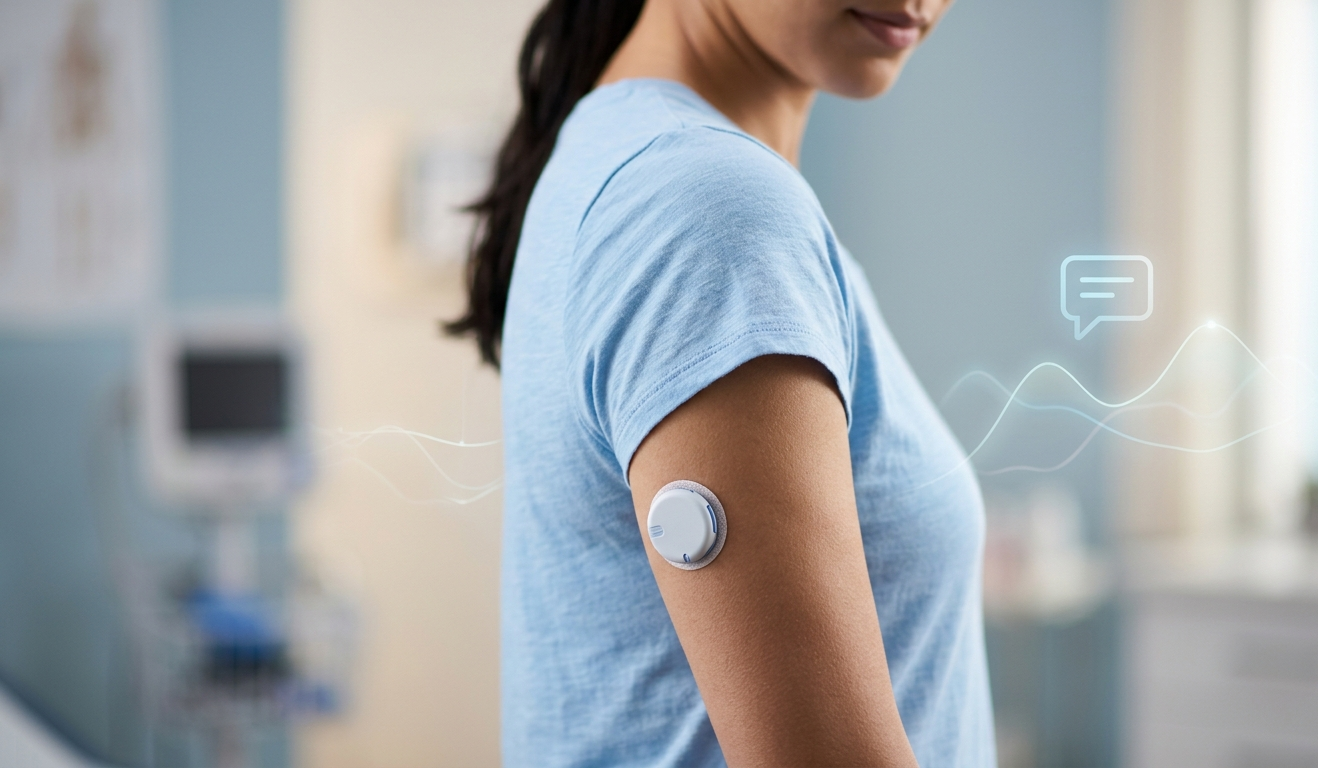
For nearly two decades, continuous glucose monitors were something you got from a doctor, not something you picked up off a shelf. That changed in 2024, and it kept changing this year. Dexcom’s Stelo — the first glucose sensor ever cleared for over-the-counter sale in the United States — just became the first OTC glucose monitor cleared for children too. Along the way, the company quietly built a generative AI coach into the product, turning a passive sensor into something closer to a conversational health assistant.
Dexcom Stelo AI is, in effect, an unusual kind of medical device: FDA-regulated hardware, wrapped in consumer-grade AI, sold without a prescription. It’s also arriving faster than the clinical evidence can keep up with it — and several independent doctors are asking whether that’s a problem.
Table of Contents
The Problem: A Glucose-Monitoring Gap for Non-Insulin Users
Continuous glucose monitors (CGMs) have been standard care for people with insulin-dependent diabetes for years. But that left out a much larger group: an estimated 125 million Americans who have Type 2 diabetes without using insulin, or who fall into the prediabetes range — a combined figure Dexcom cited at Stelo’s 2024 launch, distinct from the roughly 25 million Americans the company has separately cited as living with non-insulin Type 2 diabetes alone. For most of them, CGM access meant a prescription, a clinic visit, and — often — an insurance fight, since payers have been slow to cover monitoring for people who aren’t on insulin.
The gap extends to children. The CDC has estimated that roughly 8.4 million U.S. adolescents ages 12–17 — about a third of that age group — have glucose levels in the prediabetes range. Until June 2026, no CGM of any kind was available to families without a prescription.
Who was excluded before Stelo
- Adults with Type 2 diabetes managing their condition through oral medication rather than insulin
- People with prediabetes trying to understand how diet and exercise affect their glucose
- Children and teens with rising prediabetes rates but no pediatric CGM access
- Anyone without insurance coverage for glucose monitoring, or without an easy path to a prescription
What Is Stelo?
Stelo is made by Dexcom, a San Diego-based diabetes technology company that has been building CGMs since receiving its first FDA approval in 2006. The company launched its Dexcom G6 system in 2018 and its next-generation G7 in 2023 — the same underlying sensor platform Stelo is built on.
The FDA cleared Stelo on March 5, 2024, the first over-the-counter continuous glucose monitor cleared in the agency’s history, for adults 18 and older who don’t use insulin. Dexcom began selling it that August, priced at $99 for a one-time two-sensor supply or $89 per month on subscription. In December 2024, the company added its first generative AI feature. By June 2026, the FDA had expanded the clearance to children as young as two.
Timeline at a glance:
| Date | Milestone |
|---|---|
| 2006 | Dexcom’s first FDA-approved CGM |
| 2018 | Dexcom G6 launch |
| 2023 | Dexcom G7 launch (Stelo’s underlying sensor platform) |
| March 5, 2024 | FDA clears Stelo — first OTC CGM ever |
| Aug 26, 2024 | Stelo goes on sale in the U.S. |
| Dec 17, 2024 | First generative AI feature launches, built with Google Cloud |
| June 12, 2026 | FDA expands clearance to children 2+ |
How Stelo Works
The mechanics are straightforward. A small biosensor, worn on the back of the upper arm, is replaced every 15 days. It measures glucose in the interstitial fluid just under the skin — not blood directly, which is standard for all CGMs and introduces a brief lag, typically five to ten minutes, most noticeable during rapid glucose swings like right after a meal. Readings are sent over Bluetooth to a companion smartphone app, which updates every 15 minutes and displays trends, meal impact, and daily summaries.
Unlike Dexcom’s prescription-only G7, Stelo has no high or low glucose alarms. That’s a deliberate design choice, not an oversight — the absence of urgent alerts is widely understood in the industry as one of the factors that made a non-prescription pathway possible, though Dexcom has not publicly detailed the specific regulatory reasoning behind that design decision.
Where AI Comes In
Stelo’s AI operates on two levels, and it’s worth separating them clearly.
The first is standard CGM signal processing — the algorithms that convert a raw electrochemical reading into a displayed glucose number. This is common across the CGM industry and isn’t something Dexcom markets as a distinct AI feature.
The second is newer and more distinctive: a generative AI layer added to the app in December 2024, built using technology from Google Cloud. Initially, it produced a personalized weekly report explaining how a user’s meals, sleep, and activity had affected their glucose that week, along with relevant tips. By 2026, Dexcom had expanded this into a fuller AI coaching experience — pattern recognition, personalized daily insights, photo-based meal logging where the AI identifies and describes a photographed meal, and a conversational “AI coach” that lets users ask free-text questions about their own data and get tailored responses.
Dexcom has been explicit that these AI outputs are not medical advice, and the company has said it used an FDA framework for AI-enabled device features to guide the tool’s development. What the company has not disclosed publicly is which specific model or model version powers the coach, or precisely how user data is used in training versus simply feeding into real-time responses — details that remain proprietary.
The Evidence
The accuracy data behind Stelo comes from its shared sensor platform with the Dexcom G7. A peer-reviewed study of 316 participants, using 619 sensors and more than 77,000 matched glucose readings, published in Diabetes Technology & Therapeutics, found an overall mean absolute relative difference (MARD) — the standard accuracy measure for CGMs, where lower is better — of 8.2% for arm placement and 9.1% for abdomen placement, with no serious adverse events reported.
The pediatric clearance rests on a different kind of evidence. Rather than running a new clinical trial in children, the FDA combined existing clinical study data from both pediatric and adult populations with real-world evidence drawn from how the integrated CGM technology has performed in practice, to model expected accuracy across the full 15-day wear period in younger users. The FDA itself has framed this decision as an example of how it intends to use real-world evidence more broadly in future device reviews — a notable regulatory shift, independent of what it says about Stelo specifically.
Stelo vs. leading OTC competitors:
| Dexcom Stelo | Abbott Lingo | Abbott Libre Rio | |
|---|---|---|---|
| FDA cleared | March 2024 (adults); June 2026 (pediatric) | June 2024 | June 2024 |
| Wear time | 15 days | 14 days | 15 days |
| Published MARD | ~7.3–9.1% | ~8.1–10.7% | Not independently confirmed in this research |
| Price (approx.) | $99 one-time / $89 monthly subscription | ~$89/month | Not yet publicly priced; limited commercial availability |
| Intended for | Non-insulin T2D, prediabetes, general wellness; children 2+ | General metabolic wellness | Adults with T2D not on insulin |
| Alarms | None | None | None |
Note: MARD figures come from separate manufacturer trials and are not strictly comparable across brands.
Regulatory Status
Stelo’s regulatory path has two milestones, both firsts:
- March 5, 2024: FDA clearance as the first over-the-counter continuous glucose monitor in U.S. history, for adults 18+ not using insulin.
- June 12, 2026: FDA expands the clearance to children two years and older who don’t use insulin, making Stelo the first CGM of any kind cleared for pediatric OTC use — supported by real-world evidence rather than a dedicated new pediatric trial.
An “OTC clearance” means the device has been reviewed and authorized for direct consumer sale, but it is not the same as a claim that the device improves health outcomes for everyone who buys it — a distinction that matters for how the device should be understood.
Stelo’s regulatory status outside the U.S. — including any CE marking in Europe or approval in other markets — was not confirmed in available sources for this article.
Real-World Use
In its first several months on the market, Stelo reached about 140,000 users by the end of 2024, generating roughly $22 million in revenue for Dexcom that year. Company executives noted that early demand skewed toward general wellness users before shifting toward more people with Type 2 diabetes and prediabetes. More recent user or revenue figures for 2025–2026 were not available in the sources reviewed for this article.
Benefits, Supported by Evidence
- Access: Removes the prescription and insurance barriers that previously kept CGM technology away from most non-insulin users — a documented, concrete gap Stelo directly addresses.
- Accuracy: Sensor performance, inherited from the G7 platform, is in line with prescription-grade CGMs based on published peer-reviewed data.
- Behavioral insight: A 2025 systematic review found some evidence that CGM data can help guide lifestyle changes — for instance, timing exercise around meals to blunt glucose spikes — in select non-diabetic populations, though the evidence base remains limited and the studies reviewed were heterogeneous.
- Reduced pediatric access barriers: The June 2026 clearance removes, in the FDA’s own framing, the first link in a chain that previously required a clinic visit and prescription before a child could even be monitored.
Limitations, Risks, and Open Questions
Stelo is not designed for everyone, and its own labeling reflects that:
- No hypoglycemia alerts. Because it lacks urgent low-glucose alarms, it is not appropriate for insulin users or anyone at risk of dangerous low blood sugar.
- Not for dialysis patients, and people with a history of disordered eating are advised to consult a healthcare provider before use, per FDA labeling.
- The lifestyle-only population is where the evidence is weakest. Multiple endocrinologists interviewed by GoodRx said they do not recommend CGMs for people without diabetes, with one noting that in people who are metabolically healthy, “using a CGM doesn’t add clinical value.” Johns Hopkins’ Bloomberg School of Public Health similarly reported that experts describe the evidence for CGM improving outcomes in non-diabetics as scant. This is a real, ongoing clinical disagreement — not a settled question — and it applies specifically to the general-wellness use case Dexcom actively markets Stelo for.
- Labeling lag. As of mid-2026, one independent reviewer noted that Dexcom’s own consumer purchase page still described the product as for adults 18+ and asked buyers to confirm the purchase wasn’t for a minor — suggesting the retail experience hadn’t yet fully caught up to the new pediatric clearance.
- Privacy. Dexcom’s own terms state that information submitted through Stelo “may not be subject to HIPAA,” and is instead governed by the company’s privacy policy and applicable state law. Dexcom says it does not sell data in the traditional sense, but does allow some third parties to collect data on non-HIPAA-covered pages for analytics and advertising — activity that may qualify as a “sale” or “share” under certain state privacy laws. De-identified data may also be disclosed to third parties under contractual restrictions against re-identification.
- AI coach is not medical advice. Dexcom is explicit that no treatment decisions should be made based on the app’s AI output without consulting a clinician.
How Stelo Compares
Stelo isn’t alone in the OTC glucose space. Abbott’s Lingo, aimed at general wellness users, and Libre Rio, aimed specifically at people with Type 2 diabetes, both received FDA clearance in June 2024 and run on Abbott’s FreeStyle Libre sensor technology. On published figures, Stelo’s accuracy range edges out Lingo’s, though manufacturer-reported MARD numbers from different trials aren’t directly comparable. For people who need alarm functionality — primarily insulin users — the relevant comparison isn’t to any OTC device at all, but to prescription-tier CGMs like the Dexcom G7 or Abbott’s FreeStyle Libre 3+, both of which include high/low alerts and are generally insurance-eligible.
What’s Next
Dexcom’s public statements point toward a broader ambition for the AI layer: moving from weekly reports toward real-time feedback, and eventually using the platform as a predictive early-warning tool. In a December 2024 interview with CNBC, a Dexcom executive described exploring how the technology could flag potential problems before they become serious — a concept CNBC’s reporting likened to a car’s check-engine light. Whether that vision is realized, and whether it’s backed by the kind of independent clinical evidence still missing for general wellness use, will likely shape how the next generation of AI-driven consumer health devices is regulated and received.
Conclusion
Stelo represents an unusual combination: a regulated medical device, sold without a prescription, that has evolved into a generative AI health companion in under two years. Its expansion to children in 2026 extends glucose monitoring to a population that never had non-prescription access before. But the device’s most heavily marketed use case — helping metabolically healthy adults understand their bodies better — is also the one where independent experts are most divided. The sensor’s underlying accuracy is well-documented in peer-reviewed data; the case for using it if you don’t have diabetes remains, for now, an open clinical question rather than a settled recommendation.
FAQ
Is Dexcom Stelo the same thing as a regular CGM? It uses the same core sensor technology as Dexcom’s prescription G7 device, but with a different software experience and no high/low glucose alarms, which is part of what allowed it to be sold without a prescription.
Does Stelo require a prescription? No. It was the first continuous glucose monitor cleared by the FDA for over-the-counter sale, in March 2024.
What does the AI coach in the Stelo app actually do? It analyzes a user’s own glucose, meal, activity, and sleep data to generate personalized insights and answer free-text questions, using generative AI technology built with Google Cloud. Dexcom states this is not medical advice.
Is Stelo safe for children to use? The FDA cleared Stelo for children 2 and older who don’t use insulin in June 2026, based on a combination of prior clinical data and real-world evidence rather than a new pediatric trial. It must be used under adult supervision, and sensor wear time may be shorter in younger children.
Should someone without diabetes use a CGM like Stelo? This is genuinely contested. Multiple endocrinologists interviewed by independent outlets have said CGM use adds little clinical value for people who are metabolically healthy, and some research institutions describe the evidence for benefit in this population as limited.
How accurate is Stelo compared to prescription CGMs? Peer-reviewed data on the shared G7 sensor platform shows a MARD (mean absolute relative difference) of about 8–9%, comparable to prescription-grade CGMs.
Is my Stelo health data protected the same way as data at my doctor’s office? Not necessarily. Dexcom’s own terms state that information submitted through the Stelo app may not be covered by HIPAA and is instead governed by its privacy policy and state privacy laws, which allow certain data sharing with third parties for purposes like analytics.
Sources
- U.S. Food and Drug Administration. “FDA Clears First Over-the-Counter Continuous Glucose Monitor for Children.” June 12, 2026.
- HCPLive. “FDA Clears Dexcom Stelo Sensor, First OTC Glucose Sensor in Agency History.”
- Dexcom, Inc. “Stelo by Dexcom First Glucose Biosensor to be Cleared by FDA as Over-the-Counter.” March 5, 2024.
- Garg, S.K. et al. “Accuracy and Safety of Dexcom G7 Continuous Glucose Monitoring in Adults with Diabetes.” Diabetes Technology & Therapeutics, PMC9208857.
- CNBC. “Dexcom Launches Generative AI Platform for Stelo Users.” December 17, 2024.
- GoodRx. “How to Get a Continuous Glucose Monitor OTC Without Diabetes.”
- Johns Hopkins Bloomberg School of Public Health. “Is Glucose Monitoring Useful for Non-Diabetics?”
- MedTech Dive. “Dexcom CEO Talks Stelo Sensor Launch, OTC Strategy.” January 15, 2025.
- Dexcom/Stelo. “Privacy Policy.”
Editorial note: This article reflects publicly available information as of August 2026. Regulatory status, clinical trial results, and product availability for these tests may change. Readers should consult a licensed healthcare provider before making decisions.