

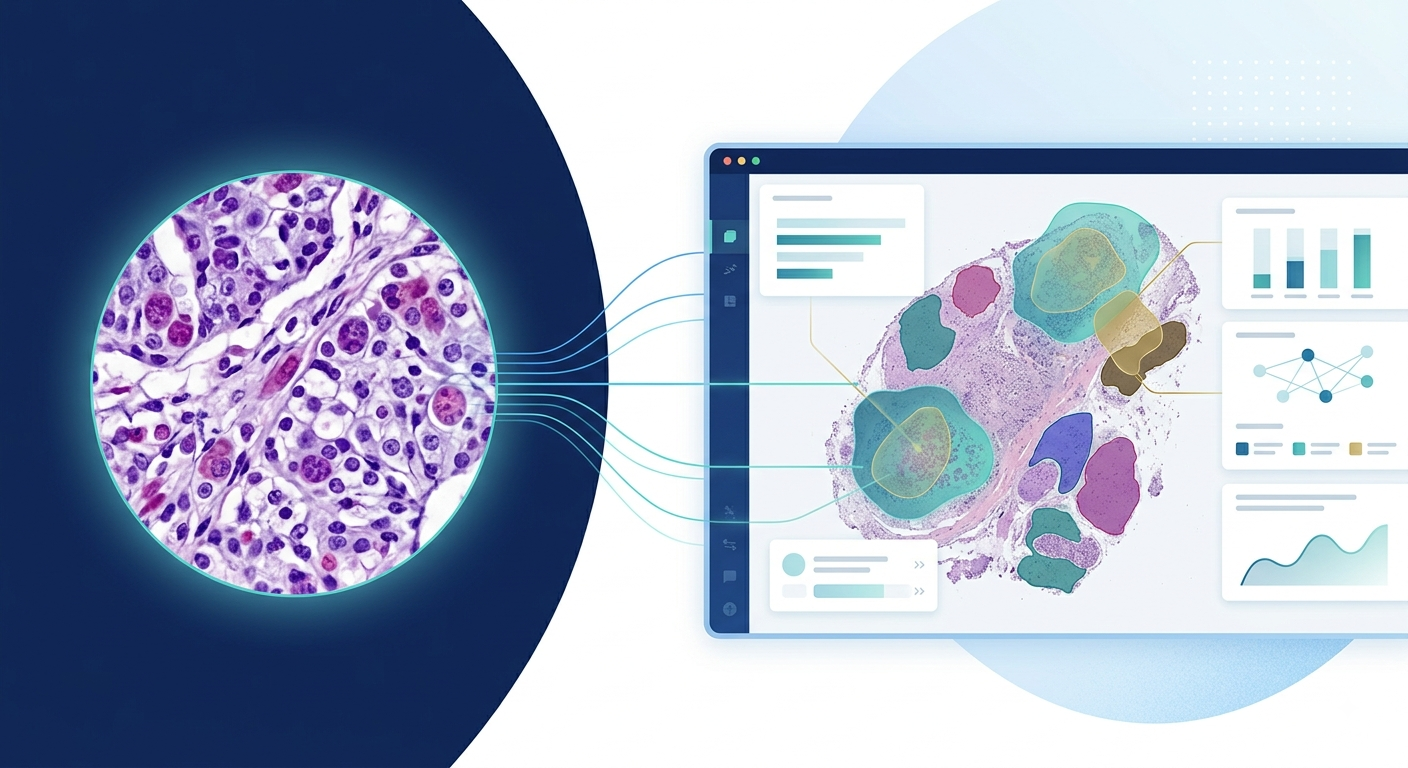
Cancer diagnosis usually begins the same way it has for more than a century: a biopsy, a stained glass slide, and a pathologist studying it under a microscope. It’s careful, high-stakes work, and there aren’t enough people to keep up with demand. Into that gap has stepped an unusual kind of AI product — not a chatbot, not a wearable, but software that reads biopsy slides alongside pathologists and flags what a human eye might miss. That software, built by a company called Paige and now owned by Tempus AI, holds a distinction few AI pathology cancer detection tools can claim: it was the first artificial intelligence system ever cleared by the FDA to assist in diagnosing cancer from pathology images.
This is the story of how that happened, what the evidence actually shows, and what still isn’t known.
Table of Contents
The Problem: Too Few Pathologists, Too Many Slides
A biopsy diagnosis still depends, almost always, on a pathologist examining stained tissue under a microscope — a process under growing strain.
Paige has cited a projected 60 percent increase in global cancer cases over the next two decades, arriving at a moment when the pathologist workforce isn’t growing to match (FierceBiotech, 2021). Industry analysis has estimated a shortfall equivalent to roughly 5,700 pathologists per 100,000 people in the United States (Vachette Pathology, via Fortune Business Insights). Pathology itself has long been described by researchers as a subjective, time-consuming process prone to variability between reviewers.
Traditional fixes — training more pathologists, seeking second opinions, running additional lab tests — help, but they don’t scale quickly. That’s the gap artificial intelligence has moved into.
What Is Paige — and How Did It Start?
Paige was founded by researchers connected to Memorial Sloan Kettering Cancer Center (MSK), including Dr. Thomas Fuchs, who led MSK’s computational pathology research. Most company and investor records — Crunchbase, industry press, and Paige’s own partnership announcements — date the founding to 2017 (AI Business, 2018); a handful of contemporaneous news accounts from 2018, however, describe the founding event as taking place that February, so the exact year varies slightly depending on the source. The name is an acronym: Pathology AI Guidance Engine.
The company’s origin came with early controversy. In 2018, a joint investigation by ProPublica and The New York Times reported that Paige had been founded by MSK insiders who then received an exclusive, eight-year license to MSK’s archive of roughly 25 million pathology slides — in exchange for MSK receiving a 9 percent equity stake in the company (Syracuse University Science & Technology Law Center). Legal experts questioned whether the arrangement met nonprofit governance standards, since the people negotiating the deal for MSK also stood to benefit financially from it — a piece of the company’s history worth knowing, even though it predates the FDA-cleared products discussed below.
In August 2025, Tempus AI acquired Paige for $81.25 million, paid predominantly in Tempus stock, along with assuming Paige’s remaining cloud-computing commitments to Microsoft Azure (Tempus, August 2025). Tempus CEO Eric Lefkofsky said the deal was meant to “substantially accelerate” the company’s effort to build the largest foundation model in oncology (MedTech Dive).
How the Technology Works
Paige’s core products aren’t physical devices — they’re diagnostic software that operate on digitized versions of glass biopsy slides, known as whole-slide images (WSIs).
The workflow looks like this:
- A lab technician prepares and stains a tissue biopsy on a glass slide, as in traditional pathology.
- The slide is scanned into a high-resolution digital image using a compatible scanner — Paige’s original FDA clearance specifies the Philips Ultra Fast Scanner, paired with Paige’s own FullFocus digital pathology viewer.
- The AI analyzes the digital image and classifies it as either “suspicious” or “not suspicious” for cancer, marking the specific region with the highest likelihood of malignancy.
- A pathologist reviews the AI’s output alongside the original image and makes the final diagnostic call.
Crucially, Paige’s products are built and regulated as assistive tools, not autonomous diagnostic systems. The FDA-authorized version of Paige Prostate Detect is not continuously retrained on new patient cases in clinical use — it operates as a fixed, validated algorithm until a formal update is issued (NCBI Bookshelf / CADTH evidence review, 2024).
The AI Technology: Foundation Models and Virchow
Paige’s earliest products relied on deep convolutional neural networks trained on labeled biopsy images. In 2023, the company took a significant technical step in partnership with Microsoft Research, building a foundation model called Virchow.
Virchow is a 632-million-parameter deep neural network trained using self-supervised learning — meaning it learned patterns from raw image data without every slide needing a manual label — on 1.5 million H&E-stained whole-slide images spanning diverse tissue types (arXiv preprint, Paige/Microsoft Research). According to independent industry analyses summarizing subsequent model releases, a follow-up version, Virchow 2, expanded training to more than 3 million slides sourced from roughly 800 laboratories worldwide, with a variant reaching 1.8 billion parameters — figures that come from third-party technical surveys rather than a peer-reviewed Paige/Microsoft publication, and should be read with that caveat.
The strongest independent validation remains the original Virchow model: a peer-reviewed paper describing a Virchow-based pan-cancer detection model was published in Nature Medicine in 2024, reporting an overall specimen-level area-under-the-curve (AUC) of 0.949 across 17 cancer types, and 0.937 AUC on seven rarer cancer subtypes (Nature Medicine, 2024). AUC is a standard statistical measure of a diagnostic model’s ability to distinguish between positive and negative cases, where 1.0 represents perfect discrimination.
A related model, PRISM, combines Virchow’s image understanding with clinical text — trained on 587,000 slides paired with 195,000 clinical reports — aiming to connect visual tissue patterns with the language pathologists actually use.
Foundation Model Comparison
| Model | Training Data | Parameters | Key Capability |
|---|---|---|---|
| Virchow (V1) | 1.5 million H&E slides | 632 million | General-purpose slide image embeddings; peer-reviewed |
| Virchow 2 | 3+ million slides, 800 labs (per third-party reports) | Up to 1.8 billion | Broader lab/geographic generalization |
| PRISM | 587,000 slides + 195,000 reports | Not fully disclosed | Links image findings to clinical language |
Source: Paige/Microsoft Research publications; Nature Medicine (2024); third-party technical surveys as noted
Does It Work? The Clinical Evidence
Paige’s flagship product, Paige Prostate Detect, has been evaluated in more studies than most AI diagnostic tools on the market — including several genuinely independent validations conducted at institutions with no financial stake in the company. Across these studies, a consistent pattern emerges: pathologists working with AI assistance detect more true cancers than pathologists working alone, typically at little or no cost to specificity.
| Study | Setting | Sensitivity | Specificity | Notes |
|---|---|---|---|---|
| FDA pivotal study (2021) | 16 pathologists, 150+ institutions | +7.3% average improvement with AI | — | Basis for FDA De Novo clearance |
| Yale Medicine (Modern Pathology, 2021) | 1,876 independent biopsy slides | 97.7% | 99.3% | Fully independent validation |
| Multi-institutional study (2021) | 600 part-specimens, 100 patients | 99% (part-specimen level) | 93% (part-specimen level) | ~65.5% reduction in diagnostic review time |
| ASCO abstract (2020) | Independent dataset, consensus read | +5.7 percentage points to 96.6% | −0.8 percentage points | 3 missed cancers newly identified |
| Multi-reader study (2023) | 610 slides, 218 sites, 16 pathologists | Improved across all grades/sizes | Improved across all grades/sizes | Company-reported 70% error reduction |
Sources: PubMed, Nature/Modern Pathology, ASCO Publications
Independent reviewers have flagged real limits to this evidence base, though. A 2024 systematic evidence review noted that while cancer-detection performance is well supported, evidence for the tool’s benefit in tumor grading, quantification, and identifying perineural invasion remains limited, and that outcome data — whether AI assistance actually changes patient survival — still requires further study (NCBI Bookshelf).
Regulatory Status
- September 2021: Paige Prostate Detect received FDA De Novo marketing authorization — the first FDA clearance ever granted to an AI-based pathology product, classified as a Class II device (FDA decision summary, DEN200080).
- April 2025: Paige PanCancer Detect, designed to flag suspicious findings across multiple tissue and organ types, received FDA Breakthrough Device Designation — the first such designation for a multi-tissue AI cancer-detection tool (Paige.ai press release). This designation expedites FDA review; it is not itself a marketing authorization.
- 2025: The Paige Prostate Suite achieved EU IVDR certification, a significantly more rigorous standard than the EU’s previous In Vitro Diagnostic Directive (Tempus).
- As of the most recent available reporting, the suite was authorized for use in the US, EU, and UK, but not yet available in Canada.
Real-World Deployment
Paige’s commercial reach has grown through partnerships rather than direct-to-consumer sales. In 2021, the company began a collaboration with Quest Diagnostics to apply its AI to Quest’s AmeriPath and Dermpath laboratory businesses (Quest Diagnostics). It has also worked with Philips on scanner integration.
What’s notably absent from public disclosures: the exact number of hospitals or labs currently running Paige’s tools in routine practice, total patient-slide volume processed, and specific pricing. These figures are simply not publicly available.
Benefits Backed by Evidence
- Statistically significant improvements in pathologist sensitivity across multiple independent studies
- Documented cases where AI assistance surfaced cancers that pathologists had initially missed
- Meaningful reductions in diagnostic review time in at least one independent study (~65.5%)
- Consistent performance across different pathologist experience levels and remote vs. on-site review settings
Limitations, Risks, and Open Questions
- No continuous learning in the clinical version: the FDA-cleared algorithm is static between formal updates, unlike some adaptive AI systems.
- False positives exist: in one independent study, 27 specimens the AI marked as suspicious ultimately proved benign, underscoring that pathologist review remains essential.
- Grading and quantification evidence is thinner than the evidence for basic cancer detection.
- Training data transparency: demographic and geographic diversity of the underlying training data, and any formal bias auditing, have not been publicly detailed.
- Governance history: the 2018 MSK conflict-of-interest reporting remains a relevant data point on institutional transparency, separate from the technology’s current performance.
- Outcome data gap: no long-term studies yet demonstrate that AI-assisted diagnosis changes patient survival, as opposed to diagnostic accuracy metrics.
The Competitive Landscape
Paige operates in a crowded and fast-growing computational pathology field:
- PathAI — has raised more than $240 million and partners with Quest Diagnostics on AI lab services
- Ibex Medical Analytics (Israel) — its own prostate detection tool received FDA 510(k) clearance in February 2025
- Proscia — works with 16 of the top 20 global pharmaceutical companies; its colon polyp detection tool received FDA clearance for primary diagnosis in 2025
- Aiforia Technologies (Finland) — holds EU IVDR compliance for its pathology AI products
- Visiopharm (Denmark) — an established image-analysis vendor integrated into multi-vendor AI platforms
What’s Next: Tempus and the Foundation Model Race
Since the Tempus acquisition, Paige’s roughly 7-million-slide dataset has become a core asset in Tempus’s broader push to build what its leadership has called the largest foundation model in oncology. Tempus’s own financial disclosures noted the acquisition was expected to add approximately $5 million per quarter to losses in the near term — a sign of continued investment rather than immediate profitability (TipRanks/The Fly). What remains to be seen is whether Paige’s tools — under new ownership — will expand into full FDA marketing authorization for products like PanCancer Detect, and whether the company will publicly address the transparency gaps around bias and training data that independent reviewers have flagged.
Conclusion
Paige’s technology represents one of the more substantiated cases of AI pathology cancer detection: a genuinely novel FDA regulatory pathway, a real foundation-model research achievement, and a body of independent peer-reviewed evidence that most AI health products can’t match. That doesn’t mean the story is finished. Real-world deployment scale, patient-outcome data, and bias transparency remain open questions — the kind that matter as this technology moves from a small number of validated products toward the far larger ambitions Tempus has set for it.
Frequently Asked Questions
Is Paige AI approved by the FDA?
Yes. Paige Prostate Detect received FDA De Novo marketing authorization in 2021 — the first FDA clearance for an AI pathology product. Paige PanCancer Detect currently holds FDA Breakthrough Device Designation, which expedites review but is not itself a marketing authorization.
Does the AI replace pathologists?
No. It is built and regulated as an assistive tool. The AI identifies suspicious regions on digitized slides for a pathologist to review; the pathologist makes the final diagnosis.
How accurate is Paige’s AI at detecting cancer, and how does it compare to pathologists alone?
Independent studies have reported sensitivity generally in the 96–99% range when the AI works alongside pathologists, consistently higher than pathologists reviewing slides unassisted — one independent study found unassisted sensitivity around 74% rising to 90% with AI support. Specificity varies by study and analysis level, and evidence is strongest for basic cancer detection, more limited for tasks like tumor grading.
Who owns Paige now?
Tempus AI, Inc. acquired Paige in August 2025 for $81.25 million, paid predominantly in stock.
What is the Virchow model?
Virchow is a large-scale AI foundation model built by Paige with Microsoft Research, trained via self-supervised learning on more than a million digitized pathology slides. It underlies several of Paige’s current diagnostic products; a larger successor, Virchow 2, has been described in industry reports but has less direct peer-reviewed documentation.
Is the technology available outside the United States?
Yes. The Paige Prostate Suite holds EU IVDR certification and UK conformity assessment. As of the most recent published data reviewed, it was not yet available in Canada.
What are the main risks or limitations?
The FDA-cleared version is not continuously retrained on new cases, can generate false positives requiring pathologist review, and — like most AI diagnostic tools — faces open questions about training-data diversity and bias that have not been fully publicly addressed.
Sources: FDA De Novo Decision Summary (DEN200080); Nature Medicine (2024); Modern Pathology (2021); Archives of Pathology & Laboratory Medicine (2023); arXiv (Virchow preprint); Tempus AI press releases; MedTech Dive; Fierce Biotech; NCBI Bookshelf (CADTH evidence review, 2024); ProPublica/New York Times (2018) via Syracuse University Science & Technology Law Center.
Editorial note: This article reflects publicly available information as of August 2026. Regulatory status, clinical trial results, and product availability for these tests may change. Readers should consult a licensed healthcare provider before making decisions.