

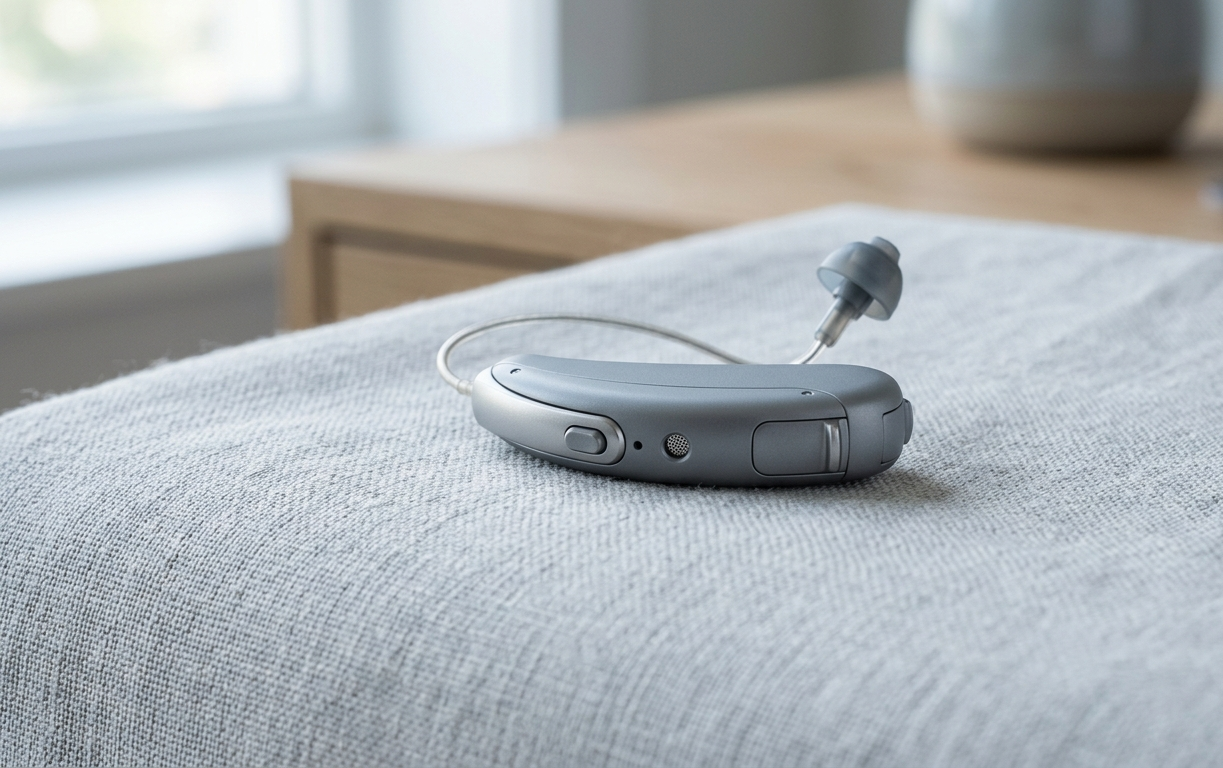
For decades, hearing aid makers have chased the same elusive goal: helping people follow a conversation in a crowded room. Audiologists call it the “speech-in-noise” problem, and it has remained the single most common complaint among hearing aid users even as devices got smaller, smarter, and more connected. In August 2024, Swiss hearing care company Sonova tried something different — not another software tweak, but a second, dedicated chip built solely to solve it.
That chip is called DEEPSONIC, and it powers the Phonak Audéo Sphere Infinio, the flagship device in Sonova’s Infinio hearing aid platform. Two years on, with a firmware update behind it and a successor platform now arriving, there’s enough real-world evidence to ask a fair question: did the approach actually work?
Table of Contents
What Sonova Launched, and When
Sonova announced the Infinio platform on August 6, 2024, introducing two new hearing aid lines under its Phonak brand: the standard Audéo Infinio and the flagship Audéo Sphere Infinio. Hearing care professionals in the United States could begin ordering the devices the following day, August 7, 2024, with other markets following on a rolling basis.
The launch also included the Phonak Virto R Infinio, the company’s first rechargeable custom hearing aid. But the headline device was the Sphere Infinio, built around a new dual-chip design that Sonova positioned as its biggest release to date.
CEO Arnd Kaldowski told Reuters at the time that the timing itself was meant to catch the market off guard: nobody expected real-time AI processing to be available in a hearing aid that year. The announcement briefly moved markets — Sonova’s shares rose around 5% following the news, even as competitors Amplifon, Demant, and GN Store Nord had all issued profit warnings that same summer.
The Cocktail-Party Problem, and Why It Matters
Hearing aids have always had to make a difficult trade-off: amplify the voice someone wants to hear while suppressing the noise around it. According to the World Health Organization, hearing loss affects an estimated 430 million people globally, a number projected to reach 700 million — roughly one in ten people — by 2050. Left unaddressed, hearing loss can also reduce social participation and has been linked to cognitive decline.
Sonova frames the speech-in-noise problem as the most pressing unmet need in that population. Restaurants, family gatherings, and other everyday noisy settings are where conventional hearing aids tend to struggle most, and where users often report the most fatigue from straining to follow along.
Inside DEEPSONIC — A Dedicated AI Chip, Not a Software Feature
Most hearing aids run their sound processing — noise reduction, feedback control, environmental classification — on a single main chip, with any AI-like features sharing that same limited processing budget. Sonova took a different approach with the Sphere Infinio: two chips, each with its own job.
The first, called ERA, handles the tasks a modern hearing aid is expected to manage: overall sound quality, Bluetooth connectivity, feedback control, and power management. The second, DEEPSONIC, is dedicated entirely to running a deep neural network in real time — the AI model responsible for identifying and separating speech from surrounding noise, from any direction, as it happens.
Sonova describes DEEPSONIC as delivering 53 times more processing power than the chip technology previously used across the hearing aid industry. That figure comes directly from the company and has not been independently benchmarked. More specific technical details — such as exact operations-per-second figures or the size of the training dataset — appear in some third-party product reviews but were not found in Sonova’s own published specifications, so they should be treated as unconfirmed rather than official figures.
What is well documented is the architectural choice itself: a dedicated second chip for AI processing, separate from the chip running everything else. That trade-off shows up directly in the device’s size — the dual-chip Sphere Infinio is noticeably larger than single-chip competitors like Starkey’s Edge AI — and, as it turns out, in its battery life.
Does It Work? Company Claims vs. Independent Testing
Sonova’s own marketing cites substantial gains from the Sphere Infinio’s approach, including a signal-to-noise ratio improvement of up to 10.2 decibels and claims that users are two to three times more likely to understand speech from any direction compared to two leading competing devices. These figures come from Phonak-sponsored field studies — real research, but conducted and funded by the company itself, not independent or peer-reviewed clinical trials.
Independent verification does exist, and it’s broadly favorable. HearAdvisor, an independent hearing aid testing lab, evaluated the Sphere Infinio using standardized acoustic-manikin measurements and ranked it first among 36 prescription hearing aids tested, with an overall SoundScore of 5.0 out of 5. Its speech-in-noise score came in nearly three points above the category average — a substantial margin in that testing framework.
That’s a meaningfully different kind of evidence than a company field study, and it’s worth treating as such: HearAdvisor’s lab testing supports Sonova’s general claim that the Sphere Infinio performs unusually well in noisy conditions, even though it doesn’t independently confirm every specific number Sonova has published.
The Battery Tradeoff
Running a dedicated neural network chip in real time takes power, and that cost shows up clearly in battery life. In standard use, Sonova says the Sphere Infinio lasts up to 56 hours on a charge — a figure that was extended through a firmware update released in October 2025, branded “Ultra.”
| Mode | Battery Life |
|---|---|
| Standard daily use | Up to 56 hours |
| Continuous AI (“Sphere mode”), post-Ultra update | ~10–11 hours |
| Continuous AI mode, pre-Ultra update (before Oct 2025) | ~7 hours |
That 56-hour figure describes typical daily use, not continuous AI processing. When the Sphere mode — the dedicated speech-separation feature — runs continuously in loud environments, independent reviewers report battery life drops to roughly 10 to 11 hours. Before the October 2025 update, that number was closer to 7 hours. The update reportedly improved AI-mode battery efficiency by around 30%, alongside retraining the device’s automatic sound-classification system on a larger set of real-world listening data.
In practical terms, that means a full day mixing quiet and noisy environments should still get most users through the day, but sustained heavy use in loud settings — a long, noisy shift at a restaurant job, for instance — could still require a midday charge.
How It Compares to Other AI Hearing Aids
Phonak isn’t the only manufacturer building AI into its devices, and it isn’t the only one facing this power-versus-performance trade-off. The main split in the industry is between dual-chip designs, which dedicate separate hardware to AI processing, and single-chip designs, which integrate AI functions into the main processor.
| Manufacturer | Chip Approach | AI Architecture |
|---|---|---|
| Phonak (Sonova) | Dual-chip | ERA (general processing) + DEEPSONIC (dedicated AI chip) |
| Starkey | Single-chip | G2 Neuro Processor with integrated neural processing unit |
| GN Store Nord (ReSound) | Dual-chip | Separate DNN chip, trained on a reported 13.5 million sentences |
| Demant (Oticon) | Single-chip | Existing devices use an integrated single chip (Polaris R); a newly announced device called “Reveal” introduces a separate “Dual AI” approach not yet detailed in available sources |
Starkey markets its own noise-reduction gains through its integrated single-chip design, which company materials suggest is more power-efficient by keeping all processing on one unit. Separate Starkey materials cite figures ranging from a reported 13-decibel noise improvement to a claimed 30% improvement in speech identification, depending on the study cited. ReSound’s Vivia takes a dual-chip approach similar to Phonak’s and reportedly sees a comparable battery trade-off, dropping from around 30 hours of standard use to roughly 10 hours under sustained AI processing.
None of these comparisons point to a clear industry-wide winner. Each company’s headline performance figures come from its own testing, and the architectures reflect different bets about the same underlying trade-off between processing power and battery life.
Where the Platform Stands in 2026 — and What’s Next
The Sphere Infinio is not Sonova’s newest device. Two years after the original Infinio launch, on August 24, 2026, Sonova unveiled its next hearing aid platform, Phonak EON, built around a newly developed chip called HYPERSONIC.
Timeline:
- August 2024 — Phonak Audéo Sphere Infinio launches with the DEEPSONIC chip
- October 2025 — “Ultra” firmware update improves AI-mode battery efficiency
- August 2026 — Phonak EON launches with the HYPERSONIC chip
EON is described by Sonova as its third-generation real-time AI hearing aid platform. According to the company, the HYPERSONIC chip runs two AI systems simultaneously — speech separation and scene classification — while using 37% less power than the previous generation. That efficiency gain is reflected in the hardware: EON is roughly 25% smaller and 20% lighter than the Sphere Infinio, and offers up to 38 hours of battery life. It also adds Auracast broadcast-audio support, letting users connect directly to compatible public audio systems in venues like museums, theaters, and airports. The Sphere Infinio’s hardware was reportedly Auracast-ready but had not been activated via a firmware update as of mid-2026.
Notably, Sonova isn’t claiming EON leapfrogs the Sphere Infinio’s raw speech-in-noise performance. Chief R&D Officer Anders Rosengren has said the goal with EON was to preserve the performance already achieved with Sphere while making it more efficient and available in a smaller device. In other words, EON reads less like a bigger leap in AI capability and more like an engineering refinement — solving the size and battery trade-offs that came with the original dual-chip design.
EON became available to hearing care professionals in the United States starting August 24, 2026, with Germany, France, the United Kingdom, and Australia expected to follow in September. Sonova has not disclosed pricing for the new platform, which is standard for a product category sold through clinicians rather than direct retail.
Limitations and Open Questions
The Sphere Infinio’s core appeal — real-time, dedicated AI processing for speech in noise — is well supported by an independent lab ranking, but most of the specific performance numbers in circulation trace back to Sonova’s own sponsored research rather than independent, peer-reviewed clinical trials. That doesn’t make the numbers false, but it does mean they should be read as company claims rather than settled scientific fact.
Some technical details remain unclear. Sonova has not published a full specification sheet disclosing DEEPSONIC’s exact processing speed or the scope of its training data, so more specific figures circulating in some reviews should be treated with caution. Pricing is also inconsistent: retail listings for Sphere Infinio devices range from roughly $1,998 to $5,798 per pair, depending on the retailer, region, and technology tier, since Sonova doesn’t set a fixed consumer price.
Conclusion
Two years after its debut, the evidence suggests Sonova’s bet on dedicated AI hardware largely paid off on its central promise: independent lab testing backs up the idea that the Sphere Infinio meaningfully improves speech clarity in noisy environments, a claim that’s harder to make stick in an industry full of AI marketing. The trade-off — shorter battery life during heavy AI use, and a larger device — was real, and Sonova has spent the time since trying to engineer it away rather than ignoring it.
The arrival of Phonak EON suggests where the company is headed next: not necessarily better noise cancellation, but the same capability in a smaller, more efficient package with broader connectivity. Whether that shift matters more to users than the raw performance gains of 2024 will likely depend on the person wearing the device. What’s worth watching now is how EON performs in independent testing once labs like HearAdvisor get their hands on it, and whether competitors’ single-chip designs can close the performance gap without the same battery cost.
FAQ
What is the DEEPSONIC chip in Phonak hearing aids? DEEPSONIC is a dedicated AI processing chip built by Sonova specifically to run a real-time deep neural network that separates speech from background noise. It works alongside a separate chip, called ERA, which handles the hearing aid’s other functions.
How is the Phonak Audéo Sphere Infinio different from a regular hearing aid? Most hearing aids process sound, including any AI features, on a single main chip. The Sphere Infinio uses two chips instead — one for general hearing aid functions and a second dedicated entirely to real-time AI speech separation.
How long does the battery last with AI mode active? Sonova states up to 56 hours in standard use. Under continuous AI (“Sphere mode”) processing, independent reviewers report battery life of roughly 10 to 11 hours, an improvement from about 7 hours before an October 2025 firmware update.
Is the Phonak Sphere Infinio independently proven to work better in noise? Independent lab testing from HearAdvisor ranked it first among 36 prescription hearing aids tested, with strong speech-in-noise scores. However, many of Sonova’s specific performance figures, such as exact decibel improvements, come from company-sponsored field studies rather than independent trials.
How does Phonak’s DEEPSONIC compare to Starkey’s Neuro Processor? DEEPSONIC is a separate, dedicated chip, while Starkey’s G2 Neuro Processor integrates AI processing into the hearing aid’s main chip. Each company reports its own performance gains from its approach, and no independent side-by-side comparison was found.
Has Sonova released a newer AI chip since DEEPSONIC? Yes. In August 2026, Sonova launched the Phonak EON platform, powered by a new chip called HYPERSONIC, which the company says uses 37% less power while running speech separation and scene classification simultaneously.
How much does the Phonak Audéo Sphere Infinio cost? Sonova does not publish direct consumer pricing. Retail listings observed range from approximately $1,998 to $5,798 per pair, depending on the retailer, region, and technology tier.