

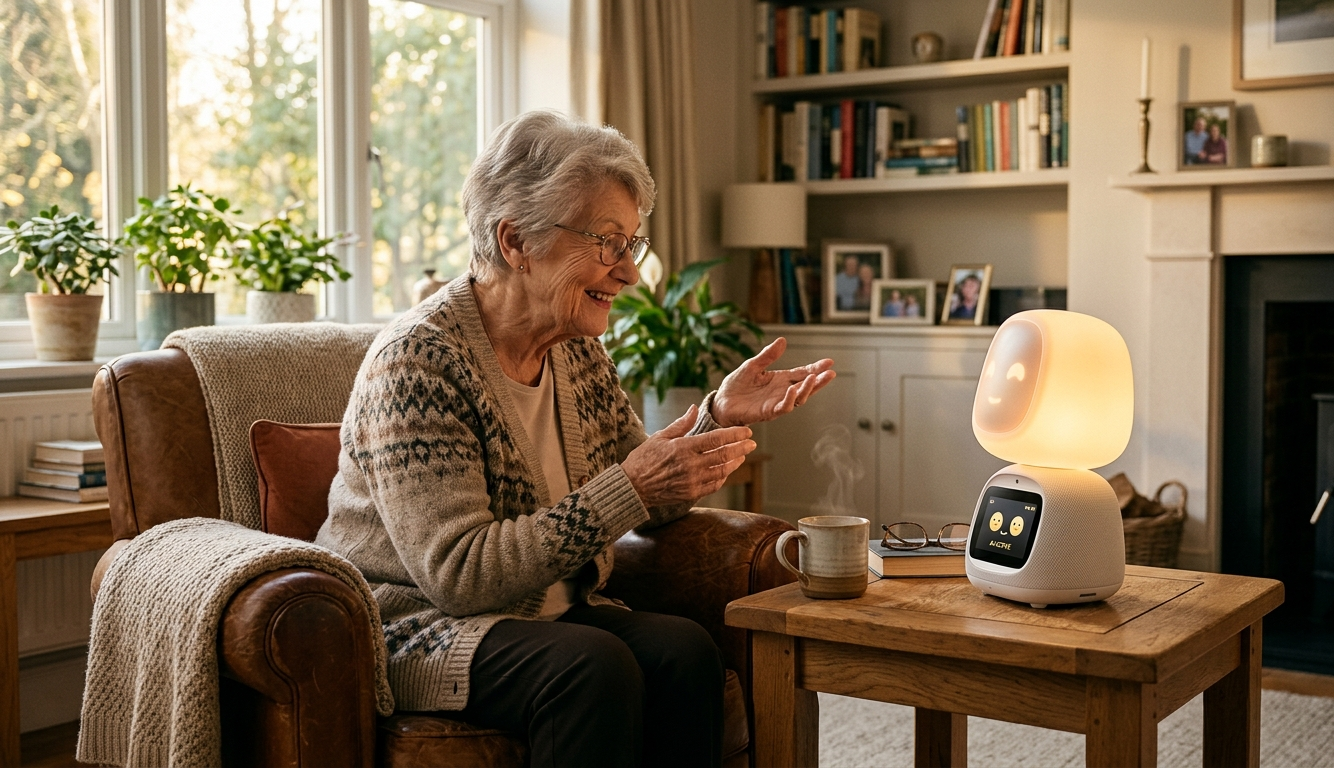
Loneliness has quietly become one of the most consequential health issues facing older adults — and a small robot with a lamp-like head is one of the more closely studied AI responses to it. ElliQ, made by the Tel Aviv-based company Intuition Robotics, doesn’t wait for a command like a typical smart speaker. It starts the conversation itself. That difference — proactive engagement powered by generative AI, rather than reactive voice control — is what separates ElliQ from the broader category of “smart home” gadgets, and why it’s worth a closer, evidence-based look.
This article draws on Intuition Robotics’ own product and pricing pages, a peer-reviewed evaluation published via ScienceDirect, MediaTek’s technical disclosures about ElliQ’s chip, contemporaneous reporting from TechCrunch, Voicebot.ai and The Robot Report, and independent 2026 consumer reviews. Where claims come only from the company or its program partners, that’s noted explicitly.
Table of Contents
The Home Problem
Social isolation among older adults living alone is associated with well-documented negative health outcomes, and it became a more visible public concern following the COVID-19 pandemic. Conventional smart-home technology — voice assistants, security cameras, connected thermostats — is built to respond to requests, not to notice when someone hasn’t spoken to another person all day. A senior who doesn’t ask Alexa a question doesn’t get an Alexa check-in. That passivity is the gap ElliQ was built to address.
What Is ElliQ?
ElliQ is an AI companion robot developed by Intuition Robotics, a company founded in 2016. After roughly five years of beta testing, ElliQ officially launched commercially on March 15, 2022. It has since gone through two more major generations:
- ElliQ 2.0 (December 2022) — refreshed hardware (improved screen, simpler tablet charging, better far-field microphones) and more contextual software
- ElliQ 3 / 3.0 (announced January 2024) — the biggest change yet: a large language model (LLM) was built into the device, alongside new processing hardware from MediaTek
Physically, ElliQ looks less like a humanoid robot and more like an animated desk lamp: a swiveling “head” with a soft glowing light where a face would be, paired with a removable touchscreen tablet that snaps onto its base and auto-charges.
How ElliQ Works
According to Intuition Robotics’ own specifications, ElliQ’s hardware includes:
- Quad microphones with noise and echo cancellation, with audio engineering by Harman
- Computer-vision-based cameras (used for presence detection and video calls)
- Three brushless motors for quiet head/body movement
- A touchscreen tablet (independent secondary sources cite approximately 8 inches; this exact figure is not listed on Intuition Robotics’ official spec pages)
- Air quality and temperature sensors
- LED arrays for non-verbal, mood-style feedback
- A battery and dock
The ElliQ 3.0 generation added a new octa-core processor paired with a dual-core AI chip from MediaTek — hardware Intuition says allows the device to run its generative AI features while using less power than before. That claim comes from Intuition Robotics and MediaTek’s joint materials; independent chip-level benchmarking of the device was not found in available sources.
Users interact with ElliQ primarily through spoken conversation, supplemented by the touchscreen for images, video calls and activity content, and by physical cues — the head turning toward a speaker, the light changing to signal ElliQ is “listening” or “thinking.”
How AI Is Actually Used
It’s worth being precise here, because not everything marketed as “smart” involves meaningful AI. Ordinary automation — a light that turns on at sunset, a thermostat that follows a fixed schedule — makes decisions based on static, pre-programmed rules. ElliQ’s core function is different in kind:
- Generative AI conversation: ElliQ 3 has an LLM built in, which Intuition Robotics says lets it hold more natural, flexible conversations across a wide range of topics, rather than relying on scripted responses.
- A proactive decision engine: Intuition Robotics calls this its “Relationship Orchestration Engine.” In real time, it decides whether ElliQ should offer a scripted reminder, take an action (like starting a video call), or open a free-form conversation — a layer of autonomous decision-making, not simple if-this-then-that logic.
- Personalization and memory: ElliQ is designed to build context over repeated interactions, referencing past conversations to tailor future ones.
- Computer vision: used narrowly, for presence detection and camera-based features like video calling and selfies — not for continuous facial recognition, per the company’s public FAQ.
Exactly how much of this processing happens on the device’s own AI chip versus in Intuition Robotics’ cloud is not publicly disclosed. Given that generative conversation typically requires substantial computing power, it is reasonable to assume a hybrid approach, but the company has not published a technical breakdown.
Key AI Capabilities
- Initiating conversations and check-ins without being prompted first
- Offering medication, hydration, and exercise reminders
- Suggesting personalized activities: cognitive games, audiobooks, guided “virtual travel” or museum tours
- Recording memories or messages to share with family
- Facilitating video calls and messages with family members and caregivers
- Providing a caregiver-facing app and dashboard for remote monitoring (marketed as the “ElliQ Caregiver Solution”)
Real-World Performance: What’s Verified, What’s Claimed
This is where distinguishing evidence types matters most.
Company- and partner-reported outcomes: ElliQ has been deployed through more than a dozen U.S. and Canadian healthcare-affiliated programs, most notably the New York State Office for the Aging (NYSOFA), which has provided subsidized devices to isolated older adults.
- NYSOFA reported a 95% reduction in loneliness among a sample of 107 users who had ElliQ for at least 30 days.
- A separate 2022 company-run survey of 40 long-term users, using the standardized UCLA loneliness scale, found a majority reported increased companionship and decreased loneliness, with no respondents disagreeing.
- NYSOFA data also shows heavy usage — reportedly over 30 interactions per day, most related to social, physical, or mental well-being.
Peer-reviewed evidence: A 2024 peer-reviewed article (co-authored by researchers affiliated with the deployment programs, published via ScienceDirect) documents these outcomes in more academic detail. It’s a legitimate, published evaluation — but because the authors are connected to the programs and to Intuition Robotics’ data-sharing agreements, it isn’t the same as a fully independent, arms-length randomized controlled trial. No such independent RCT was found in available research.
Independent, non-affiliated reviews: These are more mixed. One 2026 independent review cites a figure finding 59% of users felt ElliQ was “very effective” against loneliness — notably lower than the company-cited 95% figure — though the review does not name or link the underlying study, so it can’t be independently verified here. The same review reports that some users described the device’s proactive prompting as “nagging” or even “rude.” No independent hands-on lab review measuring, for instance, speech-recognition accuracy or response latency was located.
In short: the loneliness-reduction signal is real and consistently reported across multiple sources, but the strongest numbers come from company-affiliated programs, and user sentiment in less filtered reviews is more nuanced.
Practical Benefits
ElliQ appears best suited for:
- Older adults living alone who want proactive social contact, not just a tool that waits for commands
- Families seeking a lower-friction way to stay connected via video calls and shared “memories”
- Caregivers who want visibility into a loved one’s engagement and wellness patterns through the companion app
It is not designed, and is not marketed, as a substitute for medical monitoring or emergency response.
Privacy and Security
ElliQ’s privacy policy (last updated January 2026) states that the personal information it may collect includes account details, usage patterns, interaction content — text, video, and audio — user preferences, and any health information a user voluntarily shares, along with automatic technical and usage data.
The company’s public FAQ states that ElliQ listens for its wake word while idle, does not record background conversation, and only fully activates its camera for specific features like video calls or selfies. That is a company claim; no independent technical audit of this behavior was found in available sources.
Under GDPR, the company’s policy also acknowledges EEA residents’ right to object to decisions made through fully automated processing or profiling — meaning some of ElliQ’s personalization does involve automated decision-making about users, which the policy allows Europeans to challenge.
Interaction data has also been shared with external research partners under program consent agreements, as documented in the peer-reviewed evaluation cited above. No public disclosure of a formal third-party cybersecurity audit or vulnerability history for ElliQ was found.
Limitations
- Not a medical or safety device. ElliQ’s own terms state it is not a medical device, healthcare provider, or emergency alert system, and it cannot contact 911.
- Requires setup help. Independent reviews note that many older adults need a tech-savvy family member to complete initial setup and Wi-Fi connection.
- Mixed user sentiment. Some independent reviews report users found the proactive check-ins intrusive or repetitive over time.
- Subscription lock-in. ElliQ only functions with an active membership; if the device isn’t returned within 45 days of cancellation, Intuition Robotics’ terms state a $1,500 non-return fee applies.
- Limited independent technical testing. Claims about AI accuracy, conversation quality, and on-device processing rely largely on company disclosure rather than third-party benchmarking.
Cost and Availability
| Plan | Price | Notes |
|---|---|---|
| One-time lease initiation fee | $249 | Required to enroll; unchanged since 2022 launch pricing structure |
| Monthly subscription (month-to-month) | $59.99/month | No annual commitment |
| Annual subscription | $49.99/month | Requires 12-month commitment |
| 24-month subscription | $39.99/month | Longest commitment, lowest monthly rate |
Pricing sourced directly from Intuition Robotics’ official ElliQ store pages as of 2026. Some earlier press coverage cited different figures (e.g., a $1,499 device plus $35/month during an early pre-order period) — pricing has evolved since ElliQ’s first pre-order phase. Note also that a small number of secondary sources round these current figures down (e.g., “$59/month” instead of “$59.99/month”); the store-listed figures above reflect the most specific, directly sourced pricing available.
According to independent review coverage, ElliQ is not sold through general retailers like Amazon; it’s available directly through elliq.com or through subsidized distribution via partner programs such as state offices for the aging, healthcare organizations, and nonprofits.
How ElliQ Compares to Alternatives
| Device | Focus | Proactive AI? | Medical-Grade? | Approx. Cost |
|---|---|---|---|---|
| ElliQ | Companionship, wellness reminders, family connection | Yes | No | $249 + $39.99–$59.99/mo |
| Paro | Therapeutic interaction (dementia/Alzheimer’s) | No (responsive to touch) | Yes, certified medical device | Varies, purchase-based |
| Jibo | General-purpose social robot | Limited | No | Current availability not independently verified in this research |
| Spiritify Joy | Companionship/caregiver support | Emerging | No | Newer entrant; less deployment evidence than ElliQ |
| Amazon Alexa (Care Hub) | General voice assistant with basic check-in features | No — reactive only | No | Included with existing Echo devices |
The Future of AI-Powered Homes
ElliQ is an early, real-world example of a broader shift in home AI: from devices that wait to be asked, toward devices that observe, initiate, and adapt. Industry observers generally expect that as generative AI models become smaller and more efficient — potentially enabling more processing to happen on-device rather than in the cloud — this proactive model could spread beyond eldercare into general-purpose home AI assistants, though this is a forward-looking trend rather than a confirmed roadmap for ElliQ specifically. The core tension it raises, though, will likely follow it: how much autonomous initiative should an AI device take in someone’s home, and how transparent should that decision-making be to the person living with it.
Conclusion
ElliQ is a genuine example of applied AI solving a real, well-documented problem — not a smart-home gadget with an “AI” label bolted on. Its generative conversation, proactive engagement engine, and personalization are meaningfully different from the automation found in typical connected devices. The loneliness-reduction evidence behind it is real but comes mostly from company-affiliated programs rather than fully independent trials, and prospective users should weigh its real limitations: it’s not an emergency device, it requires ongoing subscription payments, and some users find its proactive style intrusive rather than comforting. For the right household — an older adult who wants a proactive conversational presence and simple video connection to family — the evidence suggests it can genuinely help. It is not, and doesn’t claim to be, a complete solution to elder isolation or safety.
FAQ
What is ElliQ and how does it work? ElliQ is a tabletop AI companion robot made by Intuition Robotics that uses generative AI to proactively start conversations, offer reminders, and connect users with family, rather than only responding to commands like a typical smart speaker.
How much does ElliQ cost per month? As of 2026, ElliQ requires a one-time $249 lease initiation fee plus a monthly subscription ranging from $39.99 (24-month plan) to $59.99 (month-to-month), according to Intuition Robotics’ official pricing.
Is ElliQ a medical device or emergency alert system? No. Intuition Robotics explicitly states ElliQ is not a medical device, healthcare provider, or emergency service, and it cannot contact 911.
Does ElliQ actually reduce loneliness in seniors — what does the evidence say? Program-reported data, including a New York State Office for the Aging report, found a 95% reduction in loneliness among a 30-day-plus user sample, and a company survey found similar self-reported benefits. However, this evidence comes largely from company-affiliated programs; one independent review cites a lower “very effective” rate of 59%, and some users describe the proactive check-ins as intrusive.
What data does ElliQ collect, and is the camera always on? According to its privacy policy, ElliQ may collect account details, interaction content (text, video, audio), usage patterns, and any voluntarily shared health information. The company states the camera activates fully only for specific features like video calls, though this has not been independently audited.
How is ElliQ different from Alexa or Google Home for elderly users? Alexa and Google Home are reactive — they wait for a spoken command. ElliQ is built to proactively initiate conversations, reminders, and activity suggestions without being asked, using an AI system Intuition Robotics calls the “Relationship Orchestration Engine.”
Can I return ElliQ if I cancel my subscription? Yes, cancellation is possible at any time, but per ElliQ’s terms of use, the device must be returned within 45 days of cancellation or a $1,500 non-return fee applies.
Sources
- Intuition Robotics — ElliQ official product, pricing, and FAQ pages: https://elliq.com/
- ElliQ Privacy Policy: https://elliq.com/pages/elliq-privacy-policy
- ScienceDirect — “ElliQ, an AI-Driven Social Robot to Alleviate Loneliness: Progress and Lessons Learned”: https://www.sciencedirect.com/science/article/pii/S2534773X24000466
- MediaTek — “ElliQ 3.0, by Intuition Robotics, powered by MediaTek AI”: https://www.mediatek.com/tek-talk-blogs/elliq-3.0-by-intuition-robitics-powered-by-mediatek-ai
- Voicebot.ai — “Intuition Robotics Releases ElliQ 3 Robot With Upgraded Hardware Augmented by Generative AI”: https://voicebot.ai/2024/01/09/intuition-robotics-releases-elliq-3-robot-with-upgraded-hardware-augmented-by-generative-ai/
- TechCrunch — “The ElliQ eldercare robot is finally available”: https://techcrunch.com/2022/03/15/the-elliq-eldercare-robot-is-finally-available/amp
- The Robot Report — “Intuition Robotics launches ElliQ 2.0 and companion app”: https://www.therobotreport.com/intuition-robotics-launches-elliq-2-0-and-companion-app/
- Independent review — “ElliQ Review 2026: Price, Features and Limits”: https://robotcompanion.online/elliq-review/