

The Problem: Why Weed Control Is Farming’s Costliest Headache
Weeds compete with crops for water, nutrients, and light — and controlling them has traditionally meant one of two costly options: herbicides or manual labor. Both are under pressure. Herbicide resistance is spreading, regulatory restrictions on chemical use are tightening in multiple regions, and farm labor for hand-weeding has grown scarcer and more expensive year over year.
Into that gap has stepped a wave of AI laser weeding technology — and one Seattle company, Carbon Robotics, has become a focal point for the industry’s most ambitious claims about what artificial intelligence can actually do in a field.
Table of Contents
What Is the Carbon Robotics LaserWeeder?
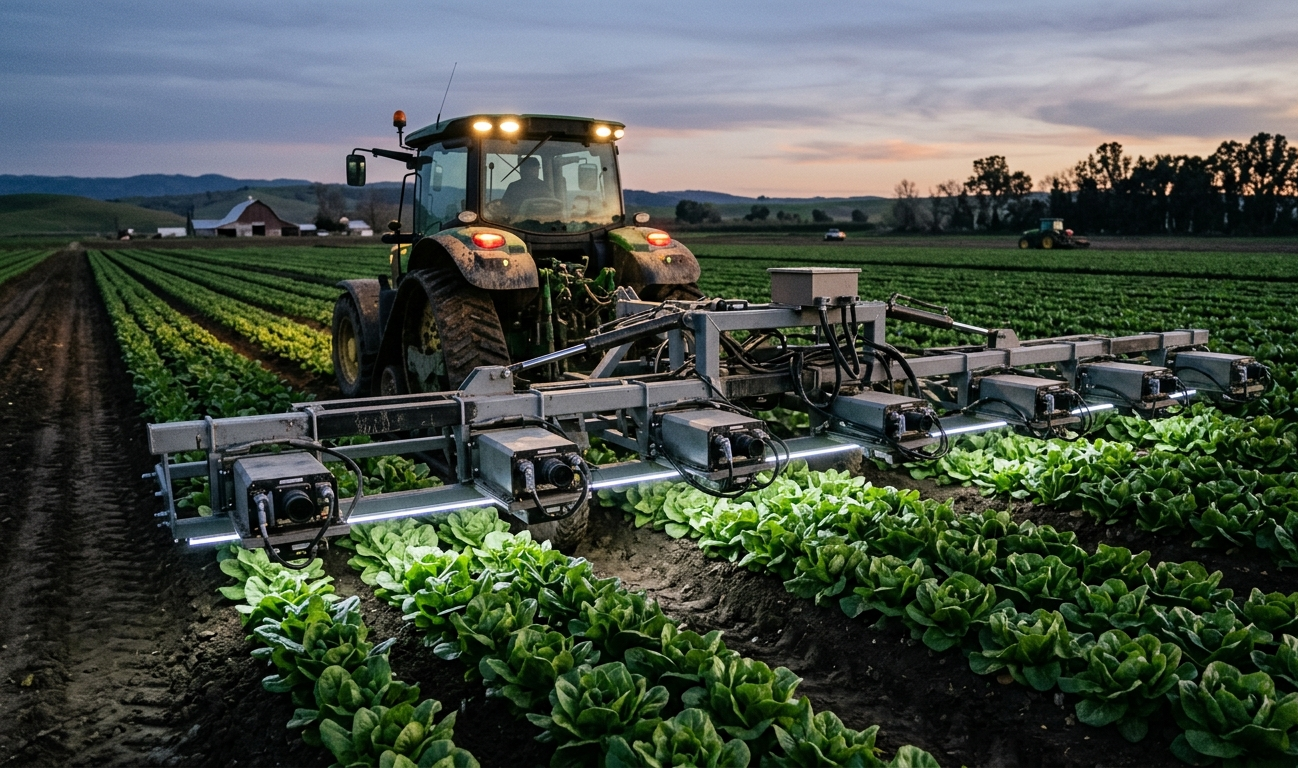
The LaserWeeder is a tractor-towed implement that uses cameras and lasers to identify and destroy weeds as it passes over crop rows. Founded in 2018 by CEO Paul Mikesell, Carbon Robotics moved from a field-demo-only prototype in March 2021 to a commercial product, with the first commercial LaserWeeder introduced in February 2022. The current generation, the LaserWeeder G2, launched in February 2025 as a lighter, modular redesign of the original machine.
Two further developments followed. In March 2025, the company introduced the Carbon ATK — an autonomous tractor kit — and by early 2026 it had added something conceptually new to the LaserWeeder itself: an AI system called the Large Plant Model (LPM).
How It Works: From Detection to Destruction
As the machine moves through a field, high-resolution cameras continuously photograph the crop bed. An onboard computer running deep-learning models classifies each plant in view, then a bank of lasers fires at any plant identified as a weed, targeting the meristem — the plant’s growing point — without harming valuable crops.
Independent researchers who studied the system’s methodology found the classification process is more granular than simple “weed or not”: the AI categorizes each weed by type — broadleaf or grass — and by size, from small (one-to-three leaf) up through large (five-to-nine leaf) growth stages, then adjusts how long the laser fires accordingly. The system is tuned to prioritize weeds at the two-leaf stage or smaller, when the growing point is easiest to identify and treatment is fastest.
The AI Behind the Machine: The Large Plant Model
This is where Carbon Robotics’ announcement stands out from typical “smart farming” marketing. The Large Plant Model is built on a training set the company says spans more than 150 million labeled plant photos and data points collected from its machines operating across more than 100 farms in 15 countries.
The practical claim is that the model can generalize: rather than requiring engineers to relabel and retrain the system every time it encounters an unfamiliar weed — a process the company says previously took around 24 hours — the LPM is designed to recognize a new plant species from a single reference image. This is a company claim rather than something independently benchmarked in the studies reviewed for this article, but it represents a meaningful shift in approach: treating plant recognition less like a fixed classifier and more like an adaptable model that keeps learning from new field data — what the company describes as a continuously compounding “data flywheel.”
Sensors and Computer Vision
The hardware feeding this AI is substantial. The largest current configuration, the LaserWeeder G2 1200, is built around 16 modules containing 32 diode lasers rated at 240 watts each, 48 high-resolution cameras, and 320 high-intensity LED lights for consistent nighttime imaging, all processed through NVIDIA GPUs, with a Starlink satellite connection for cloud model updates. Smaller field configurations scale this down proportionally.
What the vision system can detect and classify, based on both company documentation and independent trial descriptions:
- Individual plants, distinguishing crop from weed
- Weed species and category (broadleaf vs. grass)
- Growth-stage size, to calibrate laser dwell time
- Row and furrow structure, for the companion autonomous tractor system
Autonomous Capabilities: The Carbon ATK
It’s worth separating two different products here. The LaserWeeder implement itself is AI-assisted precision equipment — it makes real-time detection and targeting decisions, but a tractor still pulls it. The Carbon ATK, introduced in March 2025 and expanded toward large-acre row-crop use by mid-2026, is a step toward autonomous field operation, though not one free of human involvement.
Unlike conventional auto-steer systems that depend heavily on GPS, CEO Paul Mikesell has described the ATK’s navigation as needing GPS only to establish field boundaries, with the tractor using AI vision to follow furrows without pre-marked rows. The kit attaches to certain John Deere tractor models, including the 6R, 8R, 8RX and 8RT series from 2019 onward, without permanent modification, and includes 360-degree cameras, LiDAR, radar, and AI-based detection of implement problems.
This is not unsupervised autonomy, however. Carbon ATK machines are monitored around the clock by technicians at a dedicated operations center, who can take manual control if the system encounters a situation it can’t resolve. That places the system in the highly autonomous category — capable of extended independent operation with active human oversight — rather than fully autonomous in the sense of zero human involvement.
Real-World Farm Use
The LaserWeeder is not a lab prototype. Original units have been owned and operated by more than 100 growers across North America, Europe, and Australia, and by early 2026 the company said the G2 platform and Large Plant Model were in production across hundreds of farms in 15 countries. Named commercial customers include Grimmway Farms, Braga Farms, Taylor Farms, and Cal-Organic Farms, along with Tanimura & Antle, a major California vegetable grower.
Performance and Evidence: Company Claims vs. Independent Research
This is where distinguishing marketing from verification matters most. The strongest independent evidence comes from a 2024 field study conducted jointly by Cornell AgriTech and Rutgers University, published in the peer-reviewed journal Pest Management Science. Testing beets, spinach, and peas, researchers found laser weeding performed as effectively as, or better than, conventional herbicides — reducing weed biomass by 97% or more and improving crop growth by at least 30%.
That same research flagged a real constraint on adoption: an estimated minimum implementation cost of $500,000 per unit.
| Metric | Source | Verification Level |
|---|---|---|
| Weed biomass reduction ≥97%, crop growth increase ≥30% | Cornell/Rutgers field trial, Pest Management Science (2025) | Independent, peer-reviewed |
| Kills up to 99% of weeds, sub-millimeter accuracy | Carbon Robotics spec sheet | Company claim |
| Eliminates 100,000+ weeds per hour | Carbon Robotics | Company claim |
| Reduces weed control costs by up to 80% | Carbon Robotics | Company claim |
| Minimum unit cost ~$500,000 | Cornell/Rutgers researchers | Independent estimate |
| 150M+ labeled plants in training data | Carbon Robotics / TechCrunch reporting | Company-disclosed figure |
Benefits
Based on evidence gathered for this article, the technology’s most well-supported benefits are:
- Reduced reliance on chemical herbicides, addressing resistance and regulatory pressure
- Reduced weed competition, supporting measurably better crop growth in trial conditions
- No-till operation, avoiding the soil disturbance associated with mechanical cultivation
- Ability to operate in low-light or nighttime conditions using onboard LED lighting
Limitations and Risks
- Cost is a real barrier. Independent researchers — not just critics — identified the roughly half-million-dollar price point as limiting adoption to well-capitalized operations.
- Laser safety is a genuine hazard. The company’s own product labeling designates the lasers as Class 4 — the highest hazard classification, capable of causing eye and skin injury from direct or scattered radiation — requiring trained operators.
- Autonomy has boundaries. The Carbon ATK depends on continuous remote human monitoring and can require manual takeover; it is not designed to operate without oversight.
- Effectiveness varies by growth stage. Comparative laser-weeding research indicates effectiveness is highest against small, young weeds, with treatment becoming more resource-intensive as weeds mature.
- Connectivity dependency. The system relies on satellite connectivity for cloud-based model updates, which could be a constraint in areas with limited coverage.
Several details remain undisclosed publicly, including exact commercial failure or downtime rates outside limited academic trials, and the full terms governing how individual farms’ field data feeds into the shared AI model.
Cost and Availability
Independent research places baseline system cost at a minimum of roughly $500,000. The Carbon ATK autonomous tractor system uses a different model: operators pay by the hour, with usage automatically recorded, rather than purchasing hardware outright. Geographically, the LaserWeeder currently operates in the United States, Canada, the United Kingdom, several European countries, and Australia, while the ATK launched initially to a select group of U.S. farms, with a Canadian market entry tentatively planned for 2027.
Competitors and Alternatives
| Company | Approach | Notable Distinction |
|---|---|---|
| FarmWise Labs | AI/computer-vision mechanical and laser weeding | Acquired by Taylor Farms; partnered with RDO Equipment for distribution |
| Ecorobotix | Dual laser and electro-herbicide targeting | Launched ARA 2.0 platform in February 2026 |
| Escarda Technologies | Lower-power laser weeding | Uses a Class 1 laser design — a substantially lower hazard classification than Carbon Robotics’ Class 4 system |
| John Deere / Blue River Technology | Laser weeding attachment | Prototype unveiled at the 2025 Farm Progress Show; not yet commercial |
| FarmDroid | Solar-powered seeding and mechanical weeding | GPS-guided, non-laser alternative for row crops |
The Future of AI-Powered Agriculture
The direction suggested by the Large Plant Model points toward where agricultural AI appears to be heading more broadly: fewer narrow, single-purpose classifiers, and more adaptable systems that improve continuously from field data. Whether that pattern holds up over time, and whether costs fall enough to reach mid-sized farms rather than only large operations, remains to be seen.
Conclusion
The LaserWeeder and its Large Plant Model represent one of the better-documented examples of AI in agriculture today — not because every company claim has been independently confirmed, but because a peer-reviewed university study exists to check some of the most important ones against. The core weed-control claims hold up reasonably well under that scrutiny. The autonomy claims are more nuanced: meaningfully reduced dependence on GPS, but still built around active human oversight. For now, this is commercially deployed, field-tested technology — not speculative — but one still constrained by high upfront costs and a laser-safety profile that demands careful handling.
FAQ
Does laser weeding really work as well as herbicides?
Independent Cornell and Rutgers field trials found it performed as well as or better than herbicides in beet, spinach, and pea crops, reducing weed biomass by 97% or more.
How much does a Carbon Robotics LaserWeeder cost?
Independent researchers estimate a minimum of roughly $500,000 per unit; the company’s autonomous tractor kit uses a separate pay-per-hour pricing model instead.
Is the LaserWeeder fully autonomous?
No. The implement is AI-guided but towed. The companion Carbon ATK enables highly autonomous field navigation but still requires 24/7 remote human monitoring and manual override capability.
Is laser weeding safe?
The lasers are Class 4 — the highest hazard classification, capable of causing serious eye and skin injury — and require trained operators and safety precautions.
What is the “Large Plant Model”?
An AI system trained on more than 150 million labeled plant images, designed to let the LaserWeeder recognize new weed species from a single reference photo rather than requiring retraining.
Which farms are using this technology?
Commercial customers include Grimmway Farms, Taylor Farms, Cal-Organic Farms, Braga Farms, and Tanimura & Antle, with deployments reported across roughly 15 countries.
What are the alternatives to Carbon Robotics’ system?
Competing approaches include FarmWise, Ecorobotix, Escarda Technologies (which uses a lower-hazard Class 1 laser), and a prototype laser attachment reportedly in development at John Deere/Blue River.
Sources
- Sosnoskie et al., “Deep learning‐based laser weed control compared to conventional herbicide application,” Pest Management Science (2025) — pmc.ncbi.nlm.nih.gov/articles/PMC12268811/
- Cornell Small Farms Program, “Lasers Match Common Herbicides at Zapping East Coast Weeds” — smallfarms.cornell.edu
- TechCrunch, “Carbon Robotics built an AI model that detects and identifies plants” (Feb 2026) — techcrunch.com
- Carbon Robotics official specifications — carbonrobotics.com
- The Western Producer / Manitoba Co-operator / Farmtario (Glacier FarmMedia), Carbon ATK coverage (2026)
- Vision Systems Design, “Carbon Robotics Launches Autonomous Tractor Kit”
- Business Wire, Carbon Robotics Series D and ATK launch releases