

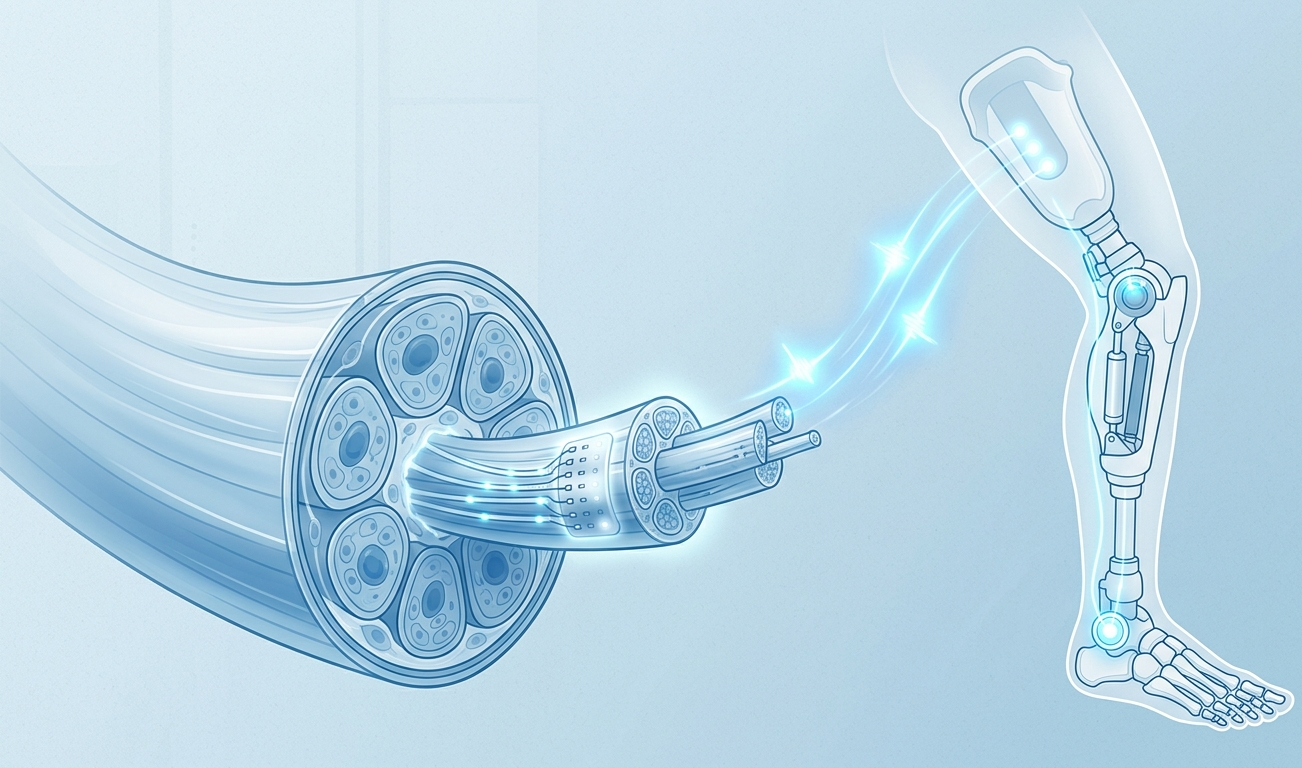
For decades, the field of AI-powered prosthetics has moved fastest at the hands. Bionic hands can now learn a user’s grip patterns, sense pressure, and adjust in real time. Prosthetic legs, by comparison, have lagged — not because researchers care less about mobility, but because the signals needed to control a leg naturally are far harder to capture. A new peer-reviewed study offers the clearest evidence yet that this gap may be closing, using an AI model built to “listen” the way real neurons do.
The research, published in Nature Communications in February 2026, is one of the most direct demonstrations yet of AI-based nerve decoding for a prosthetic leg: an AI system that can decode a person’s intended knee, ankle, and toe movements directly from nerve signals — including signals tied to muscles that no longer physically exist after amputation. It is not a commercial device, and it won’t be one for years. But it is a genuine scientific first, and it points toward a very different kind of prosthetic leg than the ones on the market today.
Table of Contents
The Prosthetics Problem This Solves
Why lower-limb prosthetics have lagged behind hands and arms
Most advanced prosthetic hands and arms today rely on surface electromyography (EMG) — electrodes placed on the skin that pick up electrical activity from remaining muscles in the residual limb. That approach works reasonably well for arms, where several independent muscle groups often survive amputation.
Legs are a harder problem. Above-knee (transfemoral) amputation removes many of the muscles that would normally control the ankle and toes, leaving little or nothing for surface sensors to read. As a result, most commercial prosthetic legs — even sophisticated, motorized ones — don’t connect to the nervous system at all. They react to external data: force sensors, accelerometers, and gyroscopes that measure how the prosthetic itself is moving through space, not what the user’s nervous system intended.
The signal problem — muscles that no longer exist
The research team’s starting question was simple but difficult to answer: after a leg is amputated, does the brain still send movement commands down the nerve toward muscles that are no longer there? And if so, can those signals be captured well enough to control a prosthetic?
Prior work suggested the answer was yes in principle. This study set out to test it directly, and to see whether an AI system could turn those faint, noisy signals into something usable.
What the Device Actually Is
It’s important to be precise here: this is not a prosthetic leg you can buy, and there is no company selling it. It’s a research collaboration between Chalmers University of Technology (Sweden), the University of Zurich and ETH Zürich (Switzerland), and the Clinical Center of Serbia in Belgrade, where the human testing took place. The corresponding author is Giacomo Valle of Chalmers; the study’s other authors include Cecilia Rossi, Marko Bumbasirevic, Paul Čvančara, Thomas Stieglitz, Stanisa Raspopovic, and Elisa Donati.
The paper, titled “Decoding phantom limb movements from intraneural recordings,” was submitted in August 2025, accepted in January 2026, and published online on February 8, 2026, in Nature Communications (Vol. 17, Article 2511) — a peer-reviewed journal, meaning the methodology and results were independently reviewed by outside scientists before publication.
How It Works
The implant — intraneural electrodes in the sciatic nerve
Two people with above-knee amputations had four multichannel electrode arrays surgically implanted into the distal branch of the sciatic nerve in their residual thigh. Each array carried 14 active recording sites, for a total of 56 data channels per person. Unlike surface EMG, these electrodes sit inside the nerve itself — closer to the source of the signal, before it would have traveled on toward the missing muscles.
The experiment — attempting phantom movements on cue
Participants sat and watched a screen that cued them to attempt specific movements: flex the knee, extend it, flex the ankle, extend it, flex the toes, extend them — each attempt lasting two seconds, followed by a two-second rest. No physical movement occurred, since there was no leg to move. But the electrodes picked up clear neural activity tied to each intended movement. In one participant, 91% of the recording sites responded to at least one attempted movement — including signals for toe movements, even though the muscles that would normally control the toes were surgically removed at the time of amputation.
How AI Is Used
What a spiking neural network is, in plain terms
To make sense of this data, the researchers built what’s called a spiking neural network (SNN) — a type of AI model designed to process information in short, timed pulses, similar to how biological neurons actually communicate. This is different from the more common deep-learning models most people associate with AI (like the ones behind chatbots or image generators), which typically work with continuous or averaged data rather than discrete spikes.
Why this AI architecture fits nerve signals better than standard machine learning
Nerve signals are naturally “spiky” — brief bursts of electrical activity rather than smooth, continuous waves. A spiking neural network is built to exploit exactly that kind of timing information, which is part of why the researchers chose it over conventional decoding approaches.
It’s worth being clear about what kind of AI this is. This is a predictive/classification machine-learning model — it takes in a pattern of nerve activity and predicts which movement was intended. It is not generative AI, and there’s no evidence of multimodal AI, personalization, or autonomous decision-making in this study. This is squarely a case of AI doing genuine pattern recognition on a difficult signal — not simple automation, since the system is learning to distinguish subtle, overlapping neural patterns rather than following fixed if-then rules.
Key AI Capabilities
According to the published results, the SNN-based decoder outperformed conventional decoding methods at predicting which movement a participant was attempting. Accuracy improved further when the researchers combined intraneural (nerve) signals with the incidental intermuscular EMG signals the same electrodes happened to pick up.
| Participant | Movement classes tested | Best reported decoding accuracy |
|---|---|---|
| Participant 1 | 6 (knee, ankle, toe — flexion & extension) | ~64% (combined nerve + muscle signal) |
| Participant 2 | 4 movement classes | ~72% |
Figures are the study’s own reported results, verified through peer review — not independently replicated by a third-party lab.
The researchers also compared their movement-recording data against a separate map of which electrode sites, when stimulated, evoked sensations of touch in the phantom limb — a capability the same research group has demonstrated in earlier work and tested again here for comparison. The two maps overlapped only minimally, suggesting motor and sensory nerve fibers occupy largely distinct areas within the nerve. That matters because it hints that a single implant could someday both read movement intent and deliver a sense of touch, through different channels — though this study’s primary and most extensive testing was on movement decoding, not on building out a full touch-feedback system.
Real-World Performance — What’s Actually Verified
- Verified by peer review: The methodology, data, and statistical analysis were reviewed by independent scientists before publication in Nature Communications, one of the most widely respected general-science journals.
- Verified by the study itself: The SNN decoder statistically significantly outperformed conventional methods (the paper reports paired t-test results with p < 0.05 for both participants).
- Not yet verified: Real-time performance. All decoding in this study was done offline — researchers analyzed recorded data afterward, rather than controlling anything live. No robotic or powered prosthetic leg was actually moved by this system in the study.
- Not yet verified: Performance outside a controlled lab setting, or performance over a period of months or years.
Practical Benefits — Why This Could Matter for Amputees
If this approach is eventually developed into a real device, the potential benefits would include:
- A prosthetic leg that responds to the body’s own original nerve signals, rather than only to external motion sensors
- The ability to control ankle and toe movement even when the muscles that once powered them are gone
- A plausible path toward a prosthetic that can both move on command and deliver touch sensation, using the same implant
These are reasonable, evidence-supported directions the research points toward — not confirmed outcomes. No prosthetic leg has yet been built or tested using this specific decoding system.
Privacy and Security Considerations
Because this is an academic research study rather than a consumer product, there is no publicly available detail about long-term data storage, cloud processing, or cybersecurity architecture. What is known:
- Data collected was limited to electrical nerve and muscle signal recordings — no cameras or microphones were involved.
- The study was conducted under formal informed consent and institutional ethics-committee approval (Clinical Center of Serbia, Belgrade).
- The registered clinical trial can be reviewed publicly on ClinicalTrials.gov.
Any future wireless or connected version of this technology would raise the same broad questions that apply to implantable neural devices generally — including how signal data is transmitted, stored, and protected from unauthorized access. None of that has been addressed in this study, since it did not involve a deployable or wireless device.
Limitations
The study’s authors were explicit about several limitations:
- Small sample size: only two participants, which limits how confidently the results generalize
- Offline testing only: the system was never tested in real time
- Unknown long-term stability: how the implant and signal quality hold up over months or years hasn’t been studied
- Single nerve implanted per participant: limiting the range of movements that could be decoded
- No independent confirmation of intent: without visual or proprioceptive feedback, researchers can’t be fully certain each recorded signal reflects a precise, intended joint movement rather than a more general muscle contraction
Cost and Availability
There is no product to buy, no price, and no release date. This is publicly funded academic research — specifically supported by the European Research Council’s FeelAgain grant, awarded under the EU’s Horizon 2020 program. It is not being sold, marketed, or distributed beyond the two study participants.
How This Compares to Other AI Prosthetic Research
| Project | Institution(s) | Signal source | Development stage |
|---|---|---|---|
| Intraneural phantom-limb decoding (this study) | Chalmers, UZH/ETH Zürich | Intraneural (sciatic nerve) | Lab research, 2 participants, offline |
| Utah Bionic Leg | University of Utah, Ottobock | External sensors (force, IMU) | Advanced prototype, moving toward commercialization |
| Phantom X | Phantom Neuro (backed by Ottobock) | Implantable EMG | First-in-human trials beginning |
| iSens sensory bionic arm | Case Western Reserve University | Implanted neural stimulation + motor control | Active clinical trial (upper limb) |
| AI-enabled BCI robotic arm | UC San Francisco | Cortical (brain-surface) implant | Peer-reviewed human study (upper limb) |
The Future of AI-Powered Prosthetics
Toward bidirectional (move-and-feel) neural limbs
The long-term ambition behind this line of research isn’t just a leg that moves when you think about moving it — it’s a leg that can also let you feel the ground, a grip, or a shift in balance, using the same kind of nerve interface. This study’s finding that motor and sensory signals occupy largely separate zones within the nerve is an early but meaningful clue that both directions could someday run through a single implant.
What has to happen before this reaches real prosthetic legs
Before anything like this could become an actual product, researchers would need to test it in more people, run it in real time rather than offline, confirm the implants remain stable and accurate over months or years, and eventually connect the decoder to an actual powered prosthetic leg. None of that has happened yet.
Conclusion
This study doesn’t hand anyone a new leg. What it does is demonstrate, for the first time in humans, that an AI model built to mimic how neurons actually fire can pull specific, joint-level movement intent for an entire missing leg out of nerve signals alone — including signals for muscles that no longer exist. That’s a foundational result, not a finished product, and the researchers are candid about how much work remains. But it closes a gap that has held back lower-limb neuroprosthetics for years, and it opens a real, evidence-based path toward prosthetic legs that connect to the nervous system the way a biological leg does.
FAQ
Is this prosthetic leg available to buy? No. It’s a peer-reviewed research study involving two participants, not a commercial product.
How accurate is the AI at reading nerve signals? Up to about 72% accuracy in one participant and around 64% in the other, depending on how many different movements the system was asked to distinguish. These are the study’s own published results, verified through peer review.
What is a spiking neural network, and why does it matter here? It’s an AI model that processes information in short, timed pulses — similar to how real neurons communicate — making it a natural fit for the pulse-like nature of nerve signals.
Can this AI also restore the sense of touch? The same implant was also used to map which nerve sites could evoke touch sensations when stimulated, building on earlier work by some of the same researchers. But this study’s main focus and most extensive testing was on decoding movement intent — the sensory side was tested mainly for comparison, not as a fully developed touch-feedback system.
How is this different from existing prosthetic legs, like the Utah Bionic Leg? Most advanced prosthetic legs today, including the Utah Bionic Leg, use external sensors to react to how the device itself is moving. This approach instead reads intended movement directly from nerve signals inside the body, including signals tied to muscles that no longer exist.
When could this become a real, usable prosthetic leg? That hasn’t been publicly disclosed. The researchers themselves note that real-time testing, a larger participant group, and long-term stability studies are all still needed.
Is there any privacy or security risk with a nerve-reading implant? No specific risks have been reported for this study. Broader research into implantable neural interfaces generally flags long-term data security as an open question for the field, but this study did not involve a wireless or connected device.
Sources
- Rossi, C., et al. “Decoding phantom limb movements from intraneural recordings.” Nature Communications 17, 2511 (2026). https://www.nature.com/articles/s41467-026-69297-0
- PubMed record: https://pubmed.ncbi.nlm.nih.gov/41656293/
- medRxiv preprint (August 2025): https://www.medrxiv.org/content/10.1101/2025.08.21.25333903v1
- StudyFinds, “An AI Learned To Decode Phantom Limb Movements From Inside The Nerve” (March 2026): https://studyfinds.com/ai-learned-to-decode-phantom-limb-movements/
- Bioengineer.org, “Decoding Phantom Limb Movements via Intraneural Signals”: https://bioengineer.org/decoding-phantom-limb-movements-via-intraneural-signals/
Comparison-table context sources:
- Utah Bionic Leg — https://www.mech.utah.edu/utah-bionic-leg-in-science-robotics/
- Phantom Neuro Phantom X — https://www.mobihealthnews.com/news/phantom-neuro-gains-study-approval-phantom-x-prosthetic-control-system
- iSens (Case Western Reserve University) — https://case.edu/news/new-clinical-trial-test-sensory-prostheses-people-upper-limb-loss
- UCSF AI-enabled BCI robotic arm — https://www.ucsf.edu/news/2025/03/429561/how-paralyzed-man-moved-robotic-arm-his-thoughts