

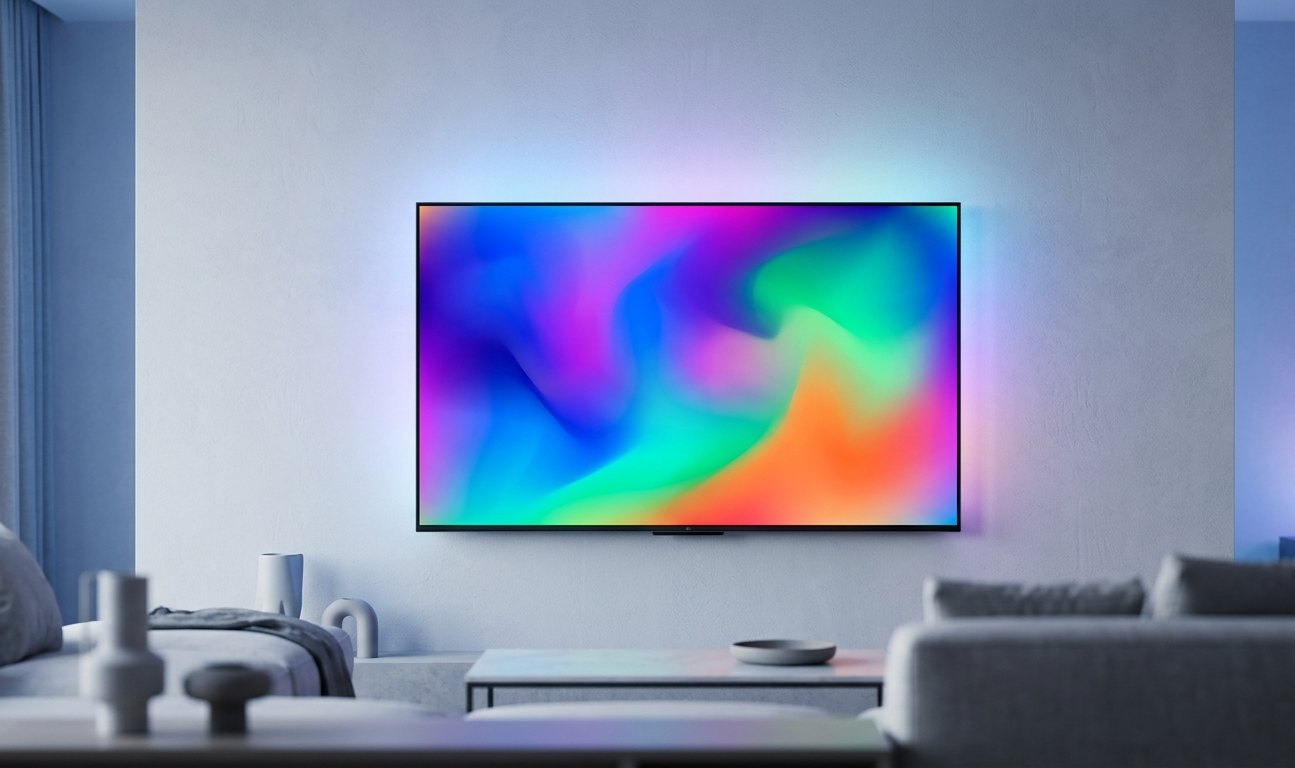
AI-driven processing is now standard across most new television lineups, from budget to flagship models.
If you’ve shopped for a television any time in the past year, you’ve probably noticed that “smart TV” has quietly given way to a new label: “AI TV.” Samsung and LG are both now using it as their primary marketing term, and it’s showing up on hardware at every price point — not just four-figure flagships. LG’s cheapest AI-branded set, the 32-inch Smart AI TV LB65, starts at around $210.
That shift matters for anyone buying a television in 2026, because an AI TV isn’t just a smart TV with a new sticker on the box. It reflects a real change in how these sets process picture, sound, and voice commands — and it comes bundled with a genuine privacy story that most buying guides haven’t caught up with yet. In February 2026, Samsung became the first television manufacturer to settle a lawsuit with the Texas Attorney General over how its TVs collect viewing data. LG followed with its own settlement in May 2026, and the case is still open against three other major brands.
This guide covers what an AI TV actually is, how it differs from a regular smart TV, what’s new from Samsung and LG this year, which other brands are doing the same thing, and what’s worth knowing about privacy and value before you buy one.
One quick note before we get into it: if you searched “AI TV” and landed here expecting an app, you’re thinking of a different product — there’s an unrelated Android app by the same name that teaches short AI-skills lessons. This article is about televisions.
Table of Contents
What Is an AI TV?
An AI TV is a smart TV built around a dedicated AI processor — a chip designed specifically to analyze and adjust picture, sound, and content in real time, rather than relying on the fixed presets older smart TVs use. In short, “AI TV” means a television whose picture and sound are actively managed by a neural-network chip, moment to moment, rather than a single preset applied to everything you watch.
Samsung’s own support materials put the distinction plainly: all Samsung AI TVs are smart TVs, but not all smart TVs are AI TVs. A smart TV just needs internet access and streaming apps. An AI TV adds a chip — usually called an NPU, or Neural Processing Unit — that actively works to make sense of whatever is on screen and adjust the picture and sound accordingly, moment to moment.
LG defines it even more specifically on the hardware side: the company’s AI TV line starts at a particular processor tier (the Alpha 5 AI Processor Gen9 and above), meaning “AI TV” isn’t just a feature bundle — it’s tied to a minimum chip requirement.
AI TV vs. Smart TV: What’s the Difference?
Short version: every AI TV is a smart TV, but not every smart TV is an AI TV.
A smart TV is defined by connectivity — internet access, app support, and streaming built in. That’s been the baseline for most new televisions for over a decade, and it doesn’t require any dedicated AI hardware.
An AI TV adds one specific thing on top of that baseline: a chip built to process picture, sound, and voice features in real time, rather than applying one fixed set of picture presets to everything you watch. In practice, that’s the entire difference — an AI TV is a smart TV with a processor powerful and specialized enough to make moment-to-moment adjustments instead of static ones.
A separate wrinkle worth clearing up: “Smart AI TV” is also the literal name of LG’s budget line (the LB65 series), which can make the terminology confusing. When people search “smart ai tv,” they’re usually asking one of two different things — either the generic concept of an AI-enabled smart TV, or LG’s specific entry-level product. Both are covered in this guide: the generic distinction is above, and LG’s Smart AI TV line specifically is covered in AI Is Reaching Budget TVs Too.
How the Technology Actually Works
The Chip Behind the Curtain
The core idea is a neural network: a set of small processing units trained to compare results and settle on the most accurate output for a given task, like sharpening a blurry frame or identifying a scene as a football match rather than a nature documentary. More neural networks generally means more granular, more accurate real-time decisions — though it’s worth being clear-eyed about where these numbers come from.
Samsung’s own 2026 buying guide states that its NQ4 AI Gen3 processor uses 128 neural networks, and its higher-end NQ8 AI Gen3 chip uses up to 768. Those are Samsung’s own published specifications, not numbers verified by an independent lab, so it’s best to treat them as a rough indicator of processing depth rather than a hard performance benchmark you can compare pixel-for-pixel against a competitor’s chip.
On-Device AI vs. Cloud AI
Most of the picture and sound processing on an AI TV happens on the device itself, which is generally faster and doesn’t require sending your viewing data anywhere. Voice assistants are a different story — asking your TV a conversational question through Google Gemini, Microsoft Copilot, or Perplexity typically requires an internet connection, and in some cases, an account or subscription. LG’s Gallery+ feature, for instance, uses Gemini to generate AI wallpaper art, but generating additional images beyond the initial allotment requires a paid subscription.
What an AI TV Can Actually Do
So what does an AI TV actually do, in day-to-day use? In practice, the AI processor in these TVs is doing a handful of specific jobs:
- Upscaling — filling in detail when you’re watching content below the TV’s native resolution, so a 1080p stream looks sharper on a 4K panel
- Motion handling — smoothing fast movement and, on some models, tracking small objects like a ball during sports
- Scene-adaptive picture settings — adjusting brightness, contrast, and color based on what’s on screen, rather than one fixed setting for everything
- Adaptive audio — boosting dialogue clarity or balancing sound based on room conditions
- Content recognition — automatically switching picture modes depending on whether you’re watching a movie, playing a game, or watching live sports
What’s New in 2026: Samsung vs. LG
Samsung’s Vision AI Companion
Samsung’s central 2026 platform is Vision AI Companion, or VAC — a concept the company first introduced at CES 2025 and has now rolled out across its entire 2026 TV lineup, from the flagship Micro RGB line down to Crystal UHD sets, according to Samsung Newsroom’s CES 2026 coverage.
VAC is built around conversational interaction: instead of digging through menus, you can ask the TV a question and get a spoken answer, with Microsoft Copilot and Perplexity built in as third-party AI options alongside Samsung’s own assistant. Samsung also debuted a 130-inch Micro RGB TV at CES 2026 — its largest consumer display to date — and is now guaranteeing seven years of Tizen OS software updates on 2026 models, a concrete commitment that’s worth checking against whatever TV you’re comparing it to.
LG’s webOS 26 and the Alpha 11 Processor
LG’s answer is built around its 2026 software platform, webOS 26, and what it calls Multi-AI Architecture — a system that routes your voice command to whichever AI engine (its own assistant, Gemini, or another) is best suited to answer it. The feature won a CES 2026 Innovation Award, according to the official CES Innovation Awards listing.
On the hardware side, LG’s 2026 flagship chip is the Alpha 11 AI Processor Gen3, which the company says features a “Dual AI Engine” capable of running two types of AI upscaling at once. According to LG’s own figures, reported independently by AV outlet FlatpanelsHD, the Alpha 11 Gen3 delivers roughly 50% faster CPU performance, 70% faster GPU performance, and 5.6 times faster NPU processing compared to the Alpha 9 Gen8 chip used in LG’s more affordable models. As with Samsung’s neural network counts, these are company-supplied figures rather than independently benchmarked results.
AI Is Reaching Budget TVs Too
Here’s the part most coverage of “AI TV” has missed: this isn’t just a flagship story anymore. LG’s Smart AI TV, the LB65 series, runs on the smaller Alpha 5 AI Processor Gen9 and starts at roughly $210 for a 32-inch model, according to LG’s own regional listings and coverage from tech outlet Gizmochina — and it still includes Gemini and Copilot access. Samsung has similarly extended Vision AI Companion down to its entry-level Crystal UHD sets rather than reserving it for premium models.
That’s a meaningful shift from just a couple of years ago, when AI features were effectively a flagship-only upsell.
| Samsung | LG | |
|---|---|---|
| AI Platform | Vision AI Companion (VAC) | webOS 26 / Multi-AI Architecture |
| Flagship processor | NQ4 AI Gen3 / NQ8 AI Gen3 | Alpha 11 AI Processor Gen3 |
| Budget-tier processor | Extended to Crystal UHD | Alpha 5 AI Processor Gen9 |
| Built-in AI assistants | Copilot, Perplexity | Gemini, Copilot |
| Entry price point (2026) | Varies by market | ~$210 (LB65, 32″) |
| Software update commitment | 7 years (Tizen OS) | Up to 4–5 years (model-dependent; verify against current LG spec sheets) |
A caveat worth stating plainly: there’s no independent, apples-to-apples benchmark comparing Samsung’s neural network chips against LG’s Alpha processors. Both companies publish their own numbers, using their own methodology, and neither is directly comparable to the other. If a specific number matters to your decision, treat it as a data point from that brand, not a settled ranking.
AI TV Isn’t Just Samsung and LG
Samsung and LG dominate the AI TV marketing conversation, but they aren’t the only manufacturers building dedicated AI processors into their TVs — a common gap in coverage of this topic, and one worth closing here if you’re comparing across brands rather than just between the two biggest names.
- Sony has branded its AI imaging technology Cognitive Processor XR since 2021. Rather than analyzing picture elements like color and contrast separately, Sony says the chip cross-analyzes multiple elements at once — closer to how human perception works — to decide how to adjust focus, contrast, and sound positioning across a scene.
- TCL uses an AiPQ Processor across much of its current lineup, including budget and mid-range QLED models. It applies AI-driven adjustments across contrast, color, motion smoothing, clarity, and HDR handling.
- Hisense markets AI picture processing under its ULED lineup, with a Hi-View AI Engine Pro available on select 2026 models (including the U85, U7S, and 100-inch U6S) that analyzes scenes in real time to adjust color, depth, and motion.
As with Samsung and LG, these are each brand’s own marketing terms for their AI processing technology — there’s no independent, cross-brand benchmark ranking Sony’s, TCL’s, and Hisense’s chips against each other or against Samsung/LG. If you’re comparing TVs across brands, treat each company’s specs and neural-network or “AI engine” claims as that brand’s own figures rather than directly comparable numbers.
The Privacy Question: What AI TVs Do With Your Data
This is the part of the AI TV story that’s genuinely new, and it hasn’t shown up in most existing coverage of the topic.
What ACR Is
Long before “AI TV” became a marketing term, most smart TVs already used a technology called Automatic Content Recognition, or ACR, which identifies what’s playing on screen — whether that’s a streaming show, a live broadcast, or something connected via HDMI — in order to power content recommendations and, often, targeted advertising. As AI features get more deeply built into these platforms, ACR-driven data collection becomes part of that same broader system.
The 2025–2026 Regulatory Story
On December 15, 2025, Texas Attorney General Ken Paxton filed lawsuits against five major TV manufacturers — Samsung, Sony, LG, Hisense, and TCL — alleging they collected and monetized viewing data through ACR technology without adequately informed consumer consent, under the Texas Deceptive Trade Practices Act. According to the Texas Attorney General’s office, the lawsuit alleges that this technology captures a fingerprint of what’s on the TV screen roughly every 500 milliseconds.
A Texas court granted a temporary restraining order against Hisense, and briefly against Samsung, halting ACR-related data collection from Texas consumers while the cases proceeded.
Two of the five companies have since settled. Samsung settled first, on February 26, 2026: under the agreement — confirmed in the Texas Attorney General’s official release — Samsung agreed to stop collecting ACR viewing data from Texas consumers without express, informed consent, and to rewrite its on-screen consent prompts to be “clear and conspicuous.” No monetary penalty was disclosed as part of the settlement.
LG followed on May 11, 2026. Under LG’s agreed settlement with the Texas Attorney General’s office, the company is barred from collecting ACR viewing data without users’ “affirmative express consent,” must present that consent request at or immediately after the point of data collection, must notify users of any changes to its terms, and is required to add a clear disclosure pop-up to its TVs and to its website.
As of this writing, the cases against Sony, Hisense, and TCL remain open, with no settlements announced as of early September 2026.
Separately, Kentucky passed a law specifically requiring consent before smart TVs can collect ACR data, becoming the first state with legislation targeting this practice by name, according to reporting from the International Association of Privacy Professionals (IAPP).
This isn’t the industry’s first brush with this issue. The Federal Trade Commission settled with Vizio back in 2017 over similar allegations — that the company enabled ACR by default on more than 11 million TVs, including some sold before the feature existed, without clearly disclosing what was being collected.
What This Means for You
None of this means AI TVs are unsafe to own. It does mean that, as of mid-2026, data collection practices on these devices are under more active legal scrutiny than at almost any point since 2017 — and that reviewing your TV’s privacy settings during setup, rather than clicking through them, is a reasonable five-minute habit rather than paranoia. Most AI TVs let you review or limit ACR and personalized-ad settings somewhere in the privacy or “viewing information” section of the settings menu.
Is an AI TV Worth It?
Short answer: whether an AI TV is worth it depends on how you watch, not on whether “AI” is on the box. For a lot of buyers, the AI features are a genuine upgrade; for others, they’re a marketing label on a TV they’d have bought anyway.
AI features are more likely to earn their keep if you:
- Watch a lot of compressed or lower-resolution streaming content, where upscaling has a visible effect
- Want voice-driven control instead of navigating menus
- Plan to keep the TV for five or more years, where a longer software update commitment (like Samsung’s stated seven years) has real value
They matter less if you:
- Mostly watch native 4K or HDR content already, where there’s less for the upscaler to do
- Have no interest in built-in AI assistants or generative features
- Are buying a secondary or budget TV where basic picture quality is the priority
Is it worth paying more for one specifically? Not automatically — the fact that AI features now show up on sub-$250 hardware like LG’s LB65 series means “AI TV” no longer requires a premium price tag. It’s increasingly just what a current-generation TV looks like, at every price point, which also means you shouldn’t assume a higher “AI TV” price is buying you meaningfully more than a comparable smart TV would.
How to Check Your TV’s AI Features — and Turn Them Off
If you’re not sure whether your current TV counts as an “AI TV,” check the model name or processor listed in your settings menu — Samsung, LG, Sony, TCL, and Hisense each use their own naming conventions (NQ-series, Alpha-series, Cognitive Processor XR, AiPQ, ULED/Hi-View) that indicate AI processing tiers. In the settings menu, look for labels like “AI Picture,” “Intelligent Mode,” “Vision AI,” or “webOS AI” to see what’s enabled by default.
To limit data collection, look for a privacy or “Viewing Information Services” section in your TV’s settings, where ACR and personalized advertising can typically be reviewed or disabled. Exact menu paths vary by brand and by how recently your TV’s software has been updated, so it’s worth checking your specific model’s support page if you can’t find these settings right away.
Frequently Asked Questions
What does “AI TV” actually mean? It means a television whose picture, sound, and voice features are managed by a dedicated AI chip (often called an NPU) that adjusts settings in real time based on what’s on screen, rather than a TV that simply applies one fixed set of picture presets to everything you watch.
Is AI TV just a marketing term, or is it a real technology? It’s both. The underlying technology — dedicated AI processors handling picture, sound, and voice features in real time — is real and measurably different from older fixed-preset smart TVs. But “AI TV” as a label is also being pushed hard by manufacturers as the successor branding to “smart TV,” so not every use of the term signals a meaningful hardware difference.
What does an AI TV actually do differently from a regular TV? Day to day, the main differences are upscaling lower-resolution content more convincingly, adjusting picture and sound settings automatically based on what’s on screen instead of using one fixed preset, and supporting conversational voice assistants like Gemini or Copilot. The processing mostly happens on-device, so it doesn’t slow down your internet connection.
Which TV brands offer AI TVs? Samsung (Vision AI Companion, NQ-series processors), LG (webOS 26, Alpha-series processors), Sony (Cognitive Processor XR), TCL (AiPQ Processor), and Hisense (ULED lineup with Hi-View AI Engine Pro on select models) all currently market AI-branded processors across parts of their television lineups.
Do I need Wi-Fi for AI TV features to work? Core picture and sound processing generally happens on-device and doesn’t require an internet connection. Voice assistant features like Gemini, Copilot, or Perplexity integration do require Wi-Fi, and some, like LG’s Gallery+ AI wallpaper generation, may also require an account or subscription.
Can I turn off AI features on my TV? Yes, generally. Most AI picture and sound modes can be toggled in the settings menu, and privacy-related data collection (like ACR) can usually be limited or disabled in a dedicated privacy or viewing-information settings section.
Does my older TV already have AI features? Possibly, if it was made in the last few years and has a marketed AI processor. Check your settings menu for AI-labeled picture modes, or look up your TV’s processor name on the manufacturer’s support site.
Is the “AI TV” app on the Google Play Store related to AI televisions? No. There’s a separate Android app called “AI TV” that offers short-form video lessons on using AI tools, made by an education company called House of Edtech. It has no connection to Samsung, LG, or television hardware.
Are AI TVs safe from a privacy standpoint? They’re not inherently unsafe, but they collect more data than older smart TVs by default, largely through Automatic Content Recognition. As of mid-2026, this is under active legal scrutiny: Samsung and LG have both settled Texas lawsuits over ACR consent practices (February and May 2026, respectively), while cases against Sony, Hisense, and TCL remain open. Reviewing your TV’s privacy settings during setup is a reasonable precaution regardless of brand.
The Bottom Line
AI TV is a real shift in how televisions process what you watch — an AI TV is simply a smart TV with a dedicated processor that makes real-time adjustments instead of using fixed presets — but it’s also arriving at a moment when regulators are actively questioning how these same AI-driven platforms handle your viewing data. It’s also not a two-brand story: Samsung, LG, Sony, TCL, and Hisense are all building dedicated AI processors into their current lineups, even though Samsung and LG currently dominate the marketing conversation. Worth paying attention to on both fronts: what a specific model’s AI features actually do for your setup, and what happens to your data once you turn the thing on. Samsung and LG have both now settled with Texas over ACR consent practices; as the remaining cases against Sony, Hisense, and TCL continue through 2026, that second question is likely to get clearer answers over the next several months.
SOURCES
- Samsung Newsroom — “Samsung Unveils Vision for the Next Era of Television at CES 2026 VD Deep Dive Session,” Jan. 6, 2026. https://news.samsung.com/global/the-next-20-years-a-bright-future-for-vision-ai
- Samsung Newsroom — “Samsung Presents ‘Your Companion to AI Living’ at The First Look During CES 2026,” Jan. 5, 2026. https://news.samsung.com/global/samsung-presents-your-companion-to-ai-living-at-the-first-look-during-ces-2026
- Samsung US — “What is AI TV? AI Smart TV Explained,” TV Buying Guide, accessed 2026. https://www.samsung.com/us/tvs/tv-buying-guide/what-is-ai-tv/
- LG Newsroom — “LG Electronics Showcases Affectionate Intelligence in Action at CES 2026,” Jan. 7, 2026. https://www.lg.com/global/newsroom/news/corporate/lg-electronics-showcases-affectionate-intelligence-in-action-at-ces-2026/
- Office of the Texas Attorney General — “Attorney General Ken Paxton Secures Major Agreement With LG to Protect Texans’ Privacy,” May 2026. https://www.texasattorneygeneral.gov/news/releases/attorney-general-ken-paxton-secures-major-agreement-lg-protect-texans-privacy-and-stop-data-being
- Office of the Texas Attorney General — “Attorney General Paxton Secures Major Agreement with Samsung to Ensure that Texans are Protected from Smart TVs Collecting Their Data Without Their Knowledge,” Feb. 2026. https://www.texasattorneygeneral.gov/news/releases/attorney-general-paxton-secures-major-agreement-samsung-ensure-texans-are-protected-smart-tvs
- Sony Electronics — “Sony Announces New TV Models and ‘Cognitive Processor XR,'” press announcement, Jan. 2021 (branding still in current use as of 2026).
- Hisense Australia — “ULED MiniLED Range,” product page, accessed 2026. https://hisense.com.au/uled