

Table of Contents
Introduction
Pathology is one of medicine’s most demanding visual disciplines. A single whole-slide image can contain billions of pixels, and diagnosing cancer from it requires years of specialized training. For over a decade, AI researchers have tried to build tools that can support this work — but most existing models classify image patches without understanding the diagnostic reasoning behind them.
PRISM2, a foundation model developed by digital pathology company Paige in collaboration with Microsoft researchers, takes a different approach. Instead of learning only from labeled images, PRISM2 is trained using clinical dialogue — question-and-answer exchanges built from real pathology reports. The goal is to teach the model not just to recognize patterns, but to communicate about them the way a pathologist would.
Paige was founded in 2017 and built what is described as the first FDA-cleared AI application in pathology, drawing on a dataset of nearly 7 million digitized slides tied to Memorial Sloan Kettering Cancer Center (MSKCC). In August 2025, Tempus AI (NASDAQ: TEM) acquired Paige for $81.25 million, aiming to accelerate what the company called its effort to build the largest oncology-focused foundation model to date. PRISM2 is the most recent output of that combined research effort, with results published in Nature Medicine in August 2026.
This article breaks down how PRISM2 actually works, what evidence supports its performance, and where its current limitations lie — without overstating what the technology has, or hasn’t, demonstrated.
What Is This Technology?
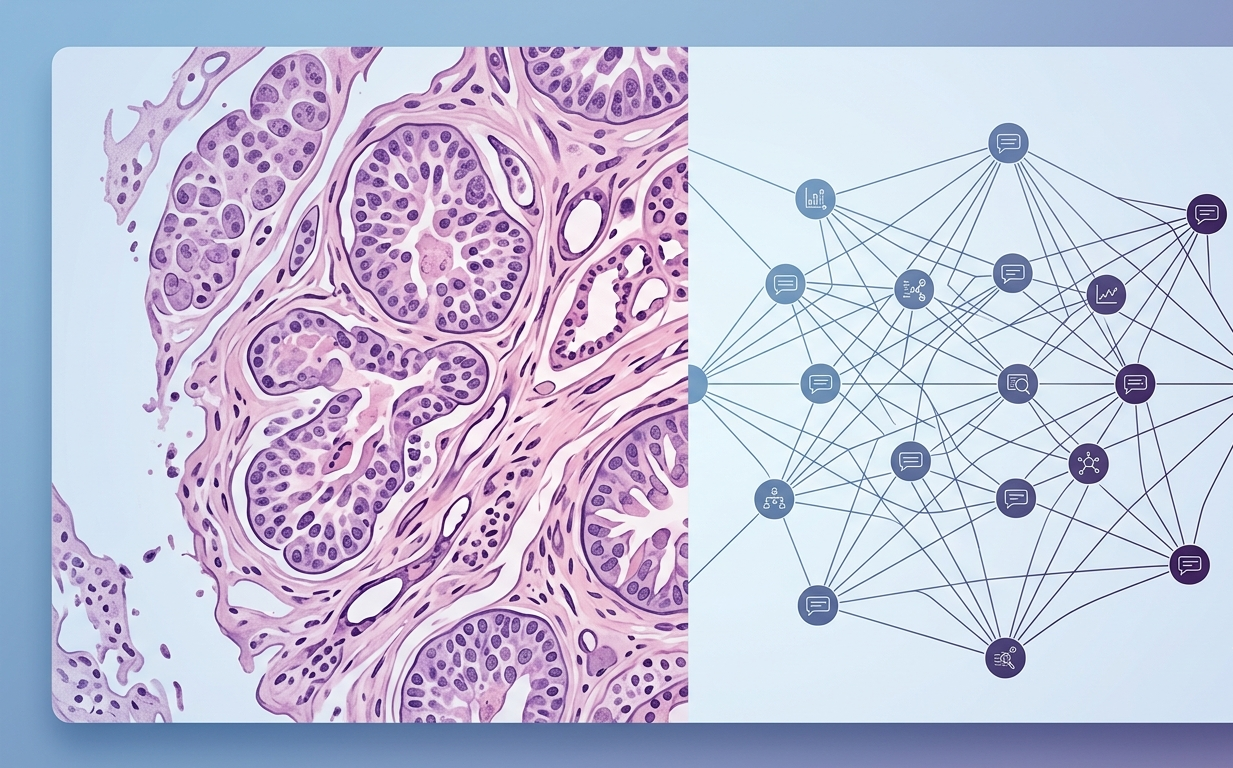
PRISM2 is a multimodal, slide-level foundation model for computational pathology. In plain terms, it’s an AI system trained to look at an entire pathology slide — not just small image tiles — and generate or interpret language about what it sees, similar to how a pathologist would describe findings in a report.
It was trained on one of the largest datasets assembled for this purpose: roughly 2.3 million whole-slide images paired with about 700,000 diagnostic specimen reports, plus 14 million question-and-answer pairs derived from that clinical text.
Importantly, PRISM2 is not a commercial diagnostic product. Its developers have released the full model weights publicly on Hugging Face specifically to support non-commercial and non-clinical research and open science. That distinction matters throughout the rest of this explanation.
How Does It Work?
PRISM2’s defining feature is how it learns. Rather than training purely on labeled images, it uses what researchers call “clinical dialogue supervision” — a method that teaches the model to align visual features with the actual language pathologists use in diagnostic reports.
Where the dialogue data came from
Paige and its research partners started with 685,507 real pathology reports collected by MSKCC during routine patient care. Because manually converting hundreds of thousands of reports into structured training dialogue isn’t practical, the team used GPT-4o to automatically generate question-and-answer pairs from each report.
Two-stage training process
PRISM2’s training happens in two distinct phases:
| Stage | What happens | Purpose |
|---|---|---|
| Stage 1 | A slide encoder learns to summarize a whole slide into one representation, aligned with report language | Teaches the model to connect visual patterns with diagnostic terminology |
| Stage 2 | The language model component is “unfrozen” and fine-tuned on dialogue | Enables the model to answer diagnostic questions and generate clinically meaningful text |
The underlying architecture
According to technical reporting on the model, PRISM2 uses a perceiver-based slide encoder that aggregates thousands of smaller image-tile embeddings (generated by a separate model called Virchow2) into one slide-level representation. Two training objectives run simultaneously on that encoder:
- A contrastive objective, powered by a text model called BioGPT, which pulls matching image-and-report pairs closer together and pushes mismatched pairs apart.
- An autoregressive (text-generating) objective, powered by a smaller language model called Phi-3 Mini, which forces the visual representation to support direct text generation rather than similarity scoring alone.
The reasoning behind combining both objectives is straightforward: contrastive training alone tends to produce representations that are good at retrieval but weak at generating language, while generative training alone can overfit to surface-level text patterns. Running both against the same encoder output is intended to balance those weaknesses.
PRISM2 also produces more than one type of output representation. A “base” embedding comes directly from the slide encoder and appears best suited for biomarker-related tasks. A separate “diagnostic” embedding is drawn from deeper inside the language model and appears to perform better on cancer detection and subtyping. A third, specially fine-tuned embedding is used for survival prediction tasks.
Healthcare Problem It Solves
Pathologists already carry significant diagnostic workloads, and earlier AI pathology models have had a structural limitation: they were typically trained to classify small image patches, not to reason across an entire slide the way a human specialist does. Many also weren’t trained on large-scale, real-world diagnostic report data, which limited how well their outputs matched clinical language and reasoning.
PRISM2’s clinical-dialogue approach is aimed squarely at that gap. By training on real diagnostic report language rather than isolated image labels, the model is designed to produce outputs that better reflect how pathologists actually communicate findings — in principle, making AI-generated analysis easier for clinicians and researchers to interpret and act on.
It’s worth being precise here: this addresses a research and workflow-support problem, not a replacement for pathologist judgment. Nothing in the published evidence suggests PRISM2 is intended to operate independently of clinical oversight.
Clinical Evidence
The strongest evidence behind PRISM2 comes from its peer-reviewed publication in Nature Medicine (August 2026). According to the study, PRISM2 matched or outperformed other existing slide-level foundation models across a range of diagnostic, biomarker, and patient-outcome prediction tasks.
One highlighted result involved colorectal cancer recurrence-free survival prediction, where a fine-tuned version of PRISM2 reportedly outperformed a specialist model built specifically for that task.
The research team also conducted an independent quality check on the synthetic training data itself — a necessary step, given that GPT-4o generated the underlying dialogue. A pathologist reviewed 50 held-out specimens across 10 tissue types and found:
- Around 3% error rates in the ground-truth training questions themselves (open-ended and multiple-choice formats combined)
- An 8% error rate in AI-generated diagnostic summaries
- Roughly 18% of yes/no training questions were irrelevant or inaccurate
When evaluating PRISM2’s own outputs against that same review, error rates ranged between 7% and 11%, with hallucination and omission — rather than direct factual contradiction — identified as the main failure types.
These figures are useful context: they suggest a genuinely capable research model, but not an error-free one.
Benefits
Based on currently available evidence, PRISM2’s demonstrated strengths include:
- Strong benchmark performance. It matched or exceeded comparison foundation models across multiple diagnostic and prognostic tasks in peer-reviewed testing.
- Reduced need for task-specific engineering. The model can be prompted directly for many diagnostic questions without additional fine-tuning, according to its developers.
- Scale of training data. It draws on one of the largest histopathology datasets assembled for this kind of model, which may support broader generalization compared to smaller, narrower training sets.
- Open research access. Publishing the model weights allows outside researchers to test, validate, and build on the work — an important factor for scientific transparency in a field where proprietary “black box” models are common.
Challenges
Equally important are the limitations that researchers and independent reporting have identified:
- No regulatory clearance. PRISM2 has not received FDA clearance and is explicitly released for non-clinical, research use only. It is not an approved diagnostic tool.
- Single-institution training data. All slides used in training and evaluation were scanned by one institution (MSKCC). The paper’s own authors call for external validation before any deployment beyond that scanning pipeline.
- No spatial awareness across tiles. The model has no built-in mechanism for reasoning about how structures are positioned relative to one another on a slide — a meaningful constraint for certain diagnostic tasks.
- Fixed image resolution. Every slide in training and testing was scanned at a single resolution (0.5 microns per pixel), so performance at other magnifications remains unproven.
- Measurable error rates. As detailed above, hallucination and omission errors occurred in a notable share of the model’s outputs during expert review.
- Infrastructure dependency. While the model weights are public, the full training and inference pipeline still relies on proprietary Paige and Microsoft infrastructure, limiting how completely outside teams can reproduce the work.
Future of AI Healthcare
Paige and Tempus executives have framed PRISM2 as a step toward broader, more clinically grounded AI tools in oncology — describing it as a way to unlock research applications capable of predicting patient outcomes and biomarker status without requiring specialized fine-tuning for every task. That framing reflects company expectations, not an established outcome, and should be read as such.
More broadly, PRISM2 fits into an industry-wide shift: foundation models across medical imaging are increasingly being trained on language-rich clinical data rather than image labels alone. Whether that translates into regulatory-cleared clinical tools will depend on the kind of external, multi-institution validation the researchers themselves say is still needed.
Key Takeaways
- PRISM2 is a research-stage AI foundation model for pathology, built by Paige in collaboration with Microsoft, and acquired into Tempus AI’s oncology AI portfolio in 2025.
- It’s trained using “clinical dialogue” — GPT-4o-generated question-and-answer pairs based on nearly 700,000 real MSKCC pathology reports — layered on top of 2.3 million whole-slide images.
- Results were peer-reviewed and published in Nature Medicine in August 2026, showing performance that matched or exceeded comparable foundation models on several tasks.
- The model is not FDA cleared and is explicitly restricted to non-clinical, research use.
- Known limitations include single-institution training data, no spatial reasoning across slide tiles, fixed-resolution training, and measurable hallucination/omission error rates.
Conclusion
PRISM2 represents a genuinely novel training approach for pathology AI — one that leans on the language of real diagnostic reasoning rather than image classification alone. The peer-reviewed evidence behind it is a meaningful step for the field, and the decision to release model weights publicly supports scientific scrutiny that’s often missing in AI healthcare research.
At the same time, PRISM2 is not a clinical product, has not been reviewed by regulators, and carries clearly documented limitations that its own researchers flag as unresolved. For healthcare professionals and technology readers tracking this space, the most accurate description is a promising research milestone — not a finished diagnostic tool, and not a replacement for pathologist expertise.
References
- Vorontsov, E. et al. “PRISM2: Unlocking Multi-Modal General Pathology AI with Clinical Dialogue.” arXiv:2506.13063.
- Tempus AI, Inc. “Tempus Study Published in Nature Medicine Demonstrates Best-in-Class Performance of PRISM2 Across Diagnostic and Prognostic Applications.” Press release, August 4, 2026.
- Tempus AI, Inc. “Tempus Announces the Acquisition of Paige.” Press release, August 22, 2025.
- Daws, R. “PRISM2 model uses clinical dialogue to interpret pathology slides.” AI News, August 5, 2026.
- Taylor, N.P. “Tempus inks $81M Paige buyout to support AI model development.” MedTech Dive, August 26, 2025.
- Tempus AI, Inc. “Tempus Announces the Launch of Paige Predict.” Press release.
“Editorial note: This article reflects publicly available information as of August 2026. Regulatory status, clinical trial results, and product availability for these tests may change. Readers should consult a licensed healthcare provider before making decisions about screening.“