

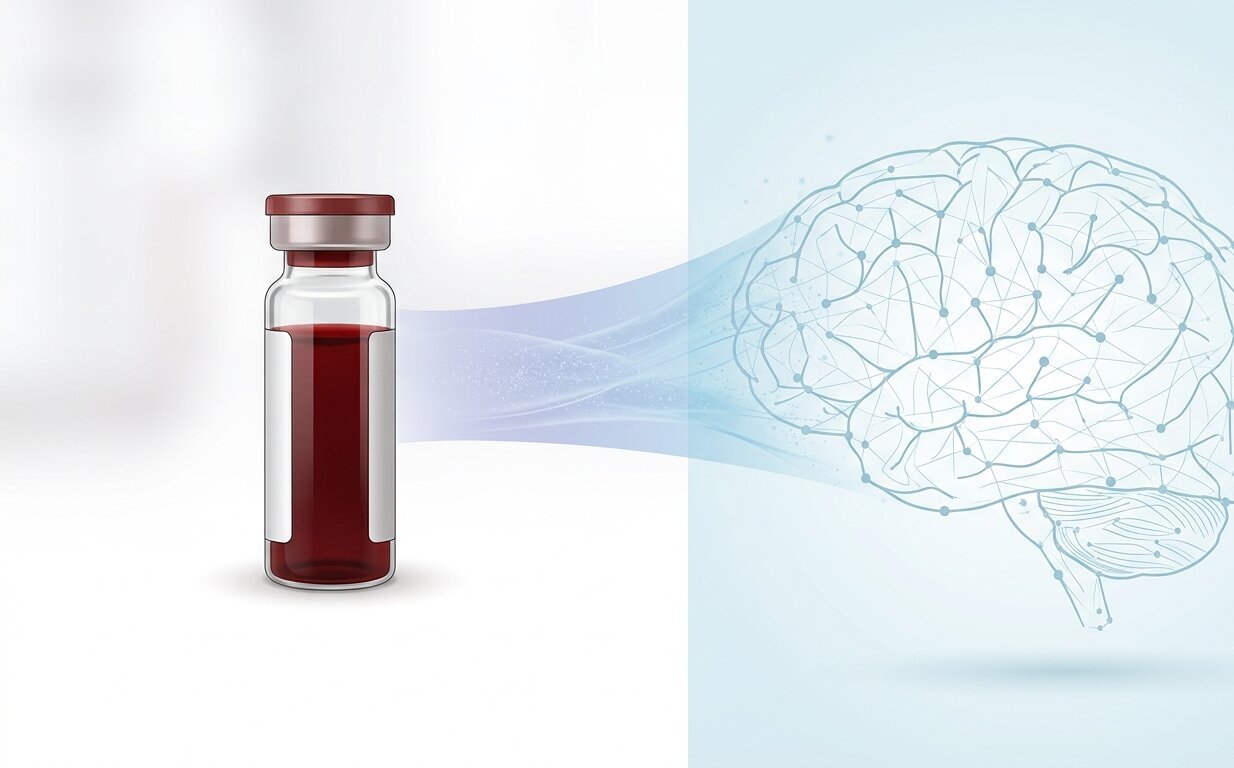
For decades, diagnosing Alzheimer’s disease meant one of two uncomfortable options: a PET brain scan that could cost thousands of dollars, or a spinal tap to draw cerebrospinal fluid. Neither was something a primary care doctor could order on a routine visit. Neither was quick. And for the roughly 7 million Americans living with Alzheimer’s — a number expected to nearly double by 2050 — that gap between symptoms and diagnosis has often meant years of uncertainty.
That started to change in May 2025, when the FDA cleared the first blood test to aid in diagnosing Alzheimer’s disease. Around the same time, researchers at Washington University School of Medicine were finishing work on something adjacent but different: an AI tool that can look at blood proteins and distinguish between several types of dementia at once, not just flag Alzheimer’s.
Together, these two developments point toward a future where diagnosing neurodegenerative disease looks a lot more like an ordinary blood panel. But they are two separate technologies, at two very different stages of readiness, and it’s worth being precise about what each one actually does — and doesn’t do — today.
Table of Contents
What Is This Technology?
The first piece is a real, commercially available product: the Lumipulse G pTau217/β-Amyloid 1-42 Plasma Ratio, made by Fujirebio Diagnostics. Fujirebio is a Tokyo-headquartered diagnostics company with a U.S. operations hub in Malvern, Pennsylvania, where it has had a presence since 1998. The Malvern team, which employs 351 people, led much of the clinical development and FDA submission work for this test.
The FDA granted the test 510(k) clearance on May 16, 2025, making it the first blood-based in vitro diagnostic test cleared to help identify amyloid pathology — the brain plaques associated with Alzheimer’s — in patients being evaluated for the disease. It had previously received the FDA’s Breakthrough Device designation in 2022, a status meant to speed review of technologies that could meaningfully improve diagnosis of serious conditions.
The second piece is still a research project, not a product. Scientists at WashU Medicine, led by Dr. Carlos Cruchaga, built an AI classifier — described in a paper published in Alzheimer’s & Dementia in April 2026 — that analyzes 15 blood proteins to distinguish among four major neurodegenerative diseases: Alzheimer’s, Parkinson’s, frontotemporal dementia, and dementia with Lewy bodies. It can also flag when a patient shows signs of more than one disease process at once, something standard clinical evaluation often misses.
It’s important to keep these straight: Lumipulse is FDA-cleared and available through labs like Quest Diagnostics. The WashU AI classifier is not FDA-approved, not commercially available, and — according to its own developers — not yet ready for clinical use.
How Does It Work?
Both technologies rely on a similar biological premise: certain proteins leak into the bloodstream in patterns that reflect what’s happening in the brain, even though the brain is walled off by the blood-brain barrier.
Lumipulse measures two specific proteins in blood plasma:
- pTau217 — a modified form of tau protein linked to Alzheimer’s-related brain changes
- β-amyloid 1-42 — a protein fragment that clumps together to form amyloid plaques
The test calculates a ratio between the two. That ratio is compared against pre-established cutoffs to estimate whether amyloid plaques are likely present in the brain. It runs on Fujirebio’s Lumipulse G1200 platform, a fully automated system already installed in many U.S. clinical labs, using chemiluminescent enzyme immunoassay technology — a standard, well-established lab method, not anything exotic.
The WashU AI classifier works differently. Instead of a single ratio between two proteins, it feeds a panel of 15 blood proteins — including established Alzheimer’s markers alongside proteins tied to synapse damage, nerve injury, and inflammation — into a machine learning model. The model was trained on blood data from more than 3,200 people with confirmed diagnoses of Alzheimer’s, Parkinson’s, frontotemporal dementia, dementia with Lewy bodies, or no cognitive impairment. Its outputs were then checked against 225 cases where researchers had both clinical records and autopsy results — the closest thing to ground truth available in this field.
In plain terms: Lumipulse answers a narrower, binary-leaning question (“is amyloid likely present?”). The AI classifier attempts a broader, more nuanced one (“which disease, or combination of diseases, is most likely driving this person’s symptoms?”).
Healthcare Problem It Solves
Alzheimer’s and related dementias share a frustrating diagnostic reality: symptoms often look alike across different underlying diseases, but treatment decisions depend on getting the underlying cause right.
Three specific problems these technologies target:
- Access and cost. PET scans and spinal taps require specialized equipment, trained specialists, and often out-of-pocket costs that put them out of reach for many patients, especially outside major medical centers.
- Delayed diagnosis. Because current methods are invasive or expensive, many patients aren’t diagnosed until the disease has progressed — often past the point where newer disease-modifying drugs are most effective.
- Diagnostic overlap. Alzheimer’s, Parkinson’s, and other neurodegenerative diseases frequently coexist or mimic one another. A patient labeled with a single diagnosis may actually have mixed underlying pathology, which can affect how they respond to treatment.
A simple blood draw addresses the first two problems directly. The AI classifier, if it eventually reaches clinical use, is aimed more squarely at the third.
Clinical Evidence
The evidence base for these two technologies is not equivalent, and treating them as such would be misleading. Here’s what’s actually been published:
| Technology | Study | Key Result |
|---|---|---|
| Lumipulse (FDA clearance study) | 499 plasma samples from cognitively impaired adults, compared to PET/CSF results | 91.7% concordance for positive results; 97.3% concordance for negative results |
| Lumipulse (independent Swedish cohort) | 1,213 patients from primary and specialty dementia care, 2020–2024 | AUC of 0.96 (primary care) and 0.97 (specialty care) for predicting clinical Alzheimer’s diagnosis |
| WashU AI classifier | 3,200+ individuals for training; 225 autopsy-confirmed cases for validation | 92.3% overall diagnostic accuracy; correctly flagged mixed pathology cases |
A few things stand out. The Lumipulse concordance data comes from a clearance-grade study directly reviewed by the FDA, plus an independent academic validation — a solid, if still evolving, evidence base for a diagnostic aid. The AI classifier’s autopsy validation is scientifically rigorous and arguably a gold-standard comparison, but it remains a single research study that its own authors say needs replication in larger, more diverse populations before it could support clinical decisions.
Benefits
Lumipulse:
- Requires only a standard blood draw, with results typically available in two to five days
- Substantially less invasive and less costly than PET imaging or lumbar puncture
- Already being rolled out through major lab networks, including Quest Diagnostics, expanding access beyond specialized memory clinics
AI dementia classifier (potential, pending further validation):
- Could help distinguish between diseases that often look clinically similar
- Designed to detect co-occurring pathology, which single-marker tests aren’t built to catch
- Researchers suggest it could eventually help match patients to the right specialists or clinical trials faster
Challenges
Neither technology is a silver bullet, and researchers and regulators involved have been fairly candid about the limits.
For Lumipulse:
- The FDA label explicitly states it is not intended as a stand-alone or screening test — it’s meant to be used alongside clinical evaluation and other diagnostic information
- It’s approved only for symptomatic patients aged 55 and older, not for testing healthy or asymptomatic people
- False positives or false negatives remain possible, which carries real consequences: unnecessary anxiety, inappropriate treatment decisions, or missed diagnoses
- Some neurologists have raised concerns about testing people without symptoms, noting there’s currently no specific treatment for asymptomatic individuals and a real risk of psychological harm from a positive result
For the AI classifier:
- It is explicitly not ready for clinical use, according to its own lead researcher
- It has not been reviewed by the FDA or any regulatory body
- It needs validation in larger, more demographically diverse populations
- Prospective studies — tracking patients forward in time rather than reviewing past cases — are still needed to see how well it predicts real-world disease progression
Future of AI Healthcare
The broader trend both technologies point to is a shift toward diagnostics that are cheaper, faster, and less invasive — replacing or supplementing tools that once required a hospital visit and a specialist. Blood-based biomarkers are becoming a serious diagnostic category in neurology, not just an experimental idea.
Where AI enters the picture is in handling complexity that simple ratios can’t capture. A two-protein ratio like Lumipulse’s is straightforward and interpretable, which is part of why it cleared FDA review relatively quickly. A 15-protein machine learning model, like WashU’s classifier, can theoretically extract more nuanced patterns — but that added complexity also means more validation work before it can be trusted in clinical decision-making.
It’s worth being direct about what these tools are not. They are not replacements for physicians, and none of the researchers or companies involved have claimed otherwise. Lumipulse is explicitly framed as an aid to clinical assessment. The AI classifier’s own developers describe it as a potential support tool for identifying which specialists a patient should see or which treatments might be worth exploring — decisions that remain squarely in the hands of clinicians.
If the AI classifier or tools like it eventually clear regulatory review, the more realistic near-term impact is on research: helping identify the right patients for clinical trials, or enabling large population studies that would be impractical using PET scans or spinal taps for thousands of participants.
Key Takeaways
- The FDA cleared Fujirebio’s Lumipulse blood test in May 2025 — the first blood-based test to aid Alzheimer’s diagnosis, measuring pTau217 and β-amyloid 1-42 in plasma.
- Clinical studies show 91.7%–97.3% concordance with PET/CSF results, and an independent Swedish study found AUCs of 0.96–0.97 for predicting clinical diagnosis.
- Lumipulse is approved only for symptomatic adults 55 and older and is explicitly not a stand-alone or screening test.
- A separate AI-based classifier from WashU Medicine can distinguish among four neurodegenerative diseases and detect mixed pathology with over 90% accuracy in a research setting — but it is not FDA-approved and its developers say it is not yet ready for clinical use.
- Both technologies reflect a broader shift toward accessible, blood-based diagnostics in neurology, but neither replaces clinical judgment or existing diagnostic tools.
Conclusion
The FDA’s clearance of Lumipulse marks a genuine, measurable step forward — patients showing signs of cognitive decline now have a less invasive path toward a diagnosis than they did a year ago. The WashU AI classifier represents something earlier-stage but conceptually important: a glimpse of how machine learning might eventually help untangle the messy overlap between different forms of dementia, something no single biomarker test currently does well.
The honest takeaway is that this field is moving in stages. One tool is already in doctors’ hands. The other is still being tested against autopsy records in a research lab. Readers — especially clinicians and patients — are best served by understanding exactly which stage each technology is at, rather than treating “blood test” and “AI” as interchangeable shorthand for a single breakthrough.
References
- U.S. Food and Drug Administration. “FDA Clears First Blood Test Used in Diagnosing Alzheimer’s Disease.” May 16, 2025. fda.gov
- Fujirebio. “Fujirebio Receives Marketing Clearance for Lumipulse G pTau 217/β-Amyloid 1-42 Plasma Ratio.” May 16, 2025. fujirebio.com
- Quest Diagnostics. “Quest Diagnostics to Offer FDA-Cleared Fujirebio Blood Test for Alzheimer’s Disease.” July 9, 2025. questdiagnostics.com
- MedTech Dive. “FDA clears first blood test to aid Alzheimer’s diagnosis.” May 2025. medtechdive.com
- AJMC. “FDA Clears First Blood Test for Early Detection of Alzheimer-Linked Amyloid Plaques.” ajmc.com
- Pharmacy Times. “FDA Grants Market Clearance to Diagnostic Blood Test for Alzheimer Disease.” pharmacytimes.com
- The Philadelphia Inquirer. “Fujirebio Diagnostics’ Malvern site played key role in new Alzheimer’s blood test.” May 27, 2025. inquirer.com
- WashU Medicine (The Source). “Blood test powered by AI could transform diagnosis of dementia.” May 21, 2026. source.washu.edu
- Xu Y, et al. “GPND-AI NULISA: A 15-protein AI classifier for diagnosis and co-pathology profiling across neurodegenerative diseases.” Alzheimer’s & Dementia, April 28, 2026. DOI: 10.1002/alz.71420
- PubMed. “The pTau217/Aβ1-42 plasma ratio: The first FDA-cleared blood biomarker test for diagnosis of Alzheimer’s disease.” Drug Discoveries & Therapeutics, July 2025.
“Editorial note: This article reflects publicly available information as of August 2026. Regulatory status, clinical trial results, and product availability for these tests may change. Readers should consult a licensed healthcare provider before making decisions about screening.“