

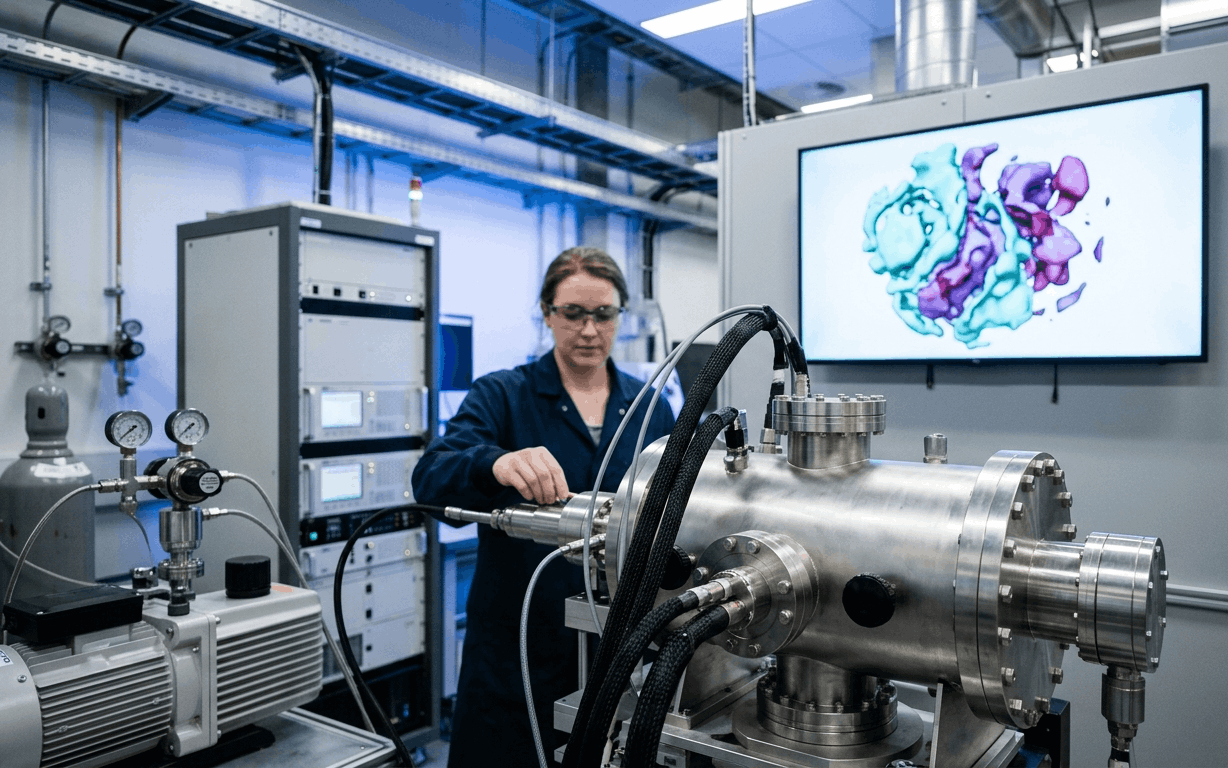
Inside a Department of Energy laboratory, a scientist watches a live X-ray experiment on a grapevine stem. In the past, understanding what that scan revealed which cells were carrying water, which had dried out under drought stress would have taken a specialist roughly a month of manual annotation. According to Meta, that same analysis now takes about 15 minutes.
The claim comes from a July 21, 2026 Meta AI blog post describing how the company’s open-weight computer vision models, Segment Anything Model 3 (SAM 3) and DINOv3, have been fine-tuned and deployed inside SYNAPS-I, a scientific imaging initiative led by Lawrence Berkeley National Laboratory as part of the U.S. Department of Energy’s Genesis Mission. It’s a notable data point for Meta’s open-source AI strategy: a named, functioning use case inside secure federal research infrastructure, rather than a hypothetical enterprise pilot.
The underlying DOE program is real and independently confirmed. The specific technical details which models, how many GPUs, how fine-tuning was done currently rest on Meta’s own account. Here’s what the evidence shows, and where the gaps are.
Table of Contents
What Meta Announced
Meta’s blog post describes SYNAPS-I’s segmentation pipeline as built around two of its open-weight vision models. DINOv3, a self-supervised model, identifies what structures appear in a scientific image and roughly where they’re located. SAM 3 then draws precise, pixel-level boundaries around each of those structures the kind of careful outlining a scientist would otherwise do by hand.
According to Meta, the SYNAPS-I team fine-tuned both models on scientific imaging data collected at DOE beamlines, then deployed them across 300 A100 GPUs at national supercomputing facilities such as NERSC (the National Energy Research Scientific Computing Center). The company says the result is a fully reconstructed, labeled 3D volume delivered back to the scientist at the instrument in about 15 minutes while the experiment is still running.
These are Meta’s own figures. No DOE agency, national laboratory, or independent technical publication has separately confirmed the GPU count, the fine-tuning approach, or the exact turnaround time.
What SYNAPS-I Actually Is
SYNAPS-I SYnergistic Neutron and Photon Science, roughly rendered is a real project, independently confirmed by Berkeley Lab and Argonne National Laboratory’s own publications. It’s a multi-laboratory effort led by Berkeley Lab’s Advanced Light Source (ALS), in partnership with Argonne, Brookhaven, Oak Ridge, and SLAC National Laboratories. Alexander Hexemer, a senior scientist at the ALS, is named as the project’s lead point of contact across multiple sources.
The goal, as described by Berkeley Lab, is to unify data analysis across DOE’s X-ray and neutron user facilities eventually spanning seven DOE Basic Energy Sciences facilities turning a process that traditionally takes months into something closer to real time. The scale of the underlying problem is substantial: DOE’s light and neutron source facilities generate tens of petabytes of data annually, and newer detectors can capture up to 100,000 images per second, compared with roughly one image every six seconds a decade ago.
What’s worth noting is that Berkeley Lab’s and Argonne’s own descriptions of SYNAPS-I are written in general terms they refer to “foundation models” or “large machine learning models” without naming Meta, SAM 3, or DINOv3 specifically. That doesn’t contradict Meta’s account, but it means the model-level specifics haven’t yet appeared in an official DOE or Berkeley Lab statement.
There’s also a small but real discrepancy in how the project’s name is written. Meta’s blog spells it out as “SYnergistic Neutron And Photon Science – Intelligence.” Berkeley Lab’s own Elements newsletter describes it as “Synergistic Neutron and Photon Autonomous Science – Imaging.” The underlying project is clearly the same one, but the two institutions haven’t converged on identical language for it.
How SAM 3 and DINOv3 Work Together
The technical logic Meta describes is straightforward. DINOv3 handles context: it looks at an image and works out what kind of structures are present and roughly where, without needing humans to have labeled similar images beforehand. SAM 3 handles precision: once it knows what it’s looking for, it traces the exact pixel boundaries of each structure.
Applied to scientific imaging, this two-step process converts a raw, grayscale X-ray or micro-CT scan what Meta calls “a wall of grayscale pixels” into a labeled map of meaningful structures: cell walls, mineral grains, semiconductor layers, depending on the experiment. That labeled output is what lets researchers quantify and compare structures across many experiments instead of examining each scan by eye.
Meta frames the pairing as complementary rather than redundant: SAM 3 supplies the fine boundaries, DINOv3 supplies the broader understanding of what’s being segmented and why.
The Demonstration: Drought Resilience in Grapevines
The clearest evidence of the pipeline actually working comes from a single demonstrated case study. Using micro-CT scans collected at the Advanced Light Source, the SYNAPS-I pipeline reconstructed 3D volumes of grapevine stems and identified xylem vessels the microscopic channels that carry water through the plant. By tracking how those vessels changed as drought conditions progressed, researchers gained a dataset that could inform work on more drought-resilient crops.
This is a real, specific result not a speculative capability. But it’s also, based on available evidence, one workflow rather than a fully scaled, facility-wide deployment. Berkeley Lab’s stated goal of extending SYNAPS-I across seven DOE user facilities is a longer-term ambition, not a confirmed current state.
Why Open-Weight Models, Specifically
Meta’s post offers a specific rationale for why open-weight models matter here: national laboratories keep prepublication research data and AI systems on government-controlled infrastructure rather than external cloud services. Because SAM 3 and DINOv3 are released with downloadable weights, the SYNAPS-I team can fine-tune and run them entirely within secure, lab-owned computing environments something not possible with a model only accessible through an external hosted API.
That’s a coherent explanation, and it’s echoed by outside tech commentary. But it’s worth being precise about its source: it is Meta’s framing of why its models were suited to this deployment, not a DOE policy document laying out formal rules on which AI systems may or may not touch prepublication data.
What’s Independently Confirmed vs. What Isn’t
| Confirmed independently | Meta-sourced only (not yet independently verified) |
|---|---|
| The Genesis Mission was launched by executive order in November 2025 | SAM 3 and DINOv3 as the specific models used |
| SYNAPS-I exists, led by Berkeley Lab, with Argonne, Brookhaven, Oak Ridge, and SLAC as partners | The 300 A100 GPU deployment figure |
| The project’s long-term goal of covering seven DOE Basic Energy Sciences facilities | The “60 researchers across five national labs” figure |
| DOE selected 278 Genesis Mission projects and secured $800 million-plus in partner commitments (July 2026) | Fine-tuning methodology and any accuracy/performance metrics |
| DOE separately launched a Genesis Open Models Initiative with Arcee AI (August 2026) | The specific ~15-minute turnaround figure, beyond the single demonstrated grapevine case |
The distinction matters for readers trying to gauge how much of this story is established fact versus a company’s account of its own product’s role. The DOE program is not in question. The precise technical specifics of Meta’s contribution to it currently are, pending independent confirmation.
The Broader Genesis Mission Context
SYNAPS-I sits inside a much larger effort. The Genesis Mission is a national initiative, launched by executive order in November 2025 and led by DOE, aimed at using AI to double the productivity of American scientific research over the next decade. In July 2026, DOE announced 278 selected projects and more than $800 million in partner commitments from its Genesis Mission Consortium, which includes all 17 DOE national laboratories.
Separately, in August 2026, DOE launched its own Genesis Open Models Initiative, working with the AI company Arcee to build a DOE-branded family of open-weight scientific models, starting with one called Genesis-Science-1. That effort is distinct from SYNAPS-I’s use of Meta’s models a different program, with a different vendor, building different models for different purposes. The two shouldn’t be conflated: SYNAPS-I is one project using Meta’s existing open-weight vision models for imaging, while the Genesis Open Models Initiative is DOE’s own effort to develop new open-weight foundation models generally.
Limitations and Open Questions
Several material questions remain open. Meta has not published fine-tuning parameters, training dataset sizes, or quantitative accuracy metrics figures like segmentation precision or recall that would let outside researchers assess how well the fine-tuned models actually perform against scientific ground truth. The one-month-to-15-minutes figure describes workflow speed, not measured segmentation accuracy.
It’s also unclear whether the fine-tuned checkpoints created for SYNAPS-I will eventually be shared publicly, extending the benefit beyond the DOE labs that produced them, or whether they’ll remain internal to the project. And because the current public record consists of Meta’s blog post plus press coverage that largely restates it, some basic questions how the fine-tuning was validated, who owns the resulting models, why SAM 3 and DINOv3 were chosen over other open-weight vision options don’t yet have public answers.
Conclusion
What can be said with confidence: the Genesis Mission and SYNAPS-I are real, actively funded DOE programs, independently confirmed by Berkeley Lab and Argonne’s own publications, tackling a genuine and well-documented data bottleneck at national scientific facilities. What rests on Meta’s account, for now, is the specific claim that its SAM 3 and DINOv3 models are the engine behind that pipeline, running at the scale and speed described.
That’s not a reason for skepticism about the story it’s a reason for precision about what’s been shown versus what’s been reported. If SYNAPS-I does scale toward its stated goal of covering seven DOE facilities, and if DOE or Berkeley Lab publish their own technical account of the models involved, this deployment could become one of the more concrete examples of open-weight AI serving as working infrastructure for U.S. science. For now, it’s a promising, well-documented pilot result attributed to the company that built the models being used.
FAQ
What is SYNAPS-I? SYNAPS-I is a multi-laboratory Department of Energy initiative, led by Lawrence Berkeley National Laboratory’s Advanced Light Source, aimed at automating and speeding up the analysis of imaging data from X-ray and neutron science facilities. It’s one of the early projects under DOE’s broader Genesis Mission.
What role do SAM 3 and DINOv3 play in the SYNAPS-I pipeline? According to Meta, DINOv3 identifies and contextualizes structures within a scientific image, while SAM 3 draws precise pixel-level boundaries around them. Together, Meta says, they form a segmentation pipeline that converts raw scans into labeled 3D volumes.
Has the Department of Energy officially confirmed it uses Meta’s SAM 3 and DINOv3? Not in the materials reviewed. Berkeley Lab’s and Argonne’s own publications confirm SYNAPS-I’s existence and describe its use of “foundation models” generally, but they don’t name Meta, SAM 3, or DINOv3 specifically. That detail currently comes from Meta’s own blog post.
Why does SYNAPS-I use open-weight models instead of cloud-based AI services? Meta says national laboratories keep prepublication research data and AI systems on government-controlled infrastructure rather than external cloud services, and that open-weight models can be downloaded, fine-tuned, and run entirely within those secure environments.
What has SYNAPS-I demonstrated so far? A specific, documented case: using micro-CT scans from Berkeley Lab’s Advanced Light Source to analyze drought stress in grapevines by identifying water-carrying xylem vessels, with Meta reporting a reduction in analysis time from about a month to roughly 15 minutes.
Is SYNAPS-I part of a larger DOE AI effort? Yes. It’s one project within the Genesis Mission, a national DOE-led initiative launched in November 2025. DOE has also launched a separate effort, the Genesis Open Models Initiative with Arcee AI, to build its own family of open-weight scientific models a distinct program from SYNAPS-I’s use of Meta’s models.
What don’t we know yet about this deployment? Publicly available sources do not include fine-tuning parameters, training dataset details, or quantitative accuracy metrics for the SYNAPS-I models. The 300-GPU figure and the 60-researcher figure also currently trace only to Meta’s account, without independent confirmation from DOE or Berkeley Lab.