


Key Takeaways
- Meta AI Muse Spark 1.1 is Meta’s new agentic AI model — it plans multi-step tasks, uses tools, and takes action instead of just answering questions.
- It now powers the free Meta AI app (rolled out July 24, 2026) and a brand-new paid Meta Model API (opened July 9, 2026) — Meta’s first-ever paid model access.
- API pricing is $1.25 per million input tokens and $4.25 per million output tokens — roughly a quarter of comparable flagship pricing from Anthropic and OpenAI.
- It supports a 1-million-token context window, parallel subagents, and native computer use across desktop, mobile, and browser.
- It’s strongest at tool use and agent orchestration; independent testing suggests it still trails top rivals on the hardest, longest-horizon coding tasks.
Table of Contents
Meta AI just stopped being a chatbot.
With the rollout of Meta AI Muse Spark 1.1, the model now powering both the free Meta AI app and Meta’s brand-new developer API, Meta is pitching a genuine shift in what its assistant is for. Meta AI no longer just answers questions. It plans your week. It books itself into your calendar. It drafts your slides. And it quietly checks things off your to-do list while you do something else.
It’s also Meta’s first real attempt to charge for access to one of its own models — a sharp break from years of free, open-weight Llama releases. Here’s everything confirmed so far about what Meta AI Muse Spark 1.1 is, what it can actually do, what it costs, and how it stacks up against the model it replaces and the rivals it’s chasing.

What Is Meta AI Muse Spark 1.1?
Meta AI Muse Spark 1.1 is a multimodal reasoning model from Meta Superintelligence Labs, the AI division Mark Zuckerberg rebuilt from the ground up after publishing his “personal superintelligence” vision in mid-2025. Meta describes it as a significant upgrade to the original Muse Spark model and says it’s built specifically for agentic tasks — meaning it doesn’t just generate a response, it plans a sequence of steps, uses tools, and follows through until the job is done.
The model launched on July 9, 2026, and Zuckerberg marked the moment by posting on X for the first time in more than three years, calling it “a strong agentic and coding model at a very low price.” Alexandr Wang, who leads Meta Superintelligence Labs, told CNBC the model represents the company’s “strongest model for agentic and coding work yet.
A Quick Recap: What Came Before
The original Muse Spark debuted in April 2026 as the first product out of Meta Superintelligence Labs, but it never really left the lab. It was limited to select partners through a private API preview, and its consumer-facing strengths leaned toward everyday personal tasks — visual understanding, shopping, health, and social content. Meta AI Muse Spark 1.1 is the version Meta actually intends people and developers to use at scale.
Key Capabilities of Meta AI Muse Spark 1.1
Agentic Task Execution
The headline feature is autonomy. Meta AI Muse Spark 1.1 can act as either a main agent — planning and delegating work — or as a subagent carrying out a piece of a larger task. Meta says the model generalizes to new tools, MCP servers, and custom skills without needing task-specific retraining, which is what allows it to plug into different apps and workflows without a bespoke integration for each one.
A 1 Million Token Context Window
Muse Spark 1.1 ships with a context window of roughly 1,048,576 tokens — a full million tokens of working memory. Meta says the model actively manages and compacts earlier parts of a conversation or task to preserve room for the steps still ahead, which matters for long-running jobs that unfold over many actions rather than a single exchange.
Parallel Sub-Agents
According to Zuckerberg’s own description of the release, Muse Spark 1.1 “can delegate execution to sub-agents running in parallel.” In practice, that means one Meta AI Muse Spark 1.1 instance can break a large task into pieces and hand those pieces off to other agent instances working simultaneously, rather than working through everything in a single sequential thread.
Computer Use Across Desktop, Mobile, and Browser
Meta AI Muse Spark 1.1 is trained to operate computer interfaces directly — clicking, navigating, and filling in fields across desktop, mobile, and browser environments. This “computer-use” mode is designed to let the model complete a task by actually driving software the way a person would, rather than only calling a predefined API.
Multimodal Understanding
Muse Spark 1.1 accepts text, images, video, audio, and PDF documents as input, and it includes built-in web search with citations. That combination lets it ground its answers in current information rather than relying solely on what it learned in training.
How Muse Spark 1.1 Powers the New Meta AI App
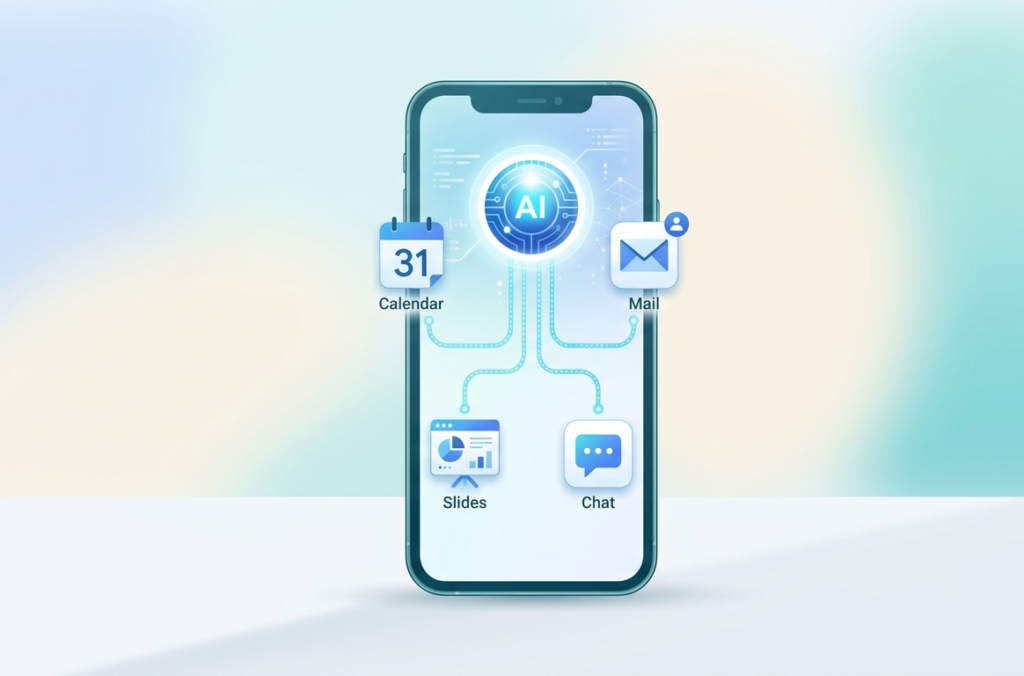
On July 24, 2026, Meta extended Muse Spark 1.1 from developers to everyday consumers, rolling it into an updated version of the Meta AI app and meta.ai. In Meta’s words, Meta AI “doesn’t just think, it acts.”
Planning and Following Through
The consumer version of Meta AI can now make plans and carry a task from start to finish rather than stopping after a single reply. Meta highlights use cases like research deep dives and mood boards for a DIY project as examples of multi-step work the assistant can now handle on its own.
Email and Calendar Integration
Meta AI can connect to email and calendar apps, letting it check availability, place items on a schedule, or act on information found in a user’s inbox as part of completing a broader task.
Creating Slides and Content
The assistant can also generate slides directly, turning a request into a finished draft rather than a set of instructions the user has to execute themselves.
Daily Briefings and Smart Notifications
Meta AI now supports a notification capability, proactively informing users about events of interest and generating recurring alerts — a daily weather update, for instance — without being asked each time.
Rollout Details
At launch, the upgraded Meta AI is available in a limited number of markets through the web and mobile app. Meta says the model will reach the version of Meta AI embedded in WhatsApp within a few weeks of the initial release. SiliconANGLE reported the consumer rollout arrived alongside two unrelated Facebook updates — Facebook Verified and a Marketplace tool called Seller — the same week, underscoring how much Meta shipped in a single cycle.

Meta AI Muse Spark 1.1 for Developers: The Meta Model API
Alongside the consumer rollout, Meta opened the Meta Model API in public preview — the first time the company has charged developers to access one of its own models, breaking from the free, open-weight approach that defined the Llama era.
Access and Pricing
The API is priced at $1.25 per million input tokens and $4.25 per million output tokens, with cached input available at a steep discount of roughly $0.15 per million tokens. New developer accounts receive $20 in free credits to start testing. Meta’s built-in web-search grounding tool is billed separately. At launch, the public preview is limited to developers in the United States, with new signups joining a waitlist.
One detail worth knowing before building a cost estimate: Muse Spark 1.1’s “Thinking” mode bills its internal reasoning tokens at the same rate as regular output, so reasoning-heavy calls cost more than a simple, short-answer request would suggest.
OpenAI-Compatible Design
Meta built the Meta Model API to be OpenAI-compatible, meaning teams that already have code written for OpenAI-shaped clients can point that same code at Meta’s endpoint with minimal changes — a deliberate move to lower the switching cost for developers already working with a competing provider.
Early Access Feedback
Meta says early partners have described Muse Spark 1.1 as a complete agentic foundation, praising the combination of a large context window, full multimodal support, built-in search, structured output, and parallel tool calling in a single package.
Muse Spark vs. Muse Spark 1.1: What Actually Changed
| Feature | Muse Spark (April 2026) | Muse Spark 1.1 (July 2026) |
|---|---|---|
| Availability | Private API preview, select partners only | Public API preview (US) + consumer Meta AI app |
| Primary strength | Everyday personal tasks: visual understanding, shopping, health | Agentic execution, coding, tool and computer use |
| Context window | Not publicly detailed | ~1,048,576 tokens (1M) |
| Multi-agent support | Not available | Main-agent and subagent orchestration, parallel execution |
| Computer use | Not available | Desktop, mobile, and browser interface control |
| Developer pricing | Not offered publicly | $1.25 / $4.25 per million input/output tokens |
| Consumer rollout | Powered the prior Meta AI app | Powers current Meta AI app and meta.ai |
Meta AI Consumer App vs. Meta Model API: Who Gets What
| Capability | Meta AI App (Consumers) | Meta Model API (Developers) |
|---|---|---|
| Cost | Free | Pay-per-token, $20 free credits on signup |
| Task planning & follow-through | Yes | Yes, configurable by the developer |
| Email/calendar integration | Built-in | Must be integrated via tool calls |
| Slide/content creation | Built-in | Must be built into the application |
| Computer-use mode | Limited to in-app actions | Full desktop/mobile/browser control |
| Access region | Limited markets at launch, expanding | US only, public preview |
| Notifications/briefings | Built-in | Not applicable — developer-built |
Meta AI Muse Spark 1.1 Pricing vs. GPT, Claude, and Gemini
Meta has repeatedly framed Muse Spark 1.1’s price as roughly a quarter of what comparable frontier models charge. Here’s how the reported per-million-token rates actually line up, based on Meta’s official pricing and rates reported in independent industry coverage as of publication:
| Model | Input (per 1M tokens) | Output (per 1M tokens) | Context Window | Source |
|---|---|---|---|---|
| Meta AI Muse Spark 1.1 | $1.25 | $4.25 | ~1,048,576 tokens | Meta Model API, official |
| Claude Sonnet 5 (Anthropic) | ~$2.00 | ~$10.00 | Varies by plan | Industry-reported pricing |
| Claude Opus 4.8 (Anthropic) | ~$5.00 | ~$25.00 | Varies by plan | Industry-reported pricing |
| GPT-5.5 / GPT-5.6 (OpenAI) | ~$5.00 | ~$30.00 | Varies by plan | Industry-reported pricing |
Note: Only Meta’s Muse Spark 1.1 pricing above comes from an official company source. Anthropic and OpenAI figures reflect rates reported by independent AI industry outlets tracking API pricing as of July 2026 and are included for directional comparison only — always confirm current rates directly with each provider before budgeting, as frontier AI pricing changes frequently.
On input tokens, Meta’s rate lands close to a literal quarter of the higher-end competing rates cited above. On output tokens — typically the larger cost driver in agentic workloads that generate a lot of text, code, or tool calls — Meta’s discount is even steeper by these reported figures. That said, price is only half the equation; see the trade-off discussed below.
How Meta AI Muse Spark 1.1 Fits the Competitive Landscape
Meta has been explicit that Meta AI Muse Spark 1.1 is aimed at the same territory currently held by Anthropic’s Claude models and OpenAI’s GPT line, particularly in agentic coding and tool use. Meta’s own pricing framing describes the API as roughly a quarter of what rival frontier models charge on input tokens, positioning cost — not raw benchmark supremacy — as its main competitive lever. Independent evaluations circulating since launch, including coverage from TechTimes, suggest Meta AI Muse Spark 1.1 performs strongly on tool-use and agent-orchestration benchmarks specifically, scoring roughly 10 points below Meta’s own reported figures on independent Terminal-Bench-style coding evaluations. In plain terms: it’s a genuine value option for orchestration-heavy workloads, and a riskier bet for the hardest, longest-horizon autonomous coding jobs. Readers evaluating the model for production use should weigh their own workload against that trade-off — workloads dominated by tool use and orchestration are where Meta AI Muse Spark 1.1’s pricing advantage matters most.
Who Should Actually Use Muse Spark 1.1?
Good fit for:
- Developers building tool-calling or agent-orchestration workflows where the per-token bill scales fast
- Teams already writing OpenAI-compatible code who want a cheaper drop-in option to test
- Everyday Meta AI users who want an assistant that plans and executes tasks, not just answers questions
- Anyone testing agentic AI on a budget, thanks to the $20 in free API credits
Less ideal for:
- Teams running sustained, long-horizon autonomous coding where a wrong step is costly — independent evaluations suggest Meta AI Muse Spark 1.1 still trails Claude Opus 4.8 and GPT-5.5 here
- Developers outside the United States, since the API public preview is US-only at launch
- Anyone who needs an open-weight model to self-host or fine-tune — Muse Spark 1.1 is closed-weight and API-only, unlike Llama
Why This Launch Matters
Three things make Meta AI Muse Spark 1.1 more than a routine model update:
- It’s Meta’s first paid model. After years of free, open-weight Llama releases, Meta is now asking developers to pay per token — a meaningful strategic pivot for the company’s AI business model.
- It reframes Meta AI’s core purpose. Rather than a Q&A chatbot, Meta AI is now presented as an assistant that takes action across email, calendars, and content creation.
- It signals where Meta wants to compete. By targeting agentic coding and tool use directly, Meta is placing itself in the same conversation as Anthropic and OpenAI rather than only competing on open-weight model downloads.
Bottom Line
Meta AI Muse Spark 1.1 is the clearest signal yet that Meta wants its assistant judged on what it does, not just what it says — and that it’s willing to charge developers for the privilege of building on that capability for the first time. Whether it earns a place in your workflow comes down to one question: is your workload dominated by tool use and orchestration (where Muse Spark 1.1’s price-to-capability ratio looks excellent), or by sustained, high-stakes autonomous coding (where more established rivals still hold an edge)? The FAQ below covers the specifics most readers ask next.
Frequently Asked Questions
1. What is Meta AI Muse Spark 1.1? Muse Spark 1.1 is Meta’s new multimodal reasoning model, built for agentic tasks like planning, tool use, computer use, and coding. It now powers the Meta AI app, meta.ai, and Meta’s new developer API.
2. When was Meta AI Muse Spark 1.1 released? Muse Spark 1.1 was announced on July 9, 2026, and rolled out to consumers in the Meta AI app on July 24, 2026.
3. Is Meta AI Muse Spark 1.1 free to use? It’s free inside the Meta AI app for consumers. Developers accessing it through the Meta Model API pay per token, though new accounts get $20 in free credits.
4. How much does the Meta Model API cost? It’s priced at $1.25 per million input tokens and $4.25 per million output tokens, with cached input priced lower at around $0.15 per million tokens.
5. What is an “agentic” AI model? An agentic model plans multi-step tasks and carries them out — using tools, calling other software, or completing actions — rather than only generating a single text response.
6. What is Meta Superintelligence Labs? It’s the AI research division Meta rebuilt following Zuckerberg’s 2025 “personal superintelligence” vision. Muse Spark 1.1 is its second major model release, after the original Muse Spark in April 2026.
7. What was Muse Spark’s original version? The original Muse Spark launched in April 2026 but stayed limited to a private API preview for select partners, focused on personal tasks like shopping, health, and visual understanding.
8. What’s the context window of Muse Spark 1.1? Roughly 1,048,576 tokens — a full one million tokens of context.
9. Can Muse Spark 1.1 use a computer like a human? Yes. Meta says the model is trained to operate computer interfaces — desktop, mobile, and browser — directly, allowing it to complete tasks by interacting with real software.
10. Does Meta AI Muse Spark 1.1 support multiple AI agents working together? Yes. It can act as a main agent that delegates work to subagents running in parallel, splitting larger tasks into simultaneous pieces.
11. Can Meta AI connect to my email and calendar? Yes, the updated Meta AI app can connect to email and calendar apps to help plan tasks and manage schedules on your behalf.
12. Can Meta AI create slides? Yes. The app can generate slide drafts directly as part of completing a task.
13. Does Meta AI send notifications now? Yes, Meta AI can proactively notify users about events of interest and set up recurring alerts, such as daily weather updates.
14. Is Meta AI Muse Spark 1.1 available worldwide? The consumer rollout started in a limited number of markets, with WhatsApp integration expected within a few weeks. The developer API public preview is currently US-only.
15. Is Meta AI Muse Spark 1.1 open-source? No. Unlike Meta’s Llama models, Muse Spark 1.1 is a closed-weight, hosted model available only through Meta’s own API and apps.
16. How does Meta AI Muse Spark 1.1 compare to GPT and Claude models on price? Meta has framed its API pricing as roughly a quarter of the input-token cost charged by comparable frontier models from Anthropic and OpenAI.
17. Is Meta AI Muse Spark 1.1 better than Claude or GPT at coding? Meta reports strong results on tool-use and agent-orchestration benchmarks, though independent evaluations suggest it can trail top competing models on the most demanding, longest-horizon coding tasks.
18. What is Muse Image, and is it related to Meta AI Muse Spark 1.1? Muse Image is Meta’s new AI image-generation model, launched the same week as Muse Spark 1.1. Meta has framed both as part of the same broader push toward more capable, action-taking AI systems.
19. Who leads Meta Superintelligence Labs? Alexandr Wang leads Meta Superintelligence Labs, the division responsible for the Muse model family, including Muse Spark 1.1.
20. Does the Meta Model API work like OpenAI’s API? Yes. Meta built the Meta Model API to be OpenAI-compatible, so developers with existing OpenAI-style code can adapt it to Muse Spark 1.1 with minimal changes.
21. What file types can Muse Spark 1.1 understand? It accepts text, images, video, audio, and PDF documents as input.
22. Does Muse Spark 1.1 include web search? Yes, it has built-in web search with citations, allowing it to ground responses in current information.
23. How do I sign up for the Meta Model API? Developers in the US can join the public preview waitlist through Meta’s developer portal, where new accounts receive $20 in free credits.
24. What does “Thinking mode” mean for Muse Spark 1.1 pricing? Thinking mode bills the model’s internal reasoning tokens at the standard output rate, so reasoning-heavy requests can cost more than a short, direct answer would.
Sources & Methodology
This article was fact-checked primarily against Meta’s own official statements, then cross-referenced against independent reporting for corroboration and pricing context. Every claim not directly attributed to Meta is noted as independently reported in the text above.
Official Meta sources:
- Meta AI Blog — Introducing Muse Spark 1.1 and the Meta Model API
- Meta Newsroom — Meta AI Doesn’t Just Think, It Acts
Independent reporting consulted:
- TechCrunch — “Meta enters the crowded AI coding battle with Muse Spark 1.1”
- CNBC — “Meta jumps into AI coding market to chase Anthropic and OpenAI”
- SiliconANGLE — “Meta makes Muse Spark 1.1 available to consumers, debuts new Facebook features”
- TechTimes — “Meta’s Muse Spark 1.1 Opens Paid API at One-Quarter of Anthropic, OpenAI Rates”
Editorial policy: Next AI Press corrects factual errors promptly when identified. If you spot outdated pricing or a factual issue in this piece, the “Last Updated” date at the top reflects our most recent verification pass.