

Table of Contents
Introduction
NVIDIA AI in 2026 : Artificial intelligence infrastructure has reached a critical inflection point in 2026. The global technology landscape has shifted from training static, multi-billion-parameter foundation models toward executing complex, multi-step autonomous workflows. These systems—widely categorized as agentic AI—demand computational paradigms capable of handling real-time reasoning, expansive context windows, and continuous environment interactions without incurring unsustainable energy or economic costs.
At the center of this transition stands NVIDIA. By executing an aggressive annual architecture cadence, the company has transformed data center design from isolated accelerator components into fully integrated, rack-scale AI factories. NVIDIA’s latest developments in 2026 demonstrate how hardware co-design, silicon specialization, and advanced interconnect topologies are redefining the economics and speed of global intelligence deployment.
What Happened?
Following the widespread deployment of its Blackwell and Blackwell Ultra architectures, NVIDIA introduced its flagship platform for 2026: the Vera Rubin architecture. Unveiled across major industry keynotes and technical papers, Vera Rubin represents a unified supercomputing environment comprising six custom-built chips designed to operate as a singular, cohesive processing unit.
The core platform centers around two foundational computing engines: the NVIDIA Rubin GPU and the custom NVIDIA Vera CPU. Unlike previous generations where CPUs served strictly as auxiliary hosts for orchestration, the Vera CPU introduces custom “Olympus” cores engineered explicitly to manage branch-heavy agent logic, tool routing, and control-flow pipelines.
At the system level, NVIDIA unveiled the Vera Rubin NVL72, a liquid-cooled rack solution combining 72 Rubin GPUs and 36 Vera CPUs over a high-speed sixth-generation NVLink switch fabric. Complementing the processing units are the ConnectX-9 SuperNIC, BlueField-4 Data Processing Unit (DPU), Spectrum-6 Ethernet Switch, and co-designed Groq 3 Language Processing Unit (LPU) integrations. Together, these components address long-standing networking and memory access bottlenecks in hyper-scale environments.
Why It Matters
The arrival of the Vera Rubin platform reflects a broader economic requirement across hyperscalers, research institutes, and enterprise deployments: inference token economics must decline drastically for autonomous AI to become financially viable at mass scale.
In prior years, scaling large language models required exponential increases in cluster size, leading to severe power grid constraints and elevated capital expenditures. The 2026 paradigm focuses on efficiency per token generated, specifically during test-time reasoning and dynamic context processing.
Strategic Implications
- Token Cost Reduction: Vera Rubin delivers up to a 10x reduction in inference token generation costs compared to the Blackwell platform.
- Resource Conservation: Training massive Mixture-of-Experts (MoE) models now requires up to 4x fewer GPUs, preserving capital and energy footprint.
- Agentic Scalability: By co-designing the Vera CPU alongside the Rubin GPU, latency-sensitive agent steps—such as multi-tool execution and code compilation—no longer stall GPU execution pipelines.
Technical Details
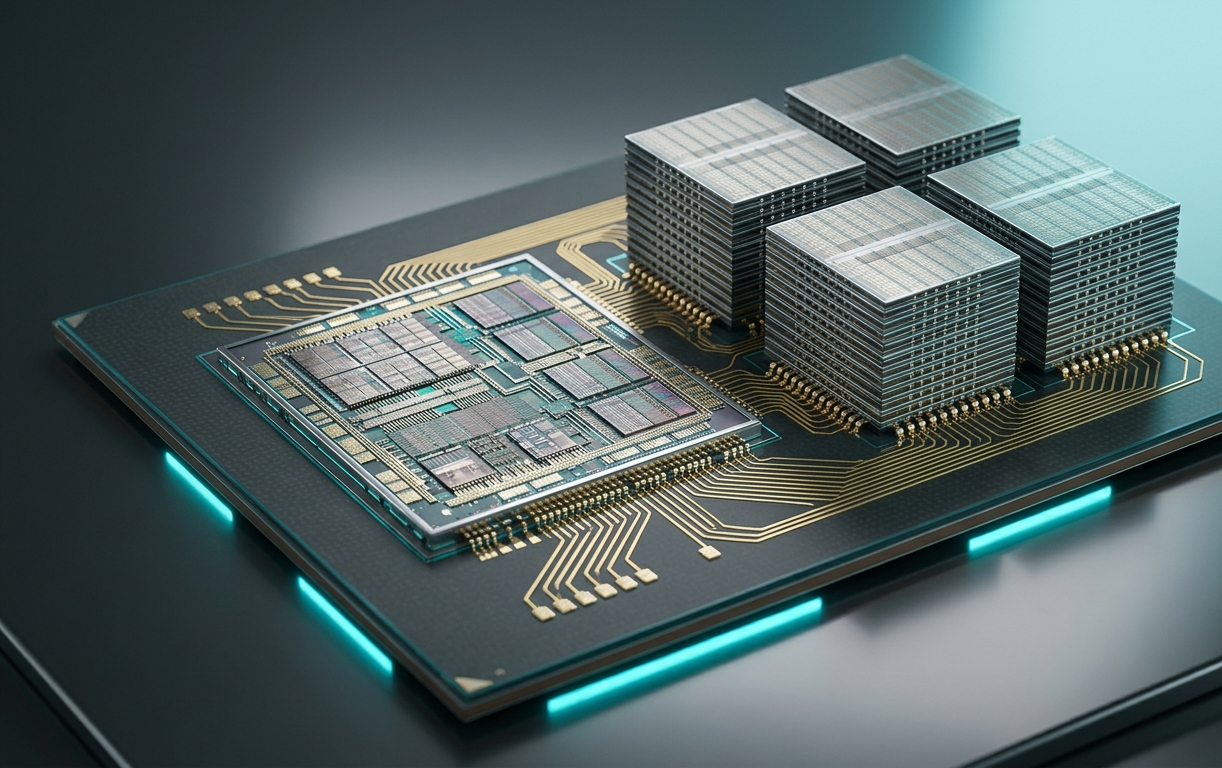
The internal architecture of the NVIDIA Rubin GPU contains 336 billion transistors fabricated on an advanced 3-nanometer process. Containing 224 Streaming Multiprocessors (SMs) and 896 expanded Tensor Cores, the chip integrates 288GB of High Bandwidth Memory (HBM4) across 12-Hi memory stacks. This configuration yields up to 22 TB/s of aggregate memory bandwidth per GPU.
Computational and Interconnect Specs
- Sparse Inference Throughput: Delivers up to 50 PFLOPS of NVFP4 precision inference compute.
- Coherent Interconnect: NVLink-C2C provides 1.8 TB/s of bidirectional, coherent bandwidth between the Vera CPU and Rubin GPU.
- Scale-Up Network: NVLink 6 delivers 3,600 GB/s of all-to-all interconnect bandwidth across GPUs within the rack.
- System-Level Memory: The NVL72 rack configuration provides 20.7 TB of aggregate HBM4 memory and 1.6 PB/s of aggregate memory bandwidth.
Key Features
Custom “Olympus” Core CPU Architecture
The standalone NVIDIA Vera CPU departs from off-the-shelf ARM implementations. Built on the new “Olympus” core design, the CPU prioritizes maximum single-thread performance, deep memory-level parallelism, and branch prediction. This ensures complex software logic in AI agents runs without hitting single-core execution walls.
Enhanced Tensor Memory Accelerator (TMA)
In Mixture-of-Experts (MoE) model architectures, dynamic routing of tokens to specialized sub-networks creates massive data-movement overhead. Rubin’s enhanced TMA allows GPU kernels to update unified MoE descriptors directly at runtime within TMA instructions, bypassing unnecessary CPU-side calculation loops.
Third-Generation Transformer Engine
The updated Transformer Engine dynamically adapts numerical precision during model execution. By utilizing sub-byte floating-point formats, including NVFP4, it preserves mathematical accuracy while significantly boosting matrix multiplication throughput along the inner dimensions.
DOCA Memos and Key-Value Cache Acceleration
Integrated with BlueField-4 DPUs, the platform introduces hardware-offloaded Key-Value (KV) cache management. This feature allows long-context inference requests—spanning up to millions of tokens—to offload context memory storage directly to high-speed NVMe and DPU fabrics, freeing up precious HBM4 capacity on the primary GPUs.

Benefits
The integration of the Vera Rubin architecture across data centers offers operational gains over previous-generation systems.
Comparative Platform Metrics
| Feature / Metric | NVIDIA Blackwell NVL72 | NVIDIA Vera Rubin NVL72 | Generational Gain |
| GPU Architecture | Blackwell (B200/B300) | Rubin | Next-Gen Architecture |
| Host Processor | Grace CPU / x86 | Vera CPU (“Olympus”) | Custom Agent-Focused CPU |
| Memory Technology | HBM3e (up to 8 TB/s) | HBM4 (up to 22 TB/s) | ~2.75x Bandwidth Increase |
| FP4 Compute per GPU | 20 PFLOPS (Dense) | 50 PFLOPS (Sparse NVFP4) | 2.5x Compute Uplift |
| Inference Token Cost | Baseline | 10x Lower | 90% Cost Reduction |
| MoE Training Efficiency | Baseline | 4x Fewer GPUs Needed | 75% GPU Footprint Savings |
| Interconnect Speed | NVLink 5 (1.8 TB/s) | NVLink 6 (3.6 TB/s) | 2x Fabric Bandwidth |
Key Advantages Summarized
- Lower Total Cost of Ownership (TCO): Higher throughput per watt allows hyperscalers to operate significantly larger token volumes within existing facility power envelopes.
- Shorter Time-to-Solution: High-precision FP64 capabilities combined with exaflop-scale AI performance accelerate scientific modeling and industrial digital twin simulations.
- Simplified Infrastructure: Direct liquid cooling and cable-free rack designs reduce failure points and simplify maintenance in multi-megawatt facilities.
Limitations
Despite its architectural leaps, the Vera Rubin platform introduces logistical, electrical, and adoption challenges.
Structural and Infrastructure Constraints
- Thermal and Power Density: A single Vera Rubin NVL72 rack requires substantial power delivery, often exceeding 120 kilowatts per rack. Facilities designed for air cooling or traditional legacy densities cannot support these systems without complete infrastructure overhauls.
- Supply Chain Pressures: Reliance on cutting-edge HBM4 memory stacks and advanced 3D packaging techniques creates potential yield bottlenecks, leading to extended lead times for non-tier-1 buyers.
- Capital Intensity: The upfront cost of rack-scale systems remains prohibitively expensive for smaller enterprises, forcing greater dependency on public cloud providers and specialized GPU clouds.
- Software Porting Curves: Maximizing performance on the new Vera CPU and custom NVFP4 precision formats requires developers to refactor pipelines around NVIDIA’s updated CUDA-X and DOCA toolkits.
Expert Analysis
Industry leaders and artificial intelligence researchers have highlighted the platform’s focus on system-level integration rather than raw chip clock speeds.
Jensen Huang, Founder and CEO of NVIDIA, underscored the necessity of this hardware progression during the platform’s launch:
“Rubin arrives at exactly the right moment, as AI computing demand for both training and inference is going through the roof. With our annual cadence of delivering a new generation of AI supercomputers—and extreme codesign across six new chips—Rubin takes a giant leap toward the next frontier of AI.”
Frontier model developers have similarly validated the transition toward agentic-focused compute. Sam Altman, CEO of OpenAI, noted the relationship between infrastructure scaling and model capability:
“Intelligence scales with compute. When we add more compute, models get more capable, solve harder problems and make a bigger impact for people. The NVIDIA Rubin platform helps us keep scaling this progress so advanced intelligence benefits everyone.”
Dario Amodei, Co-founder and CEO of Anthropic, pointed to structural improvements in memory handling:
“The efficiency gains in the NVIDIA Rubin platform represent the kind of infrastructure progress that enables longer memory, better reasoning and more reliable outputs. Our collaboration with NVIDIA helps power our safety research and our frontier models.”
Industry Impact
The deployment of NVIDIA’s 2026 platform reverberates across multiple sectors of the technology economy.
Hyperscalers and Cloud Infrastructure
Major cloud providers—including Microsoft Azure, Amazon Web Services (AWS), Google Cloud, and Oracle Cloud Infrastructure—alongside specialized GPU clouds like CoreWeave and Lambda, are aligning their data center construction strategies around rack-scale liquid cooling. Microsoft’s next-generation Fairwater AI superfactories, for example, are being engineered to house hundreds of thousands of Vera Rubin Superchips in unified fabrics.
Enterprise Automation
Lower token generation costs allow enterprise software companies to embed autonomous AI agents directly into corporate workflows. Tasks such as complex financial reconciliation, multi-repo software engineering, and automated customer operations are transitioning from human-in-the-loop experiments to fully automated background systems.
Scientific Computing and HPC
National laboratories and scientific research institutes are leveraging Vera Rubin for hybrid HPC-AI workloads. Systems like the “Blue Lion” supercomputer at the Leibniz Supercomputing Centre (LRZ) and new installations at Los Alamos National Laboratory combine double-precision FP64 performance with surrogate AI models to accelerate climate science, materials synthesis, and fusion energy research.
Who Should Care?
- Chief Technology Officers & CIOs: IT leaders managing digital transformation budgets must evaluate how lower token costs alter build-versus-buy decisions for internal AI applications.
- Data Center Operators & Facility Engineers: Infrastructure teams must prepare power, liquid cooling, and structural floor loads to support high-density, multi-hundred-kilowatt rack architectures.
- AI Research Engineers & Developers: Software teams building agentic harnesses must optimize code bases to leverage the Vera CPU’s single-thread performance and Rubin’s NVFP4 precision formats.
- Institutional Investors & Analysts: Market observers tracking the semiconductor supply chain must monitor HBM4 yield rates, annual architecture transitions, and hyperscaler capital expenditure trends.
Future Outlook
NVIDIA’s roadmap beyond 2026 confirms that the pace of silicon evolution shows no signs of decelerating. The company has reiterated its commitment to a strict annual platform release schedule.
Following the rollout of the standard Vera Rubin platform in the second half of 2026, NVIDIA plans to introduce the Rubin Ultra platform in H2 2027. Rubin Ultra will transition systems to the “Kyber” rack architecture, integrating up to 1TB of HBM4e memory per package and utilizing NVLink 7 interconnects to deliver 10.8 TB/s per GPU. Looking further ahead, NVIDIA’s publicly disclosed roadmap targets the “Feynman” architecture for 2028 and the “Rosa Feynman” platform for the 2029–2030 timeframe.
This predictable release cadence forces the broader technology ecosystem—from competitors and memory manufacturers to power grid operators—to continuously adapt to expanding compute densities.
Conclusion
NVIDIA’s AI strategy in 2026 reinforces its shift from a chip manufacturer to a holistic system provider. By addressing systemic bottlenecks in CPU single-thread throughput, memory bandwidth, networking efficiency, and token economics, the Vera Rubin platform provides the foundational compute required for the era of autonomous agentic AI. As global deployment expands throughout the year, the technology industry moves one step closer to making industrial-scale artificial intelligence an ubiquitous, highly accessible utility.
References
1. Official Press Releases & Newsroom Links
| Source | Description / Context | Direct URL |
| NVIDIA Newsroom | Official NVIDIA press releases, Keynote announcements, and Rubin architecture specs | https://nvidianews.nvidia.com |
| NVIDIA Technical Blog | Deep-dive technical explanations for CUDA-X, NVLink 6, and HBM4 architectures | https://developer.nvidia.com/blog |
| Microsoft News Center | Details on Microsoft Azure Fairwater supercomputers & Vera Rubin integration | https://news.microsoft.com |
| OpenAI News | Official announcements regarding frontier model infrastructure scale-up | https://openai.com/news |
| Anthropic Research | Statements on compute safety, reasoning models, and cluster deployment | https://www.anthropic.com/news |
2. Technical & Research Papers (arXiv & Academic)
If you wish to link directly to recent technical preprints and hardware benchmarks supporting rack-scale AI factories, high-density data centers, and multi-GPU networking:
- Hardware Acceleration & GPU Trends:
- Del Sozzo, E. (2026). How Much Progress Has There Been in NVIDIA Datacenter GPUs? arXiv preprint. https://arxiv.org/abs/2601.20115
- Multi-GPU Interconnect & Unified Memory Scaling:
- Liu, T. et al. (2026). CTA-Pipelining: A Latency-Oriented Spatial Scaling Method for Multi-GPU Systems. arXiv preprint. https://arxiv.org/abs/2607.07862
- High-Density Power & Liquid Cooling Infrastructure:
- Wilkins, G. et al. (2026). Designing Datacenter Power Delivery Hierarchies for the AI Era. arXiv preprint. https://arxiv.org/abs/2605.16255
3. How to Hyperlink in WordPress
You can easily insert these hyperlinks into key anchor terms inside your article draft:
- Jensen Huang quote anchor: NVIDIA Newsroom
- Vera Rubin NVL72 architecture anchor: NVIDIA Technical Blog
- Liquid cooling & power density anchor: arXiv Data Center Research