

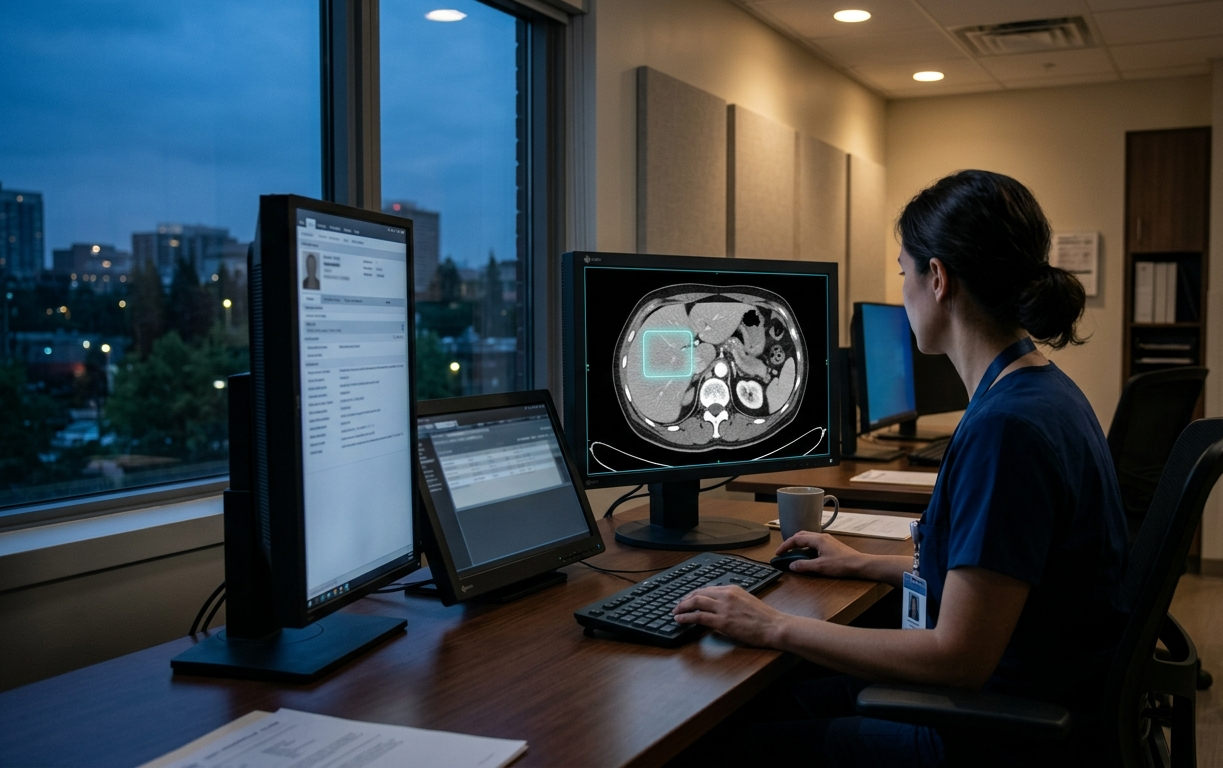
A large hospital trial has produced some of the clearest evidence yet that AI can act as a genuine safety net in cancer diagnosis — not by replacing radiologists, but by catching what they miss.
In a study published in Nature Medicine on August 19, 2026, researchers deployed an AI system called LiON (Liver DiagnOsis Network) as an additional reader alongside radiologists working through more than 10,000 real patient CT scans as part of routine hospital care. The AI flagged 51 liver lesions that had been overlooked in initial reports. Fifteen turned out to be cancer. Thirty-seven reports were amended, and 22 cases were escalated to multidisciplinary tumor boards.
Those numbers are already circulating. Less noted is that this wasn’t a retrospective exercise — it was a registered prospective trial with a pre-specified accuracy target, tested live inside a hospital’s clinical workflow.
Table of Contents
What Happened
The study was led by Shengjing Hospital of China Medical University and Zhejiang University’s affiliated hospitals, working with Alibaba’s DAMO Academy, King’s College London, and the French institute EURECOM.
LiON reads contrast-enhanced CT scans, the standard imaging method for suspected liver malignancies. Researchers trained it on 6,443 patients, validated it retrospectively across 22,251 patients from multiple hospitals, then tested it prospectively — without a separate control group for direct comparison — on 10,333 patients at a single hospital, Shengjing.
The trial’s primary endpoint was accuracy: the system needed an area under the curve (AUC) above 0.900, a standard measure of diagnostic accuracy where 1.0 is perfect. LiON achieved 0.952. The 51 overlooked lesions and 37 amended reports were secondary findings — what happened when LiON’s assessments prompted radiologists to take a second look at cases they’d already read.
Why It Matters
Liver cancer outcomes depend heavily on early detection, and missed diagnoses on CT are a recognized problem in high-volume radiology. Most published evidence for AI as a “second reader” comes from retrospective studies. This trial is more rigorous: a result defined before the data was collected, tested in real time on real patients.
It’s worth being precise about the limits, too. The study shows AI-assisted reading changed clinical decisions in documented cases. It doesn’t show patients lived longer or fared better as a result — the researchers didn’t measure survival, and they explicitly call for further comparative studies before drawing conclusions about clinical outcomes.
How LiON Works
LiON analyzes multiphase CT scans — images taken as contrast dye moves through the liver, the standard way radiologists distinguish lesion types. It requires non-contrast, arterial, and venous phase images, with an optional delayed phase. A four-part deep learning architecture extracts image features, predicts patient-level malignancy risk, and segments eight types of liver lesions; it can also incorporate blood biomarkers and medical history to refine predictions.
The full source code isn’t public — the team cites proprietary infrastructure dependencies and a pending Alibaba patent on the detection methods. A partial, non-proprietary version of the core algorithm is available on GitHub.
The Evidence
| Measure | Result |
|---|---|
| Retrospective validation AUC | 0.975 (95% CI: 0.971–0.979), n=22,251 |
| AUC in fatty liver disease | 0.971 (95% CI: 0.952–0.985) |
| AUC in cirrhosis | 0.924 (95% CI: 0.901–0.946) |
| Prospective trial primary endpoint | 0.952 (95% CI: 0.942–0.961), n=10,333 |
| Overlooked lesions found / malignant | 51 / 15 |
| Reports amended / MDT escalations | 37 / 22 |
Performance held up reasonably well in fatty liver and cirrhosis patients — both conditions that typically make CT scans harder to read — though it dipped somewhat for cirrhosis, the more difficult case. All figures come from the study’s own authors, peer-reviewed but not yet independently replicated; the paper is only days old.
Who’s Behind It, and What’s Still Unproven
This is a multi-institution academic collaboration, not a single company’s product launch, though four co-authors are Alibaba employees who hold company stock, and Alibaba has filed a patent tied to the detection methods — both disclosed in the paper. LiON extends DAMO Academy’s earlier work: its pancreatic cancer tool, PANDA, received FDA Breakthrough Device designation in 2025 and has been piloted at several Chinese hospitals; a gastric cancer tool, GRAPE, followed in 2025.
LiON itself has no regulatory clearance and isn’t commercially available — it remains a research system tested at a small number of sites. The trial also had no control arm, was conducted at a single hospital, and drew all patients from China, so how it performs elsewhere, and whether it improves outcomes, remains unknown. The authors call for broader, comparative studies before drawing firmer conclusions.
What to Watch Next
As is typical for a study published just days ago, independent commentary hasn’t yet emerged. Worth watching: expert reaction, any regulatory filings for LiON, and whether the multi-site comparative trials the researchers say are needed actually happen. For now, this is real evidence that AI changed clinical decisions in specific, documented cases — not yet evidence that it saves lives.
Frequently Asked Questions
What is LiON and what does it do? LiON (Liver DiagnOsis Network) is an AI system that analyzes contrast-enhanced CT scans to help detect and diagnose liver malignancies, developed by Chinese hospitals, Alibaba’s DAMO Academy, and European academic partners, described in a Nature Medicine study published August 2026.
Did the AI replace radiologists in the study? No. LiON worked as an additional reader alongside radiologists within their existing workflow, prompting them to review and sometimes revise their original reports.
Is LiON available for hospitals to use today? No. It’s a research system tested at a limited number of sites, with no public record of regulatory clearance or commercial availability.
How many missed liver cancers did the AI find? In the 10,333-patient prospective trial, AI-assisted reading surfaced 51 previously overlooked lesions, 15 of them malignant, leading to 37 amended reports and 22 tumor-board referrals.
Who developed LiON, and is there a conflict of interest? A consortium led by Shengjing Hospital of China Medical University, Zhejiang University-affiliated hospitals, Alibaba’s DAMO Academy, King’s College London, and EURECOM. Four co-authors are Alibaba employees/shareholders, and Alibaba has filed a related patent — both disclosed in the paper.
Has this study been independently confirmed? It was peer-reviewed by Nature Medicine, but as a study published only days ago, it hasn’t yet been independently replicated or scrutinized by outside researchers.
Does this prove AI improves liver cancer survival rates? No. The trial measured diagnostic accuracy and changes to clinical decisions, not survival or long-term outcomes. The researchers say further studies are needed to assess clinical impact.
Editorial note: This article reflects publicly available information as of August 2026. Regulatory status, clinical trial results, and product availability for these tests may change. Readers should consult a licensed healthcare provider before making decisions.