

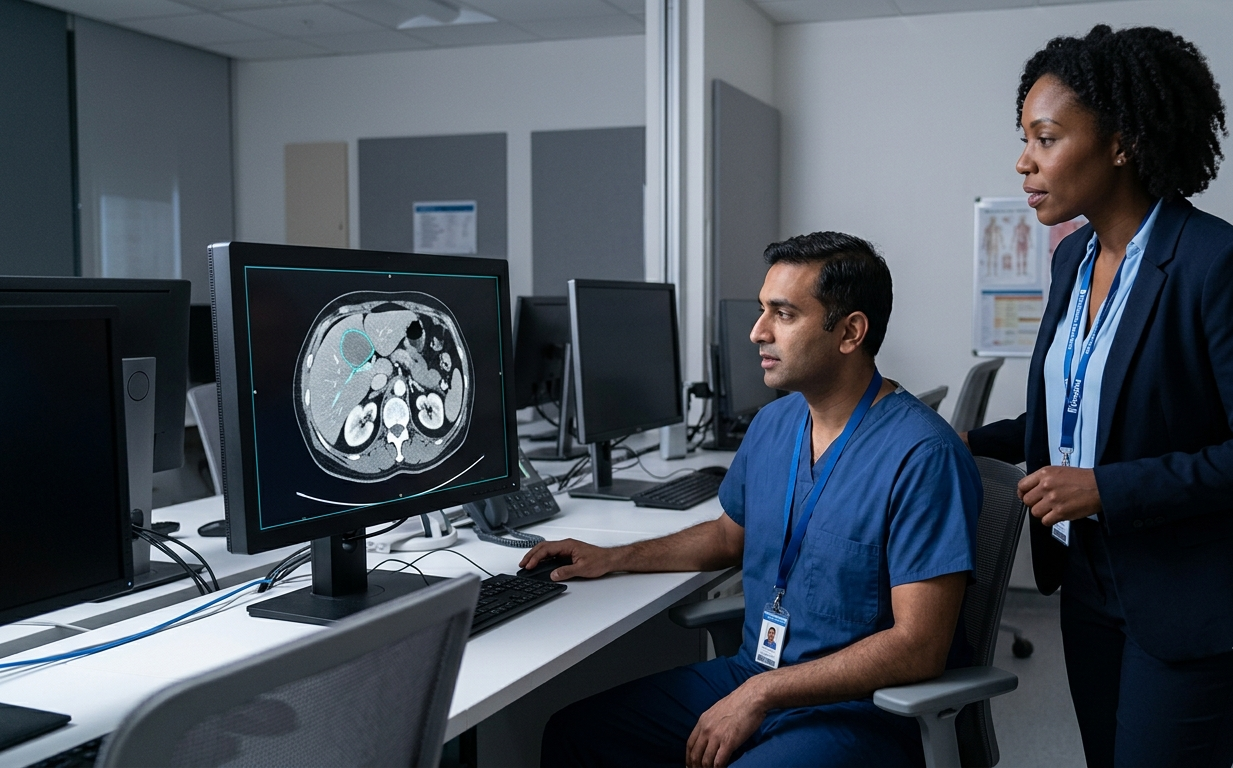
Twelve of the largest health systems in the United States have agreed to work with clinical AI company Aidoc on something the industry has largely lacked until now: a shared, multi-institution framework for evaluating and governing artificial intelligence in diagnostic medicine.
The new group, called the Diagnostic AI Consortium (DAIC), was announced on August 11, 2026. Its founding members are Advocate Health, Cedars-Sinai Health System, Hartford HealthCare, Houston Methodist, Mercy, Mount Sinai Health System, Northwell Health, Northwestern Medicine, Sutter Health, University of Florida Health, University Hospitals of Cleveland, and WellSpan Health. Aidoc, the New York-based company coordinating the effort, says the consortium is open to further growth beyond these twelve.
The announcement lands at a moment when diagnostic AI tools are proliferating across hospitals faster than the industry has been able to agree on how to test, deploy, and monitor them. DAIC is an attempt to close that gap — though it starts from an unusual position: it is built around a single vendor’s technology rather than a neutral, multi-vendor standards body.
Table of Contents
What Happened
According to Aidoc’s official announcement, the consortium’s twelve founding health systems will work together to co-design AI-enabled diagnostic workflows, measure how those workflows affect the safety, quality, and speed of diagnosis, and turn what they learn into shared implementation and governance practices that other health systems could eventually adopt.
Aidoc will supply the technical backbone for this work through two of its existing products: CARE, its clinical AI foundation model, and aiOS, the enterprise operating system that manages how AI tools are deployed, integrated into hospital workflows, and monitored after they go live.
The consortium does not yet have results to share. Aidoc says it expects to publish initial findings in 2027.
Elad Walach, Aidoc’s CEO and co-founder, framed the effort as an attempt to resolve a long-standing tension in AI development. He argued that the industry has treated speed and safety as opposing forces, and said the consortium is meant to prove that scaling AI carefully and scaling it quickly don’t have to be at odds.
Why It Matters Now
The consortium arrives against a backdrop of real strain on diagnostic capacity in American hospitals. According to research from the Harvey L. Neiman Health Policy Institute — an independent health policy research body — interpretation turnaround times for outpatient imaging more than doubled between 2014 and 2023. Over the same period, radiologists have been leaving the field at a rate 50% higher than before 2020, and Neiman researchers project that the resulting workforce shortage will persist through 2055 without deliberate intervention.
That combination — rising imaging demand and a shrinking pool of radiologists to read the scans — is the practical problem AI vendors like Aidoc have been selling into for years. What’s new here isn’t the technology itself, but the attempt to get a dozen major health systems to agree on how to evaluate it collectively, rather than each system building its own validation process from scratch.
Aidoc says the group’s work is meant to “augment and advance initiatives already underway across the industry,” explicitly naming regulators, medical societies, and health systems building their own programs as an audience for whatever DAIC produces. It’s worth noting, though, that none of those regulators or societies are described as formal participants in the consortium itself — more on that below.
Who’s Involved
The twelve founding health systems collectively describe themselves as caring for close to 20 million patients a year — a figure that comes from Aidoc’s own announcement and has not been independently audited.
A detail worth flagging for readers evaluating how independent this consortium really is: four of the twelve founding members — Hartford HealthCare, Mercy, Sutter Health, and WellSpan Health — were already financial backers of Aidoc before DAIC existed. All four participated in a $150 million funding round the company closed in July 2025. That doesn’t necessarily undermine the consortium’s work, but it does mean roughly a third of the founding members had an existing financial stake in Aidoc’s success before signing on.
| Founding Health System |
|---|
| Advocate Health |
| Cedars-Sinai Health System |
| Hartford HealthCare |
| Houston Methodist |
| Mercy |
| Mount Sinai Health System |
| Northwell Health |
| Northwestern Medicine |
| Sutter Health |
| University of Florida Health |
| University Hospitals of Cleveland |
| WellSpan Health |
The Technology Behind the Consortium
DAIC isn’t built on a new product. It runs on infrastructure Aidoc has been developing for years.
CARE, short for Clinical AI Reasoning Engine, is Aidoc’s foundation model for diagnostic imaging. In January 2026, the FDA cleared what Aidoc describes as the healthcare industry’s first comprehensive AI triage solution built on CARE, combining 11 newly cleared indications with three previously cleared ones into a single workflow covering conditions like appendicitis, bowel obstruction, and internal organ injury on abdominal CT scans. That brought CARE’s total cleared indications to 14.
aiOS is the layer that sits on top of CARE and any other AI tools a hospital runs. It handles deployment, integration with existing hospital systems, and — critically for a consortium built around governance — ongoing performance monitoring after a tool goes live. Aidoc has positioned aiOS as an open platform rather than a walled garden: as of mid-2025, the company said 69% of its customers were running AI models from other vendors on aiOS alongside Aidoc’s own tools.
That openness matters for how DAIC should be read. The consortium’s technical infrastructure is Aidoc’s, but the platform itself is designed to host non-Aidoc AI as well — a distinction between “Aidoc-run” and “Aidoc-exclusive” that’s easy to blur in coverage of the announcement.
Evidence and Performance
The clearest independently reviewable performance data available comes from CARE’s FDA clearance process, not from DAIC itself, which has not yet produced any results.
In the FDA-reviewed pivotal study supporting CARE’s January 2026 clearance, the 11 newly cleared indications achieved a mean sensitivity of 97% (reaching as high as 98.5% in some settings) and a mean specificity of 98% (up to 99.7%). That study was reviewed by the FDA as part of the clearance process, but it was designed and sponsored by Aidoc — it is not independent, third-party replication.
No performance data exists yet for the workflows DAIC members plan to co-design, since that work is only just beginning.
Business and Industry Context
DAIC’s launch follows a period of rapid growth for Aidoc. The company has raised more than $500 million in total funding, including a $150 million Series E round led by Growth Equity at Goldman Sachs Alternatives that closed in April 2026, with participation from General Catalyst, SoftBank Investment Advisors, and NVIDIA’s venture arm, NVentures. Aidoc says its technology is deployed in nearly 2,000 hospitals worldwide and analyzes roughly 60 million patient cases annually — again, company-reported figures without independent audit.
Financial analysts covering the announcement have offered their own read on the strategic logic. TipRanks, an investment research platform, characterized the consortium as a move that embeds Aidoc more deeply into its member health systems’ long-term AI strategies, shifting the company’s position from a point-solution vendor toward something closer to foundational infrastructure — a shift that could also expand Aidoc’s reach if the consortium’s playbooks get adopted by health systems beyond the founding twelve. That’s an outside analytical interpretation, not a claim Aidoc itself has made about its own motives.
No named competitor — Viz.ai, RapidAI, GE HealthCare, Philips, or Gleamer — has announced a comparable multi-hospital governance consortium of their own. RapidAI did announce an enterprise platform expansion to all 18 hospitals in the OSF HealthCare system just one day before DAIC’s launch, but that was a standard bilateral deployment deal rather than a multi-system governance initiative.
Aidoc and DAIC: Key Milestones
| Date | Milestone |
|---|---|
| 2016 | Aidoc founded |
| July 2025 | Aidoc closes $150M funding round; Hartford HealthCare, Mercy, Sutter Health, and WellSpan Health participate as investors |
| January 2026 | FDA clears CARE-powered comprehensive triage solution, bringing total cleared indications to 14 |
| April 2026 | Aidoc closes $150M Series E led by Goldman Sachs Alternatives, bringing total funding to more than $500 million |
| August 11, 2026 | Diagnostic AI Consortium formally announced with 12 founding health systems |
| 2027 | Consortium’s initial results expected |
How DAIC Compares to Other Health AI Initiatives
DAIC isn’t the first organized attempt to bring structure to health AI oversight. The Coalition for Health AI (CHAI) has been working toward similar goals for longer, with a stated mission to advance responsible AI development and oversight in healthcare by convening industry, government, academia, and patient communities. Aidoc has previously participated in CHAI’s work — the company contributed data to CHAI’s draft AI “model card” framework, a standardized documentation format akin to a nutrition label for clinical AI tools.
Editorial context — not a comparison stated by Aidoc, CHAI, or any health system involved:
| Coalition for Health AI (CHAI) | Diagnostic AI Consortium (DAIC) | |
|---|---|---|
| Structure | Multi-stakeholder coalition | Single-vendor-anchored consortium |
| Participants | Industry, government, academia, patient communities | Aidoc + 12 health systems (several also Aidoc investors) |
| Technical infrastructure | Not tied to one company’s product | Built on Aidoc’s CARE and aiOS platforms |
No source directly compares the two initiatives or claims one is meant to replace the other — the table above reflects each group’s own stated scope, offered here as context rather than as a claim made by Aidoc, CHAI, or any health system involved.
What’s Still Unknown
Several structural details about DAIC have not been made public, and readers should treat their absence as unresolved rather than assume an answer either way:
- Leadership and governance structure. No chair, steering committee, or formal decision-making body has been named for the consortium.
- Regulatory or professional society involvement. Neither the FDA, CMS, nor a medical society such as the American College of Radiology has been described as a formal participant. Aidoc’s materials mention regulators and medical societies only as external audiences the consortium hopes its findings will inform.
- Existing frameworks or white papers. No draft governance frameworks or white papers have been referenced as already completed; the announcement describes future work.
- Funding and cost-sharing. How the consortium’s work will be funded, and how costs are shared between Aidoc and its health-system partners, has not been disclosed.
- Specific success metrics. The exact measures DAIC will use to judge “safety, quality, and speed to diagnosis” have not been detailed publicly.
Limitations and Risks
The most significant structural question about DAIC is one common to vendor-led consortia generally: because the group’s shared infrastructure is a single company’s platform, any standards or governance practices that emerge may reflect what works well for that platform specifically, rather than a vendor-neutral baseline. That’s not a claim that DAIC’s work will be biased — it’s a structural feature worth keeping in mind while evaluating what the group eventually publishes.
Relatedly, nearly every quantitative claim associated with the announcement — the patient volume figure, the hospital count, the case-analysis totals — originates with Aidoc and has not been independently verified by a third party.
Aidoc itself acknowledges one real technical risk that any diagnostic AI deployment has to manage: performance can drift, and accuracy can vary across different patient populations, imaging equipment, and hospital sites. The company describes continuous monitoring for that kind of drift as part of what aiOS is designed to do — but it remains, by Aidoc’s own framing, “a discipline still rare in AI broadly.”
What Happens Next
For now, DAIC exists as a stated commitment among twelve health systems and one AI vendor rather than a body with published output. Aidoc has said the consortium expects to share initial results in 2027, and has left the door open to additional health systems joining before then.
The evidence available today supports a narrower conclusion than headlines might suggest: a well-funded, FDA-active AI company has organized a group of major hospital customers — several of them also investors — around a shared goal of building diagnostic AI governance standards. Whether that effort produces genuinely vendor-neutral practices, or ends up formalizing standards shaped heavily by one company’s platform, is a question the group’s own 2027 results, and any independent scrutiny that follows, will have to answer. Readers interested in this space should watch for whether DAIC’s membership grows beyond the founding twelve, whether a governance structure is eventually disclosed, and whether any regulator or professional medical society takes on a formal role.
Frequently Asked Questions
What is the Diagnostic AI Consortium (DAIC)? DAIC is a collaboration announced on August 11, 2026, between clinical AI company Aidoc and twelve U.S. health systems, aimed at co-designing diagnostic AI workflows and developing shared standards for evaluating and governing AI in clinical diagnostic settings.
Which health systems are part of the Diagnostic AI Consortium? The twelve founding members are Advocate Health, Cedars-Sinai Health System, Hartford HealthCare, Houston Methodist, Mercy, Mount Sinai Health System, Northwell Health, Northwestern Medicine, Sutter Health, University of Florida Health, University Hospitals of Cleveland, and WellSpan Health. Aidoc has said the consortium remains open to additional members.
What role does Aidoc play in the consortium? Aidoc provides the consortium’s technical infrastructure through its CARE foundation model and aiOS enterprise operating system, which handle AI deployment, workflow integration, and post-deployment performance monitoring across member health systems.
When will the Diagnostic AI Consortium share results? Aidoc says the consortium expects to share its initial results in 2027. No findings have been published as of this article.
How is DAIC different from the Coalition for Health AI (CHAI)? CHAI is a broader, multi-stakeholder coalition involving industry, government, academia, and patient communities, not tied to a single company’s technology. DAIC is organized around one vendor’s platform — Aidoc’s CARE and aiOS — with member health systems as Aidoc customers. No official source has directly compared the two initiatives; this distinction reflects each group’s stated scope.
Is a regulatory body or medical society like the ACR formally involved in DAIC? Not according to any information Aidoc or its consortium partners have made public. Aidoc’s announcement mentions regulators and medical societies only as external groups it hopes will benefit from the consortium’s future findings, not as formal members.
Do any DAIC member health systems have a financial relationship with Aidoc? Yes. Four founding members — Hartford HealthCare, Mercy, Sutter Health, and WellSpan Health — previously invested in Aidoc as part of a $150 million funding round the company closed in July 2025, before the consortium was formed.
References
- Aidoc. “Twelve US Health Systems and Aidoc Unite to Confront America’s Diagnostic Capacity Crisis.” PR Newswire, August 11, 2026. https://www.prnewswire.com/news-releases/twelve-us-health-systems-and-aidoc-unite-to-confront-americas-diagnostic-capacity-crisis-302848464.html
- University Hospitals. “Twelve US Health Systems and Aidoc Unite…” UH News, August 2026. https://news.uhhospitals.org/news-releases/articles/2026/08/twelve-us-health-systems-and-aidoc-unite
- Becker’s Hospital Review. “12 health systems form AI diagnostic consortium.” August 2026. https://www.beckershospitalreview.com/healthcare-information-technology/ai/12-health-systems-form-ai-diagnostic-consortium/
- Healthcare IT News. “Aidoc teams with 12 health systems to tackle issues around diagnostics.” August 2026. https://www.healthcareitnews.com/news/aidoc-teams-12-health-systems-tackle-issues-around-diagnostics
- TipRanks. “Aidoc Leads New U.S. Diagnostic AI Consortium to Tackle Capacity Crisis.” August 2026. https://www.tipranks.com/news/private-companies/aidoc-leads-new-u-s-diagnostic-ai-consortium-to-tackle-capacity-crisis
- Aidoc. “Aidoc Secures FDA Clearance for Healthcare’s First Comprehensive Foundation Model AI.” PR Newswire, January 21, 2026. https://www.prnewswire.com/news-releases/aidoc-secures-fda-clearance-for-healthcares-first-comprehensive-foundation-model-ai-302666640.html
- STAT News. “FDA clears Aidoc tool to detect multiple conditions from a single CT scan.” January 22, 2026. https://www.statnews.com/2026/01/21/fda-clears-aidoc-tool-detect-multiple-conditions-from-ct-scan/
- Aidoc. “Aidoc Raises $150 Million Series E Led by Goldman Sachs to Scale Clinical AI for Earlier, Safer Diagnoses.” PR Newswire, April 29, 2026. https://www.prnewswire.com/news-releases/aidoc-raises-150-million-series-e-led-by-goldman-sachs-to-scale-clinical-ai-for-earlier-safer-diagnoses-302757181.html
- Fierce Healthcare. “Aidoc banks $150M, backed by Goldman Sachs, to scale clinical AI foundation model.” April 2026. https://www.fiercehealthcare.com/ai-and-machine-learning/aidoc-banks-150m-backed-goldman-sachs-scale-clinical-ai-foundation-model
- Coalition for Health AI (CHAI). Organization mission and scope. https://chai.org