

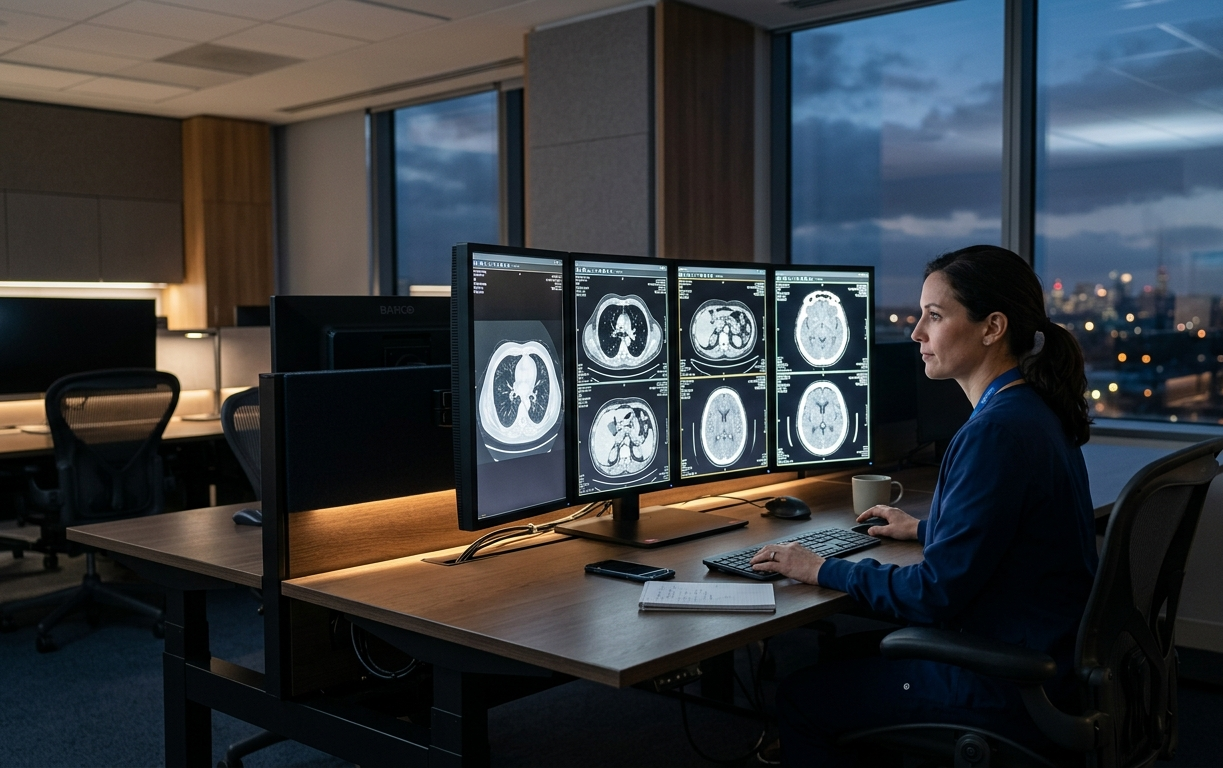
For most of the past decade, AI in radiology has been judged on a single question: can the algorithm spot what a human might miss? Increasingly, though, the more pressing question inside imaging departments is different — can the algorithm actually reach the radiologist without forcing them to open another window, log into another system, or manually copy a finding from one screen to another?
That question is at the center of a growing shift in medical imaging technology: away from AI tools that operate as isolated, standalone applications, and toward platforms that build AI directly into the systems radiologists already use every day — image viewers, reporting software, and dictation tools known collectively as PACS (Picture Archiving and Communication Systems).
The idea was laid out recently by Madhu Jahagirdar, a business and product leader for enterprise imaging at DeepHealth, in a feature published on Imaging Technology News (ITN). The piece is not a product announcement or a breaking news story — it’s an industry perspective piece, written by an executive at one of the companies building these tools. But the trend it describes is real, and it extends well beyond DeepHealth to nearly every major player in medical imaging software.
Table of Contents
The Shift From Standalone AI Tools to Integrated Workflows
Radiologists’ day-to-day work often involves moving between several disconnected systems: one to view images, another to pull up clinical history, another to run an AI detection tool, and yet another to dictate and finalize a report. Each tool can be useful on its own. The problem, as Jahagirdar describes it, is what happens when they don’t talk to each other — the burden of connecting the dots falls on the radiologist.
This friction has a name in the industry: “swivel-chair” workflow, sometimes also called the “toggle tax.” The phrase appeared in an earlier ITN feature published in February 2026 by Jordan Bazinsky, CEO of the PACS vendor Intelerad, who argued that fragmented systems force clinicians to “toggle between screens, log into separate portals and manually bridge the gaps between systems,” eroding any speed gains that individual AI tools might otherwise offer.
Both pieces point to the same underlying diagnosis: adding more AI point solutions without connecting them doesn’t necessarily make radiology departments more efficient. It can just move the bottleneck somewhere else.
Why It Matters Now — Workforce Shortage and Rising Volumes
The push toward integration is closely tied to concerns about radiologist capacity. Imaging volumes have been rising for years, and workforce shortages are a persistent theme in industry commentary. DeepHealth’s own materials, tied to Reporting Pro, cite a projected U.S. radiologist shortage of about 15% by 2029, and shortages of up to roughly 40% in some European countries by 2030 — figures the company attributes to outside sources but does not fully detail.
Independent data offers a somewhat more measured picture. A December 2025 report from the U.S. Health Resources and Services Administration, cited by the American College of Radiology, projected radiology would reach about 90% workforce adequacy by 2038 — a comparatively better position than the physician workforce overall. Separately, research from the Neiman Health Policy Institute found that radiologist attrition more than doubled between 2014 and 2022, rising from 1.1% to 2.5% annually.
Burnout is frequently cited alongside these figures. The February 2026 Intelerad-authored ITN piece states that 54% of radiologists report burnout symptoms, “likely” driven by administrative burden and disjointed workflows — but the figure appears without a cited primary source, so it’s best read as an industry talking point rather than a confirmed statistic. Together, these numbers explain why vendors are marketing integration so heavily, even if whether it actually delivers on that promise remains a separate, less settled question — addressed below.
What Integration Looks Like in Practice
DeepHealth’s Reporting Pro offers a concrete example of what an integrated workflow is meant to look like. The platform, developed by DeepHealth — a subsidiary of the imaging company RadNet (NASDAQ: RDNT) — was first shown at the RSNA 2025 conference and formally launched for commercial use on June 10, 2026. It combines several previously separate functions into one interface: speech recognition for dictation, AI-generated clinical findings and measurements pulled from both DeepHealth’s own tools and third-party AI systems, AI-drafted report impressions generated using generative AI, and structured quality-assurance checks before a report is finalized.
According to DeepHealth, Reporting Pro is designed to work with a hospital’s existing PACS and radiology information system rather than requiring a wholesale replacement, and it supports migrating templates from legacy reporting software. As of its June 2026 launch, the company said the platform was commercially available in the United States and the United Kingdom, with plans — not yet confirmed as completed — to expand to Australia, South Africa, and select European markets by the end of 2026. It covers imaging modalities including X-ray, ultrasound, CT, PET/CT, and MRI.
DeepHealth also says Reporting Pro has been “deployed and validated” across RadNet’s own network of imaging centers. That claim is worth reading with context: RadNet is both DeepHealth’s parent company and, in this case, its primary customer and testing ground. That doesn’t make the deployment untrue, but it does mean the “validation” so far comes from within the same corporate family rather than from an independent third party.
The Wider Competitive Landscape
Reporting Pro is one entry in a much broader movement. Nearly every major imaging technology vendor has introduced its own version of a unified or orchestrated AI platform over the past year and a half.
GE HealthCare has been promoting its Genesis Radiology Workspace, built around a new viewer called Genesis View, which the company describes as designed to unify the radiologist’s user experience and reduce fragmentation. GE has also worked with the AI orchestration company Blackford to bring third-party AI applications into its True PACS and Centricity PACS platforms.
Philips markets a comparable approach through its IntelliSpace AI Workflow Suite and Philips AI Manager, which the company describes as a single integration point connecting more than 100 AI applications from over 35 contracted vendors into existing PACS and radiology information systems. In a customer case study, Norway’s Vestre Viken Hospital Trust said it selected Philips AI Manager to connect AI algorithms directly into its existing Vue PACS and RIS environment.
Siemens Healthineers offers AI-Rad Companion, a modular system built to embed automated image analysis — including measurements and structured DICOM reports — directly into the reading and reporting workflow, rather than as a separate application.
Outside the traditional imaging-equipment makers, the clinical AI company Aidoc has built its own orchestration layer called aiOS, which it describes as a vendor-agnostic operating system that connects to a hospital’s PACS, electronic health record, and communication tools to run and manage multiple AI algorithms at once. Intelerad, whose CEO first popularized the “toggle tax” framing referenced above, has taken a similar position, emphasizing interoperability standards — including DICOM, HL7, and the Integrating the Healthcare Enterprise (IHE) framework — as the foundation for connecting AI tools across vendors.
The consistent theme across all of these platforms is the same: rather than competing primarily on the accuracy of any single algorithm, vendors are now competing on how seamlessly they can connect algorithms, images, and reports into one place.
| Vendor | Platform | Connects To | Core Capability | Availability |
|---|---|---|---|---|
| DeepHealth (RadNet) | Reporting Pro | PACS / RIS | Speech recognition, AI-generated findings, generative AI draft impressions, and quality-assurance checks in one workflow | Commercially available in the U.S. and U.K.; expansion to Australia, South Africa, and select European markets planned by end of 2026 |
| GE HealthCare | Genesis Radiology Workspace (with Genesis View viewer); True PACS/Centricity PACS orchestration with Blackford | PACS | Unified viewer plus third-party AI application orchestration | Marketed and showcased at industry conferences through 2026; specific commercial rollout details not disclosed in company materials reviewed |
| Philips | IntelliSpace AI Workflow Suite / Philips AI Manager | PACS / RIS | Central integration point connecting 100+ AI applications from 35+ contracted vendors | In use at health systems including Vestre Viken Hospital Trust (Norway) |
| Siemens Healthineers | AI-Rad Companion | PACS | Automated image analysis, measurements, and structured DICOM reports embedded in the reading/reporting workflow | Commercially deployed; regional availability varies |
| Aidoc | aiOS | PACS / EHR / worklists / communication tools | Vendor-agnostic orchestration layer running and governing multiple AI algorithms | Commercially deployed across health systems; deployment scale not detailed in sources reviewed |
Does Integration Actually Improve Efficiency? What the Evidence Shows
This is where the picture becomes more uncertain. Company materials consistently describe integration as a path to faster, less burdensome workflows; independent research offers a more mixed and conditional view.
A systematic review and meta-analysis published in npj Digital Medicine examined how AI implementation affects efficiency across medical imaging studies. It found that when AI tools functioned as a “supplementary reader” — meaning radiologists had to review both the original images and the AI’s separate output — the added step could actually extend interpretation time rather than shorten it. Workflows using “concurrent reading,” where AI findings are presented alongside the primary read rather than as an extra step, appeared more likely to help without slowing radiologists down. In other words, the benefit of integration seems to depend heavily on exactly how it’s implemented, not simply on whether AI and PACS are connected at all.
A separate structured narrative review, published in the International Journal of Computer Assisted Radiology and Surgery in November 2025, raised a different concern: it found that roughly 24.8% of both AI-generated and human-generated radiology reports contained clinically significant errors, though the types of errors differed between the two. That finding is a reminder that integrating AI-drafted content into reports doesn’t eliminate the need for careful radiologist review — it changes what that review needs to focus on.
It’s also worth separating DeepHealth’s specific efficiency claims from Reporting Pro itself. In FDA submission data for a different DeepHealth product — an AI tool that reads breast ultrasound images — the company reported a 37% reduction in radiologist interpretation time and an 8% improvement in sensitivity for breast cancer detection. That study involved only 16 radiologists, and the full results have not yet been published. Those figures describe a specific breast-imaging AI feature, not the Reporting Pro platform discussed in the ITN feature, and they shouldn’t be read as evidence for integration in general.
Taken together, the available evidence supports the idea that integration can reduce friction under the right conditions, but it does not yet support a blanket claim that integrated AI platforms reliably save time or reduce burnout across radiology as a whole. That remains, at this point, more of an industry hypothesis than a settled finding.
Risks and Limitations
Beyond the open question of whether integration delivers on its efficiency promise, two other limitations are worth noting.
Report accuracy remains a live concern: the error-rate findings cited above apply broadly across AI- and human-generated reports, so integrated platforms that draft report content still require the same level of scrutiny before sign-off — arguably more, since a well-organized draft can create a false sense of completeness. There’s also a vendor lock-in question. As health systems adopt one company’s integrated ecosystem, they may find it harder to switch AI vendors later without disrupting the connected reporting and PACS environment built around it — a concern Intelerad’s CEO has raised in arguing for open standards like DICOM and HL7. And several of the specific figures cited throughout this piece — DeepHealth’s shortage projections, the 54% burnout statistic, and RadNet’s internal validation of Reporting Pro — trace back to the companies selling these platforms and are best read as industry positioning rather than independently confirmed research.
What’s Next
DeepHealth plans to expand Reporting Pro to Australia, South Africa, and additional European markets by the end of 2026, though that rollout wasn’t confirmed complete at the time of publication. GE HealthCare, Philips, and Siemens Healthineers have continued showcasing their own orchestration platforms at industry conferences throughout 2026, suggesting this competitive push will continue rather than settle soon.
What would meaningfully move the story forward is independent, peer-reviewed research directly comparing integrated AI workflows to standalone point-solution deployments — a study design that doesn’t appear to exist yet. Until it does, claims about integration’s impact on radiologist time and burnout remain plausible but unproven.
Conclusion
The shift toward integrated AI workflows in radiology is genuine and industry-wide — not the initiative of a single company, but a competitive response from nearly every major imaging technology vendor to a real and well-documented set of workforce pressures. What’s less settled is whether connecting AI tools into PACS and reporting systems actually produces the efficiency and burnout benefits vendors describe. The independent evidence so far is encouraging in some workflow configurations and inconclusive in others, and the error rates found in both AI- and human-drafted reports underline that integration changes the nature of radiologist oversight rather than eliminating the need for it. The most useful thing to watch next isn’t another platform launch — it’s independent research that tests these integration claims directly.
Frequently Asked Questions
What does “integrated AI workflow” mean in radiology? It refers to building AI tools directly into the systems radiologists already use — image viewers (PACS), radiology information systems, and reporting/dictation software — rather than running AI as a separate, standalone application that requires switching between programs.
Why are radiologists dealing with a “swivel-chair” or fragmented workflow problem? Because many imaging AI tools have historically operated as isolated point solutions. Radiologists often have to move between separate systems to review images, check AI findings, and dictate reports, manually connecting information that doesn’t flow automatically between them — a pattern the industry has nicknamed “swivel-chair” workflow or the “toggle tax.”
What is DeepHealth’s Reporting Pro, and when did it launch? Reporting Pro is an AI-powered radiology reporting platform from DeepHealth, a subsidiary of RadNet. It was first revealed at the RSNA 2025 conference and formally launched for commercial use on June 10, 2026. It combines speech recognition, AI-generated findings and measurements, AI-drafted report impressions, and quality-assurance checks into a single reporting workflow, and is designed to integrate with existing PACS and radiology information systems.
Which other companies offer integrated or orchestrated AI platforms for radiology? GE HealthCare (Genesis Radiology Workspace), Philips (IntelliSpace AI Workflow Suite / Philips AI Manager), Siemens Healthineers (AI-Rad Companion), Aidoc (aiOS), and Intelerad (orchestration-focused PACS positioning) have all introduced comparable integration or orchestration platforms.
Does integrating AI into radiology workflows actually save time or reduce burnout? The evidence is mixed. Independent research shows that AI can extend interpretation time when it functions as an extra, separate step, but may help more when presented concurrently with the primary image review. No independent, peer-reviewed study has directly compared integrated platforms to standalone AI tools, so vendor claims about time savings and reduced burnout remain largely unverified by outside research.
How big is the radiologist shortage, and how is it driving this trend? Industry figures cited by DeepHealth project a roughly 15% U.S. radiologist shortage by 2029 and up to about 40% in parts of Europe by 2030, though the primary sourcing for these numbers isn’t fully disclosed. Independent U.S. government data (HRSA, cited via the American College of Radiology) projects radiology will reach about 90% workforce adequacy by 2038, while separate research found radiologist attrition rates more than doubled between 2014 and 2022. Vendors point to this workforce pressure as the main justification for reducing administrative friction through integration.
What are the risks or limitations of AI-assisted radiology reporting? One structured review found that roughly a quarter of both AI-generated and human-generated radiology reports contained clinically significant errors, meaning AI-drafted content still requires careful radiologist review. There are also concerns about vendor lock-in, as adopting one company’s integrated ecosystem can make it harder to switch AI tools later without disrupting connected reporting and PACS systems.
Sources
- Jahagirdar, M. “Transforming the Radiology Experience Through Integrated AI.” Imaging Technology News, August 17, 2026. https://www.itnonline.com/article/transforming-radiology-experience-through-integrated-ai
- Bazinsky, J. “AI-driven Orchestration is Helping Transform Medical Imaging.” Imaging Technology News, February 16, 2026. https://www.itnonline.com/article/ai-driven-orchestration-helping-transform-medical-imaging
- “DeepHealth Launches Reporting Pro, Bringing AI Automation to Radiology Reporting.” RadNet, Inc., June 10, 2026. https://www.radnet.com/about-radnet/news/deephealth-launches-reporting-pro-bringing-ai-automation-to-radiology-reporting
- “GE HealthCare to showcase AI and digital leadership at HIMSS 2026.” GE HealthCare. https://www.gehealthcare.com/en-us/about/newsroom/press-releases/ge-healthcare-to-showcase-ai-and-digital-leadership-at-himss-2026
- “Advanced Visualization and Analysis in Radiology Imaging.” Philips. https://www.philips-foundation.com/healthcare/solutions/clinical-informatics/advanced-visualization
- “How Vestre Viken Hospital Trust is empowering care with AI-powered radiology workflow.” Philips. https://www.usa.philips.com/healthcare/customer-story/ai-radiology-workflow-vestre-viken-ris-pacs
- “AI-Rad Companion.” Siemens Healthineers. https://www.siemens-healthineers.com/ai-rad-companion
- “aiOS™ | End-To-End Clinical AI Platform.” Aidoc. https://www.aidoc.com/platform/aios/
- “The Radiologist Shortage: A Workforce Update from HPI.” American College of Radiology Bulletin, February 2026. https://www.acr.org/Clinical-Resources/Publications-and-Research/ACR-Bulletin/2026/radiologist-shortage-work-force-update
- “Effects of artificial intelligence implementation on efficiency in medical imaging — a systematic literature review and meta-analysis.” npj Digital Medicine, September 2024. https://www.nature.com/articles/s41746-024-01248-9
- “AI in radiology and interventions: a structured narrative review of workflow automation, accuracy, and efficiency gains of today and what’s coming.” International Journal of Computer Assisted Radiology and Surgery, November 2025. https://link.springer.com/article/10.1007/s11548-025-03547-2
- “DeepHealth gets FDA nod for AI tool that reads ultrasounds, creates reports.” MedTech Dive (via Yahoo). https://www.yahoo.com/news/science/articles/deephealth-gets-fda-nod-ai-115640280.html