Bruker Corporation has made a minority equity investment in Atinary Technologies, deepening a partnership that already connects the scientific instrument maker’s hardware to Atinary’s AI platform for automating laboratory research. The move, announced August 11, 2026, doesn’t create a new alliance so much as formalize and expand one that was already taking shape.
The financial terms were not disclosed. But the announcement offers a clear signal about where established scientific-instrument companies think R&D is heading: toward labs that can design, run, and interpret their own experiments with minimal human intervention, guided by artificial intelligence.
Table of Contents
What Happened
Bruker (Nasdaq: BRKR) announced an “expanded strategic collaboration” with Atinary Technologies Inc. alongside a minority investment in the company. Neither the size of the investment nor Bruker’s resulting ownership stake was made public.
The quote anchoring the announcement came not from Bruker CEO Frank Laukien, but from Bernd Gleixner, President of Bruker’s Chemspeed Division. “Our strategic investment in Atinary advances Bruker’s goal to combine differentiated analytical technologies with lab automation, scientific software and AI-guided experimentation,” Gleixner said. “The Atinary SDLabs in Basel and Boston demonstrate closed-loop R&D workflows powered by agentic AI. We intend to build on this foundation by extending the collaboration to additional analytical solutions and customer applications.”
That last line matters: it frames the investment as building on existing work, not launching something new.
Why It Matters
The scientific instruments industry is in the middle of a real, if early, shift toward what’s known as “Self-Driving Labs” — automated systems that combine robotics, analytical instruments, and AI software into closed loops that design experiments, run them, analyze the results, and decide what to try next without waiting for a human to intervene at each step.
Bruker’s move puts it alongside a broader industry trend. At the SLAS 2026 conference earlier this year, self-driving labs were among the most visible themes in laboratory automation, with multiple companies announcing AI-software and robotics partnerships. Bruker’s rival Thermo Fisher Scientific has pursued its own version of this strategy through separate collaborations with NVIDIA and OpenAI. Bruker’s answer, at least for now, is a smaller-scale bet on a startup it already works with.
Not a New Relationship — This Builds on an Existing Partnership
It would be easy to read this announcement as Bruker striking out in a new direction. The evidence suggests otherwise.
By the time of the SLAS 2026 conference, months before the August investment, Atinary was already describing Chemspeed — the Bruker-owned automation division — as one of its ecosystem partners, alongside Agilent, ABB Robotics, AWS, and Mettler-Toledo. Demonstration labs combining Chemspeed robotics and Atinary’s software were already running at that point.
That context reframes the August 11 announcement: it’s less a first date and more a decision to go steady. Bruker is putting equity behind a relationship it had already built through its Chemspeed division, and the “expansion” language in the press release reflects that continuity rather than a fresh start.
The Technology: How the Integration Works
At the center of the deal is Atinary’s SDLabs platform, described by the company as a “code-free” system that uses AI agents and machine learning to design experiments and manage what’s called a closed-loop Design-Make-Test-Analyze-Learn workflow. In practice, that means the software doesn’t just run pre-programmed steps — it uses the results of one round of experiments to decide what the next round should test.
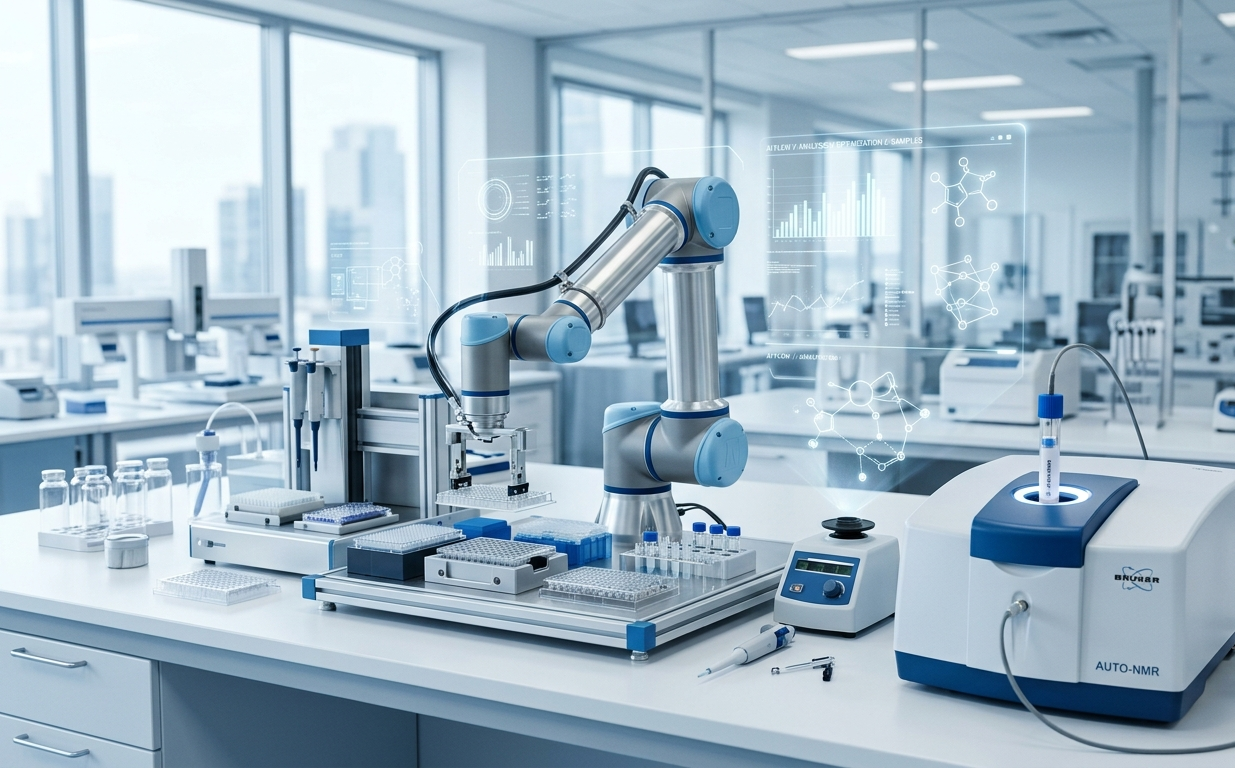
The collaboration connects three pieces: Chemspeed’s configurable laboratory automation hardware (already part of Bruker), Bruker’s analytical instruments — including its benchtop nuclear magnetic resonance (NMR) systems — and Bruker’s SciY scientific software, all orchestrated through Atinary’s AI layer.
A demonstration lab in Boston that opened in early 2026, which Atinary calls a “Scientific Data Factory,” illustrates what this looks like in practice. The system automates liquid and solid reagent addition, catalyst addition, running the chemical reaction itself, sampling with filtration, and inline NMR analysis — covering common reaction types in pharmaceutical chemistry such as Suzuki and Buchwald-Hartwig couplings. Scientists direct the platform through SDLabs, and the AI agents handle experiment design, execution, and interpretation, feeding results back into the next round of experiments.
A second site — a joint demonstration laboratory at Chemspeed’s headquarters near Basel, Switzerland — runs similar closed-loop workflows.
It’s worth being precise about what “integration” means here. The press release describes Atinary’s intent to build additional Bruker instruments and SciY software into its AI workflows going forward — meaning some of the deeper integration work is still in progress, even as the Basel and Boston sites already demonstrate a working version of the concept.
Independent Evidence and Performance Claims
Atinary’s marketing materials describe SDLabs as enabling users to “explore vastly larger chemical spaces and run complex experiments faster than ever,” citing unspecified “published work with world-renowned companies and universities.” No specific studies, customer results, or performance figures accompany that claim in the materials reviewed.
That’s a meaningful gap for readers evaluating how much to make of this announcement. No independent benchmarking, peer-reviewed comparison, or third-party analyst assessment of SDLabs’ actual performance against traditional lab methods was found. The claims that exist are general, unquantified, and come from the companies involved rather than outside evaluators. Readers should treat statements about SDLabs’ speed or discovery advantages as company assertions rather than established fact until independent data becomes available.
Business and Financial Context
The investment lands about a week after Bruker reported its second-quarter 2026 earnings on August 4. That call did not mention Atinary at all.
The earnings report did include a data point relevant to Bruker’s broader automation strategy: the company recorded a $135 million non-cash goodwill impairment charge tied to its automation and spatial biology businesses, attributed to ongoing operating losses in those segments. No source connects that impairment to the Atinary investment, and readers shouldn’t assume a causal relationship between the two — they are simply parts of the same broader financial picture for Bruker’s automation ambitions.
Atinary, for its part, is a small company by comparison. Depending on which financial database is consulted, it has raised somewhere between roughly $5 million and $9.8 million in total funding since its 2019 founding, with a headcount in the range of 10 to 25 employees. Its backers include AgFunder, Cherubic Ventures, Biopôle, and Innosuisse. That scale gap — a multibillion-dollar public instrument maker taking a stake in a startup that has raised single-digit millions — is part of what makes this a “minority investment expanding a partnership” story rather than a “bet the company” story for Bruker.
Competitive Landscape
Bruker isn’t the only major instrument maker chasing AI-driven lab automation, and its approach looks notably smaller in scale than at least one rival’s.
Thermo Fisher Scientific has pursued two separate, larger-profile AI partnerships: a strategic collaboration with NVIDIA, announced in 2026, aimed at building AI into scientific instruments and laboratory infrastructure at scale, and an earlier collaboration with OpenAI announced in October 2025. Both partnerships pair Thermo Fisher’s instrument portfolio with major AI infrastructure providers rather than a small AI-software startup.
Agilent Technologies, sometimes framed as a Bruker competitor, is not making a rival move here — it’s already listed among Atinary’s own ecosystem partners, alongside Bruker’s Chemspeed division. That makes the relevant competitive comparison for Bruker’s Atinary investment less about Agilent and more about the scale and backing of Thermo Fisher’s parallel efforts.
| Company | AI Partner(s) | Nature of Deal | Disclosed Financial Terms |
|---|---|---|---|
| Bruker | Atinary Technologies | Expanded collaboration + minority investment | Not disclosed |
| Thermo Fisher Scientific | NVIDIA | Strategic collaboration (announced 2026) | Not disclosed in sources reviewed |
| Thermo Fisher Scientific | OpenAI | Strategic collaboration (announced Oct 2025) | Not disclosed in sources reviewed |
What’s Still Unknown
Several material questions remain unanswered by public sources. The size of Bruker’s investment, the resulting equity stake, and any valuation implications for Atinary are all undisclosed. It’s not clear whether the investment comes with governance rights, such as a board seat, or whether it includes any exclusivity terms that might limit Atinary’s work with Bruker’s competitors.
There’s also no public information on how many customers are actually using the integrated Bruker-Atinary workflows beyond the two demonstration sites in Basel and Boston, or what adoption looks like at commercial scale. And while the press release frames this explicitly as a minority investment — implying Atinary remains an independent company — no source addresses whether this could be a step toward a future acquisition.
Conclusion
What’s confirmed is straightforward: Bruker has put undisclosed money behind an AI-lab-automation partnership with Atinary that already existed in a less formal shape, centered on two working demonstration labs and a shared vision of AI-orchestrated chemistry research. What’s not confirmed is nearly as important — there’s no public data on deal size, no independent verification of Atinary’s performance claims, and no clarity on how far the integration will extend beyond its current demonstration-lab stage.
For now, this is best understood as one instrument maker’s incremental, financially modest move to secure its position in a nascent but closely watched corner of AI-driven science — worth watching for how it evolves, not yet a verdict on how well it works.
Frequently Asked Questions
How much did Bruker invest in Atinary? The amount was not publicly disclosed by either company.
Is this Bruker’s first partnership with Atinary? No. Atinary was already listing Bruker’s Chemspeed division among its ecosystem partners, and joint demonstration labs were already operating, before this investment was announced. The August 2026 announcement expands an existing relationship rather than starting a new one.
What is Atinary’s SDLabs platform? It’s a “code-free” AI platform that uses machine learning agents to design experiments, run automated closed-loop research cycles, and interpret results — intended to speed up R&D in fields like pharmaceuticals, chemicals, and materials science.
Will Atinary remain an independent company? Bruker’s investment is described as a minority stake, implying continued independence, but no public source addresses whether this could lead to a future acquisition.
How does this compare to Thermo Fisher’s AI lab automation efforts? Thermo Fisher has pursued larger, separately announced partnerships with NVIDIA and OpenAI to build AI into its instruments and lab infrastructure. Bruker’s approach is a smaller-scale investment in a startup it already works with through its Chemspeed division.
Is the integrated Bruker-Atinary solution commercially available now? Two demonstration and production sites — near Basel, Switzerland, and in Boston, Massachusetts — are operating today. Broader integration of additional Bruker instruments and software into Atinary’s workflows is described as an intention going forward, not yet complete.
Who announced the deal — was it Bruker’s CEO? No. The quote in the announcement came from Bernd Gleixner, President of Bruker’s Chemspeed Division, not CEO Frank Laukien.