

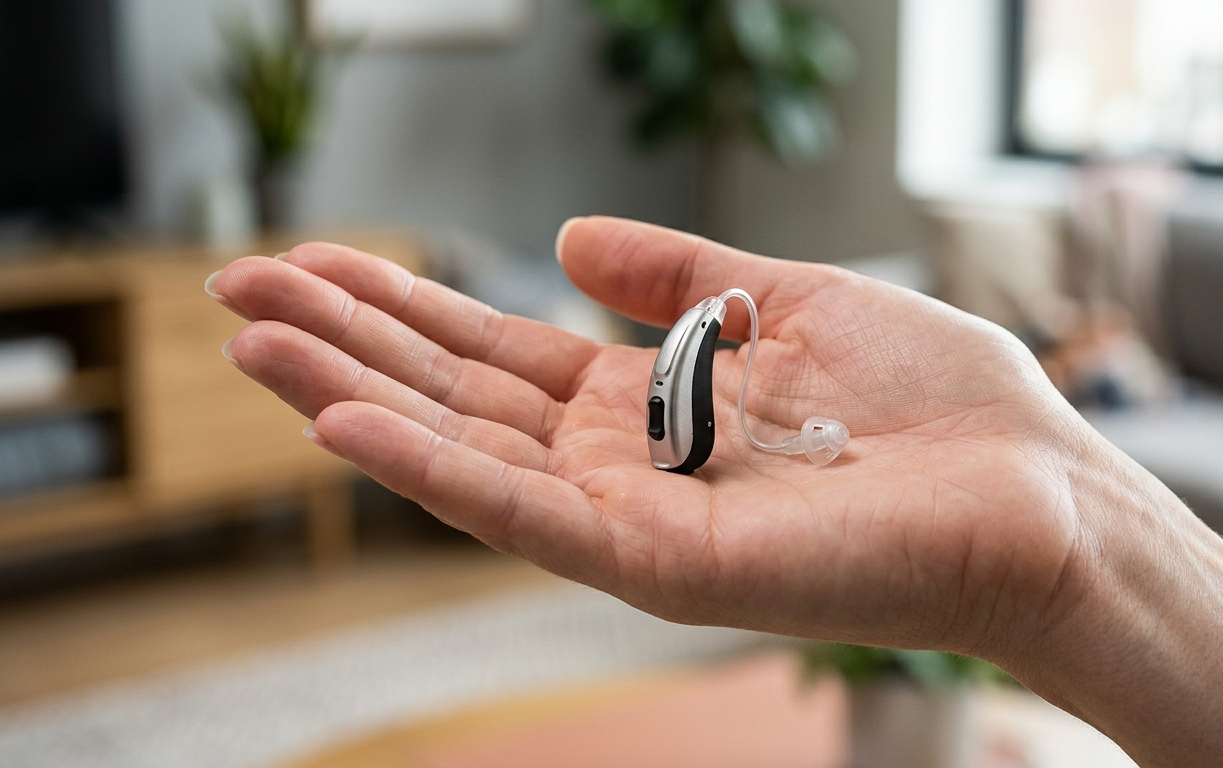
GN, the Danish hearing technology company behind ReSound, has launched a new family of premium hearing aids called ReSound Sensia. The announcement came on August 10, 2026, and the devices went on sale August 20 in the United States, Germany, and Austria, with more markets expected to follow.
At first glance, Sensia looks like an incremental update. According to independent reporting from The Hearing Review, it uses essentially the same physical hardware as its predecessor, ReSound Vivia, including the same two-chip design with a dedicated deep neural network (DNN) chip. But the way that hardware behaves has changed substantially. Where Vivia required the wearer to manually switch on its AI noise-reduction feature, Sensia does it automatically, using a new classifier system called AcoustIQ to decide, moment to moment, what kind of environment the wearer is in and which features to turn on.
That distinction — automation rather than new silicon — is the real news in this launch, and it’s worth understanding what GN is claiming versus what has been independently verified.
Table of Contents
What Is ReSound Sensia?
ReSound Sensia is a family of premium hearing aids built on what GN calls a “new AI platform,” aimed at helping wearers follow a specific conversation in noisy environments — a restaurant, a party, a crowded street — without simply amplifying whichever voice is loudest. GN’s system for this is called “Intelligent All-Around.”
Alongside Sensia, GN introduced a parallel Beltone-branded line, Beltone Illuminate, using the same underlying technology. Sensia is sold through the standard audiology channel, dispensed by hearing care professionals rather than sold over the counter, and comes in several styles: microRIE and RIE models (disposable or rechargeable), a non-wireless completely-in-canal style, a wireless in-the-canal style, and rechargeable in-the-canal and in-the-ear custom styles. GN says its rechargeable models offer 24-hour battery life even with automatic AI features running. Pricing has not been publicly disclosed.
From Manual to Automatic AI
ReSound Vivia, launched in February 2025, introduced a dedicated DNN chip that could suppress background noise and isolate speech — but only when the wearer switched it on, either via a button or the companion app. Sensia removes that step. Its DNN noise reduction, four-microphone beamformer, and a new real-time classifier now work together automatically.
It’s worth being precise about what hasn’t changed: the hardware. Reporting on the launch indicates Sensia uses essentially the same components as Vivia, including the same dedicated DNN chip. GN has not announced a new AI accelerator or upgraded processing hardware here — the advance is in software and system design layered on existing silicon.
How AcoustIQ Works
AcoustIQ is described by GN as the “brain” behind Intelligent All-Around, classifying the sound environment in real time. Notably, GN’s Chief Audiology Officer, Laurel Christensen, has said the classifier itself is intentionally simple rather than AI-driven — it detects the presence and level of speech and noise, then activates the beamformer, DNN, or a separate noise tracker accordingly. GN reportedly found that using a DNN for classification itself wasn’t accurate enough.
One deliberate design choice: Sensia doesn’t classify music as its own category, since GN considers listening to music a deliberate choice better left to manual selection rather than automatic detection. For noise-only environments with no dominant speech, GN uses a separate system called Perceptual Noise Reduction, avoiding the audio artifacts that can occur when DNN-based denoising runs continuously without speech present.
Performance Claims: Confirmed vs. Company-Sourced
GN says AcoustIQ classifies sound environments with 88% greater accuracy than “the closest premium solution.” That figure is footnoted in GN’s own materials to an internal white paper (Groth & Cui, 2026) rather than independent research. GN’s description of Sensia as the “world’s smallest AI hearing aid” is likewise sourced to “GN proprietary data on file.”
No independent lab has published test results for Sensia as of this writing. HearingTracker, whose partner lab HearAdvisor conducts independent evaluations, says testing is planned but not yet complete. UK outlet Alto Hearing described GN’s central claim as one that “still needs scrutiny,” noting that real-world clinical outcomes and independent speech-in-noise testing remain to be established. None of this means GN’s claims are wrong — only that they haven’t yet been checked by anyone outside the company.
Availability and Open Questions
GN confirms availability began August 20, 2026 in the US, Germany, and Austria. Some outlets, including HearingTracker and Aurahear, have also listed Canada as a launch market, though that detail doesn’t appear in GN’s own press release and should be treated as unconfirmed. Alto Hearing’s reporting also suggests the flagship Intelligent All-Around system may be limited to Sensia’s top technology tier (Level 9) in the microRIE style — a limitation not spelled out in GN’s own materials, so buyers considering other tiers should confirm feature availability with a provider.
Bimodal Support for Cochlear Implant Users
GN also introduced two bimodal models, ReSound Sensia Bimodal and ReSound Enzo IA Bimodal, built to work with Cochlear Nucleus sound processors for people who use a cochlear implant in one ear and a hearing aid in the other. This extends GN’s existing Smart Hearing Alliance partnership with implant maker Cochlear rather than representing a new initiative.
How Sensia Compares to Competitors
Several manufacturers have shipped DNN-based flagship hearing aids in the past two years, each with a different architecture. Oticon Intent runs a second-generation DNN on a single main chip alongside motion-sensing “4D Sensor” technology, claiming up to 12 decibels of noise suppression. Phonak’s Audéo Infinio Sphere uses a dual-chip design — a main “ERA” chip plus a dedicated “DEEPSONIC” AI chip — claiming up to 10 decibels of signal-to-noise improvement. Starkey’s current flagship, Omega AI, launched October 2025 replacing the earlier Edge AI line, and runs a system called DNN 360 on a single chip, analyzing the full surrounding sound field rather than just what’s ahead of the wearer. (Older comparisons referencing Starkey’s “Genesis AI” or Phonak’s original “Audéo Sphere” are now outdated.)
No independent, standardized testing currently compares all four devices under identical conditions, so Sensia’s distinguishing feature — automatic classification rather than new chip architecture — can’t yet be benchmarked directly against rivals.
What’s Still Unknown
Independent performance data, exact chip specifications, Sensia-specific DNN training-data figures, pricing, and Canada’s launch-market status are all undisclosed or unconfirmed as of this article’s publication. (For comparison, GN has previously disclosed that Vivia’s DNN was trained on 13.5 million spoken sentences across 3.9 million tuned sound parameters — no equivalent figures have been published for Sensia.)
Conclusion
Sensia is a confirmed, commercially available product, not a preview — it went on sale in three markets the same day this article covers. What’s genuinely new is narrower than the marketing suggests: the hardware is largely unchanged from Vivia, and the real advance is AcoustIQ, a software layer that automates features Vivia required users to activate manually. GN’s strongest performance claims remain backed by internal data rather than independent testing. What’s worth watching next: independent lab results from testing groups like HearAdvisor, confirmation of additional launch markets, and whether automatic, classifier-driven AI activation becomes an industry norm rather than a Sensia-specific feature.
Frequently Asked Questions
What is the main difference between ReSound Sensia and ReSound Vivia? Sensia automates AI noise-reduction and beamforming features that Vivia required users to activate manually, using a new classifier called AcoustIQ.
Does ReSound Sensia use new hardware or a new AI chip? No — reporting indicates it uses essentially the same two-chip hardware as Vivia, including the same dedicated DNN chip. The changes are in software, not silicon.
When and where is ReSound Sensia available? GN confirms availability from August 20, 2026 in the US, Germany, and Austria, with more markets to follow. Canada has been reported by some outlets but isn’t confirmed in GN’s own release.
What is AcoustIQ in ReSound Sensia? A real-time classification system at the center of “Intelligent All-Around.” GN describes it as deliberately simple, detecting speech and noise levels to activate the right combination of features.
Has ReSound Sensia been independently tested yet? Not as of this article’s publication. HearingTracker and its testing partner HearAdvisor plan to evaluate it but hadn’t published results at launch.
How does ReSound Sensia compare to Oticon Intent, Phonak Infinio Sphere, and Starkey Omega AI? All use deep neural networks for speech clarity but differ in architecture: Oticon Intent and Starkey Omega AI run DNNs on a single chip, while Phonak’s Infinio Sphere and GN’s Sensia use dual-chip designs with a dedicated AI chip. No independent, standardized comparison of all four exists yet.
Are ReSound Sensia’s bimodal models compatible with cochlear implants? Yes — ReSound Sensia Bimodal and ReSound Enzo IA Bimodal are designed for Cochlear Nucleus sound processors, part of GN’s existing Smart Hearing Alliance partnership with Cochlear.