

Managing type 1 diabetes is a constant math problem — one that never stops, even at 3 a.m. Every meal, every workout, every stressful meeting shifts blood sugar in ways that have to be tracked and corrected, sometimes minute by minute. For decades, that math was done almost entirely by hand. Today, a growing share of it is done automatically by a small pump strapped to the body, running software that decides, on its own, how much insulin to deliver.
In April 2026, one of those systems — Tandem Diabetes Care’s Control-IQ+ — reached a milestone no automated insulin delivery system had reached before: FDA clearance for use during pregnancy in people with type 1 diabetes. It’s a genuinely useful development for a high-risk patient group. It’s also a good opportunity to ask a question that doesn’t get asked enough in health-tech coverage: how much of this is actually “AI,” and how much is very good, very well-tested engineering wearing an AI label?
Table of Contents
The Problem: The Relentless Math of Type 1 Diabetes
People with type 1 diabetes don’t produce insulin, so they have to replace it manually — calculating doses based on food, activity, stress, and blood sugar trends, then adjusting in real time when those calculations turn out to be wrong. Get it wrong in one direction and blood sugar spikes; get it wrong in the other and it can crash dangerously low.
Pregnancy raises the difficulty considerably. Glycemic targets during pregnancy are tighter than the general recommendations for type 1 diabetes, because both high and low blood sugar carry real risks to the pregnancy. Historically, expectant mothers with type 1 diabetes have managed this with multiple daily injections or standard insulin pumps — without any pregnancy-specific automated support, since no automated insulin delivery (AID) system had been formally approved for this use. Off-label use — a legal but unofficial practice where a device is used outside its approved indication — has been common. Tandem’s clearance changes that: it’s the first automated insulin delivery system cleared for use in pregnancy with type 1 diabetes.
What Is Control-IQ+ — and Who Makes It?
Tandem Diabetes Care, Inc. (Nasdaq: TNDM), based in San Diego, has been building insulin delivery systems since it was founded in 2006. Its flagship pump, the t:slim X2, launched in 2018, followed by the smaller, phone-controlled Tandem Mobi in 2023.
The algorithm now called Control-IQ has an unusually academic pedigree. It traces back to DiAs, a closed-loop insulin delivery system developed at the University of Virginia, later commercialized by TypeZero Technologies under the name “inControl.” Tandem integrated this technology into the t:slim X2, and the FDA cleared it — under the name Control-IQ — on December 13, 2019, the first system to receive the agency’s new “interoperable automated glycemic controller” designation, meaning it was built to work with separately-approved continuous glucose monitors rather than one proprietary sensor. Commercial launch followed in January 2020.
Control-IQ+, an enhanced version of the original algorithm, received FDA clearance for adults with type 2 diabetes in February 2025 and launched commercially the following month. It runs on both the t:slim X2 and Tandem Mobi pumps.
How the System Works
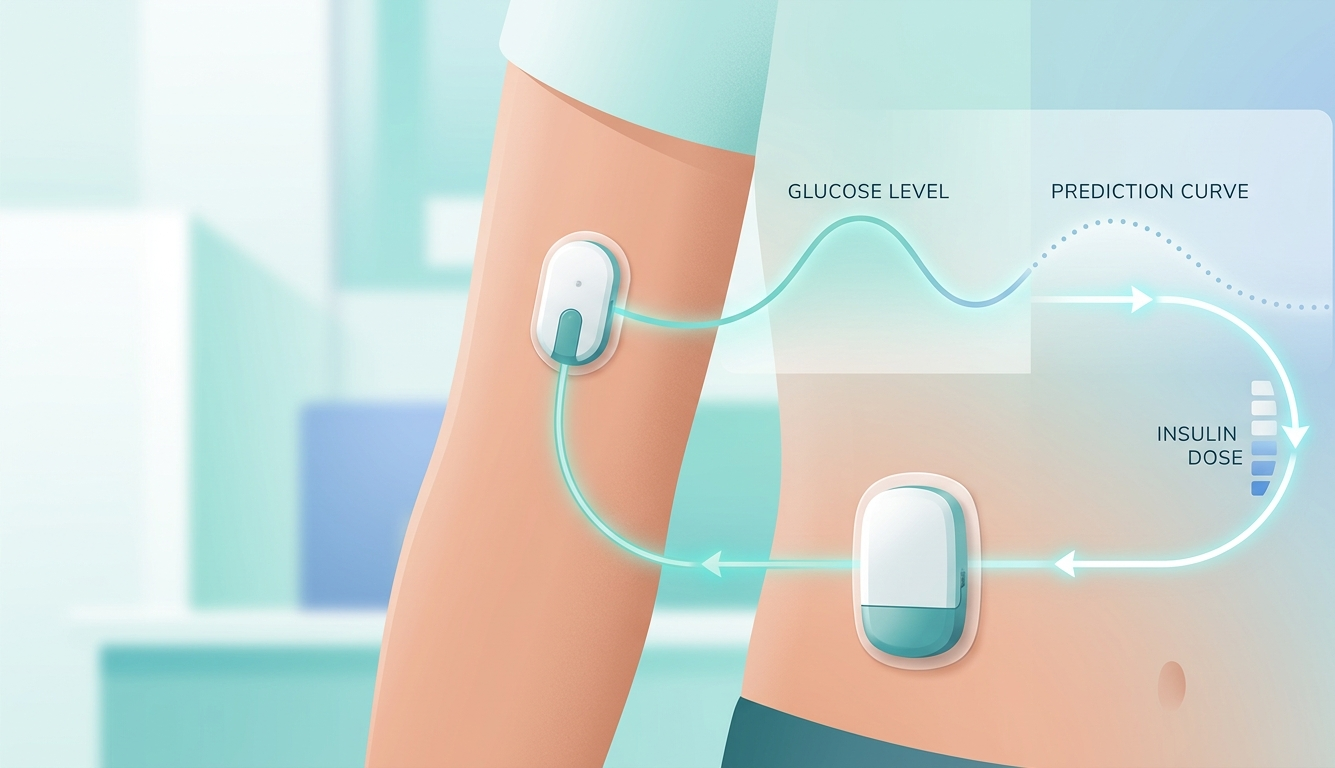
Control-IQ+ operates as a “hybrid closed loop”: the user still enters basic settings — basal insulin profile, insulin-to-carb ratio, insulin sensitivity factor — but the system takes over the moment-to-moment adjustments.
- A continuous glucose monitor (CGM) — compatible options include the Dexcom G6/G7 and, on the t:slim X2, the Abbott FreeStyle Libre 2 Plus/3 Plus — sends a glucose reading every five minutes.
- The algorithm uses that reading to predict blood glucose 30 minutes into the future.
- If glucose is predicted to rise above 160 mg/dL, the system increases basal insulin delivery.
- If glucose is expected to climb above 180 mg/dL, it can deliver an automatic correction bolus, up to once per hour.
- Target ranges shift depending on time of day — the system becomes more conservative overnight to reduce the risk of nighttime lows.
The person wearing the pump doesn’t need to approve each adjustment. That’s the core promise of automated insulin delivery: fewer manual decisions, made more consistently than a tired, distracted human might make them.
The Technology Behind the “AI” Label
Here’s where an honest technical distinction matters. Control-IQ+ is frequently described — by media coverage and sometimes by marketing — as “AI-powered.” Clinical trial protocol documents and technical literature describe the underlying algorithm more specifically: it’s a model predictive control (MPC) system, a “to-range adaptive” algorithm that uses mathematical models linking insulin dosing to expected glucose changes.
Model predictive control is a well-established branch of control engineering — the same broad family of techniques used in industrial process control and robotics — rather than a deep-learning or machine-learning system trained on massive datasets, the kind increasingly common in fields like medical imaging. It’s automated. It’s adaptive within defined parameters. But it isn’t the same category of technology as, say, a neural network trained to recognize patterns across millions of examples.
That doesn’t make Control-IQ+ less useful — the clinical results below are real and well-documented — but it’s worth being precise about what kind of automation is actually running the show. Whether Tandem has incorporated any machine-learning components into more recent versions of Control-IQ+ beyond this original MPC framework has not been publicly disclosed.
What the Evidence Shows
Few consumer medical devices have a clinical trial record as deep as Control-IQ. Much of it comes through the NIH-funded International Diabetes Closed Loop (iDCL) trial program, run through academic centers rather than solely by Tandem.
| Trial | Population | Design | Key Result |
|---|---|---|---|
| DCLP3 | Ages 14+ (n=168) | 6-month RCT vs. sensor-augmented pump | Higher time in range, less hyper/hypoglycemia, better HbA1c; no severe hypoglycemic events; published in NEJM, October 2019 |
| DCLP5 | Ages 6–13 (n=101) | 4-month RCT | Higher time in range and less hyperglycemia than control; published in NEJM, August 2020 |
| PEDAP | Ages 2–5 | RCT | About 3 more hours per day in target range than control; published in NEJM, March 2023 |
| Pooled meta-analysis | Ages 2–72 (n=369) | Combined DCLP3, DCLP5, PEDAP | Mean HbA1c fell from 7.5% to 7.0%, vs. 7.6% to 7.5% in controls; benefit consistent across race-ethnicity, income, and prior device experience |
| CIRCUIT | Pregnant women with T1D (n=91) | Multicenter, randomized, open-label | 12.6% more time in the pregnancy-specific glucose range (63–140 mg/dL) than standard therapy; published in JAMA, October 2025 — basis for the 2026 pregnancy clearance |
Sources: NEJM DCLP3, NEJM DCLP5, JAMA CIRCUIT trial, HCPLive meta-analysis
A separate real-world observational study of roughly 9,000 users found time in range increased by more than 10 percent within two weeks of starting the system — a useful signal that trial results translate to everyday use, though it’s observational data rather than a controlled comparison.
Regulatory Status
- December 2019: FDA clearance of Control-IQ with the t:slim X2 — the first automated insulin dosing system to receive the FDA’s interoperable controller designation.
- February 2025: FDA clearance of Control-IQ+ for adults with type 2 diabetes.
- April 27, 2026: FDA clearance of Control-IQ+ for use in pregnancy complicated by type 1 diabetes, covering both the t:slim X2 and Tandem Mobi — making them, per Tandem, the first and only commercially available AID systems cleared for this use in the U.S.
International regulatory status for Control-IQ+ specifically — EU, UK, or other markets — was not confirmed in the sources reviewed for this article and should be checked directly with Tandem or regional regulators for readers outside the U.S.
Real-World Use
Clinical trial protocol documentation (undated) cited more than 150,000 users of the Control-IQ system since its 2020 commercial launch — a figure that predates Control-IQ+ and almost certainly understates the current total. Tandem has not publicly disclosed an updated total user count, current geographic breakdown, or total device shipments specific to Control-IQ+.
Evidence-Supported Benefits
- Statistically significant increases in time-in-range, replicated across multiple independent, NIH-funded trials spanning ages 2 to 72
- Improved HbA1c in the pooled three-trial analysis
- Benefit held consistent across race-ethnicity, income level, and prior device experience — a meaningful equity finding
- The only FDA-cleared indication and supporting randomized trial data (CIRCUIT) for automated insulin delivery specifically in pregnancy with type 1 diabetes
- No severe hypoglycemic events reported in the DCLP3 pivotal trial
Limitations and Risks
- User error carries real consequences. Tandem’s own safety materials note that failing to correctly use the pump, CGM, or other system components can cause insulin over- or under-delivery, leading to high or low blood sugar events.
- The system is only as good as the CGM feeding it. Sensor inaccuracies or compatibility issues can propagate directly into dosing decisions.
- The pregnancy trial was small. CIRCUIT enrolled 91 participants — typical for a specialized population, but a real constraint on how broadly the results generalize.
- Data practices aren’t fully public. How CGM and pump usage data is stored or shared with third-party CGM manufacturers like Dexcom and Abbott has not been publicly detailed.
- The “AI” framing deserves scrutiny. As covered above, Control-IQ+ is best understood as sophisticated automated control engineering rather than machine-learning AI — a distinction that matters for readers trying to calibrate expectations across the health-tech landscape.
The Competitive Landscape
Control-IQ+ competes in a genuinely crowded field. As of 2025–2026, five FDA-cleared automated insulin delivery systems are commercially available in the U.S.:
- Medtronic MiniMed 780G — offers basal adjustments as precise as 0.025 units per hour; received FDA clearance in September 2025 to expand to adults with type 2 diabetes; CGM compatibility limited to Medtronic’s own sensors.
- Insulet Omnipod 5 — the only fully tubeless AID system in the U.S., compatible with Dexcom G7; expanded to adults with type 2 diabetes in 2024.
- Beta Bionics iLet — simplifies bolus dosing by having users estimate meal size (small, medium, large) rather than precise carb counting.
- Sequel twiist — a newer entrant among the five current U.S. systems.
What’s Next
Tandem secured FDA clearance for a 7-day infusion set in August 2025, with commercial availability expected in 2026 — a change reported to roughly halve how often users need to change their infusion site, though this specific benefit estimate comes from trade coverage rather than a peer-reviewed source and should be read as a company/industry projection rather than confirmed clinical data. Longer-term, multi-year outcome data — whether automated insulin delivery measurably reduces complications like retinopathy or kidney disease over time, beyond short- and medium-term glycemic metrics — is not yet available and remains an open question across the entire AID category, not just for Tandem.
Conclusion
Control-IQ+’s pregnancy clearance is a genuine, well-evidenced advance in automated insulin delivery for a patient population that has waited a long time for a formally approved automated option. The device’s clinical record — built substantially through independent, NIH-funded trials published in NEJM and JAMA — is stronger than what many commercial health-tech products can claim. But it’s worth naming plainly what this technology is: mature, rigorously tested control engineering, not the deep-learning AI increasingly common elsewhere in healthcare. Both things can be true — a device can be genuinely valuable and modestly “AI” at the same time — and readers navigating today’s health-tech landscape deserve that distinction made clearly.
Frequently Asked Questions
Is Control-IQ+ approved for use during pregnancy?
Yes. As of April 2026, it’s the first and only commercially available automated insulin delivery system FDA-cleared specifically for pregnancy in people with pre-existing type 1 diabetes.
How does Control-IQ+ actually work?
It uses continuous glucose monitor readings, taken every five minutes, to predict blood sugar 30 minutes ahead, then automatically adjusts insulin delivery — increasing basal rates or issuing correction doses — without requiring the user to calculate or approve each change.
Is Control-IQ+ actually “AI”?
It’s automated, algorithm-driven software, but technically it’s built on model predictive control — a mature control-engineering method — rather than the deep-learning systems typically meant by “AI” today. “Automated” or “algorithmic” is a more precise description than “AI” in the machine-learning sense.
What evidence supports its effectiveness?
Multiple NIH-funded, peer-reviewed randomized controlled trials, published in NEJM and JAMA, spanning ages 2 to 72, showing consistent improvements in time-in-range and HbA1c compared to standard therapy.
What pumps use Control-IQ+?
Tandem’s t:slim X2 and Tandem Mobi insulin pumps.
What are the main competitors?
Medtronic’s MiniMed 780G, Insulet’s Omnipod 5, Beta Bionics’ iLet, and Sequel’s twiist are the other FDA-cleared automated insulin delivery systems currently available in the U.S.
What are the risks or limitations?
Incorrect use of the pump, CGM, or other system components can cause insulin over- or under-delivery, leading to high or low blood sugar events. The pregnancy clearance is also based on a relatively small trial (91 participants), typical for this specialized population but worth keeping in mind.
Sources: Tandem Diabetes Care investor relations (FDA clearance releases, Dec 2019, Feb 2025, Apr 2026); New England Journal of Medicine (DCLP3, 2019; DCLP5, 2020; PEDAP, 2023); JAMA (CIRCUIT trial, 2025); NIDDK Central Repository / ClinicalTrials.gov protocol documents; Medscape; Contemporary OB/GYN; diaTribe; HCPLive; DiabetesWise/Diabetesnet.com.
This article is for informational purposes only and does not constitute medical advice. Control-IQ+ and other automated insulin delivery systems are prescription medical devices that must be set up, calibrated, and monitored under the guidance of a qualified healthcare provider. Insulin dosing — automated or manual — carries real risks, including hypoglycemia and hyperglycemia, and individual needs vary significantly, especially during pregnancy. Anyone with type 1 or type 2 diabetes considering this technology, particularly if pregnant or planning a pregnancy, should consult their endocrinologist, maternal-fetal medicine specialist, or diabetes care team before making any changes to their treatment plan. Clinical trial results describe group-level outcomes and may not predict individual results.