

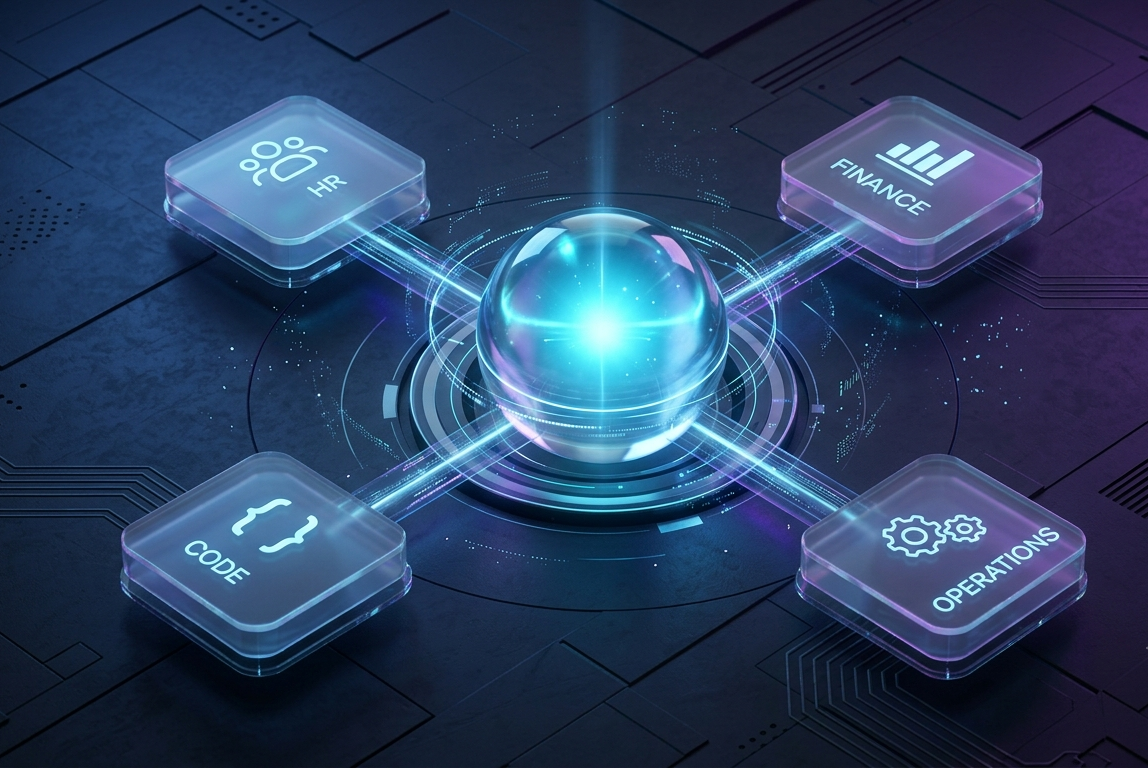
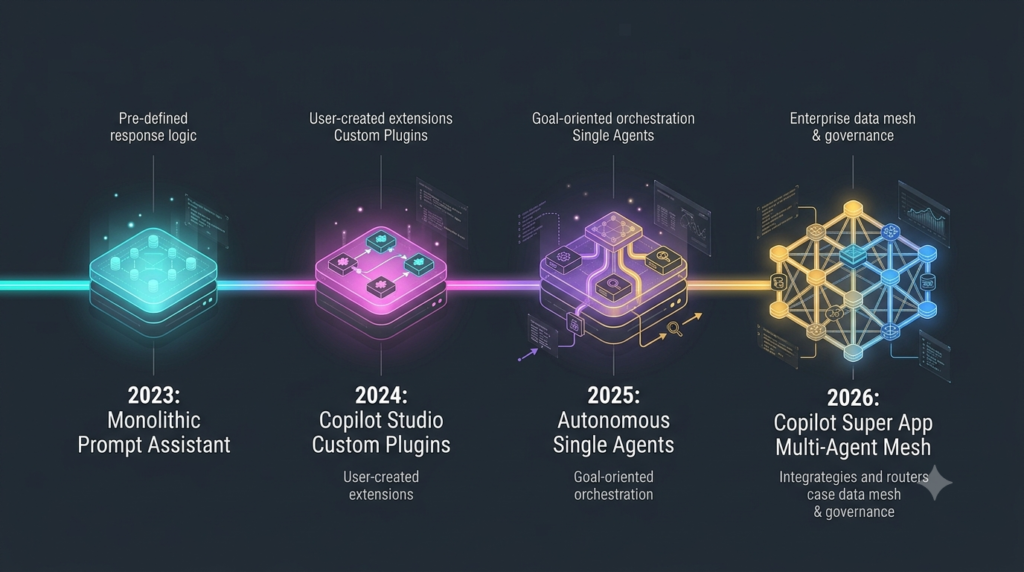
Enterprise artificial intelligence has reached a decisive structural boundary. The era of isolated single-prompt chatbots—where developers, knowledge workers, and analysts bounced between separate AI tools for coding, writing, and data analysis—is rapidly ending. In its place, tech leaders face a new paradigm: the Copilot Super App Architecture.
By unifying fragmented touchpoints like GitHub Copilot, Microsoft 365 Copilot, and custom enterprise tools into a single front door, Microsoft is shifting the focus of AI strategy. This architecture is not just a UI refresh. It is a multi-agent control plane designed to route tasks, decompose complex goals, and enforce security boundaries across distributed enterprise systems.
For CTOs, enterprise architects, and systems engineers, this shift changes how software gets built, deployed, and secured. Understanding how multi-agent convergence works within Microsoft’s ecosystem requires opening the hood to inspect its protocol stack, grounding layers, orchestration patterns, and identity guardrails.
Table of Contents
Key Takeaways
- The Super App Shift: Microsoft is consolidating disparate AI touchpoints into a unified front-door client that delegates incoming requests to domain-specific sub-agents.
- Dual Protocol Architecture: Inter-agent orchestration relies on two complementary open standards: Model Context Protocol (MCP) for tool/data ingestion and Agent2Agent (A2A) for peer collaboration.
- Grounding via Microsoft IQ: Four dedicated grounding pillars—Work IQ, Fabric IQ, Foundry IQ, and Web IQ—supply agents with real-time enterprise context without polluting token windows.
- Identity-First Security: Autonomous background agents are secured via Microsoft Entra Agent ID and monitored through Microsoft Agent 365, enforcing double-key authorization and token scoping.
- Cost and Latency Management: Advanced model routing via Azure AI Foundry prevents token cost explosion by matching query complexity to optimal model sizes.
1. The Architectural Shift: From Single Copilot to Super App Mesh
Single-model AI assistants fail when forced to execute complex enterprise workflows. In a single-model setup, an LLM must hold system instructions, API specifications, organizational context, and conversation history inside one prompt window.
This monolithic approach runs into three major bottlenecks:
- Context Window Inflation: Stacking thousands of lines of API documentation and background data into a single prompt increases latency and degrades reasoning quality.
- Security Scope Creep: A single assistant with broad API keys poses a severe security risk if compromised via prompt injection.
- Execution Bottlenecks: Monolithic models process multi-step workflows sequentially, leading to slow response times for multi-department tasks.
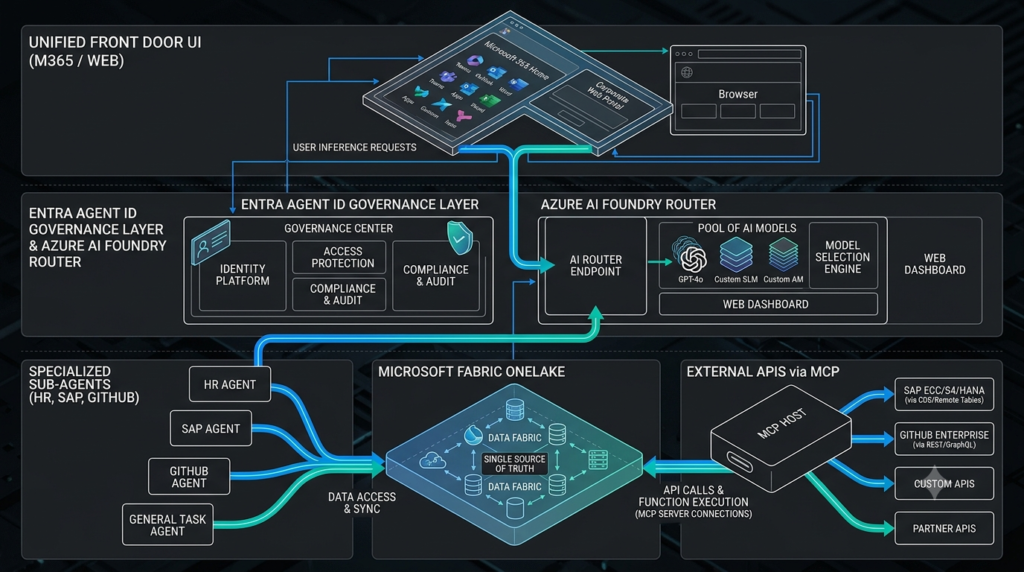
The Super App architecture replaces this monolithic approach with a router-specialist topology. The central Copilot client acts as a unified front door. It analyzes incoming prompts, breaks complex tasks into discrete sub-goals, and dispatches those sub-goals to specialist sub-agents operating within strict boundaries.
2. Protocol Stack: MCP vs. Agent2Agent (A2A)
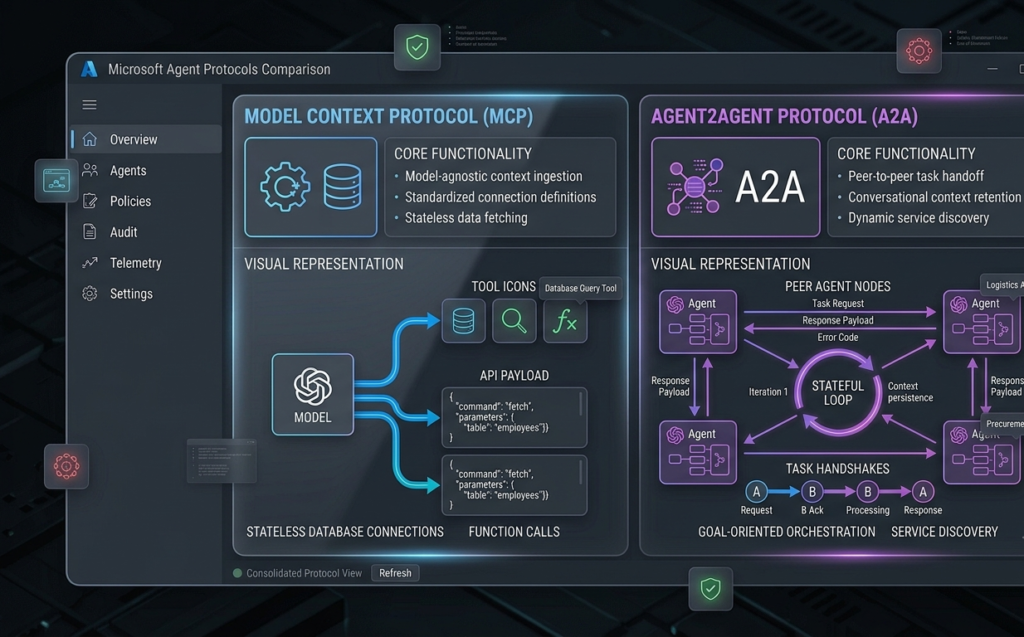
A common challenge in building enterprise agentic infrastructure is determining how agents communicate with external databases versus peer agents. The Microsoft Copilot ecosystem relies on two complementary protocols to handle these paths
Model Context Protocol (MCP)
Originally pioneered by Anthropic and broadly adopted across Azure AI Foundry and Copilot Studio, Model Context Protocol (MCP) defines the interface between an AI agent and external resources. MCP allows agents to inspect tool definitions, execute API functions, and read data schemas through standardized client-server connections over JSON-RPC.
Agent2Agent (A2A) Protocol
While MCP governs agent-to-tool connections, the Agent2Agent (A2A) protocol governs communication between independent reasoning agents. A2A enables a supervisor agent to hand off tasks, pass session context, monitor background execution status, and receive structured outputs from domain-specific sub-agents.
By combining MCP and A2A, an enterprise orchestrator can use A2A to assign a financial auditing goal to a specialized Finance Agent, which then uses MCP tools to query underlying SQL databases or ERP systems safely.
3. Grounding Architecture: The Four Pillars of Microsoft IQ
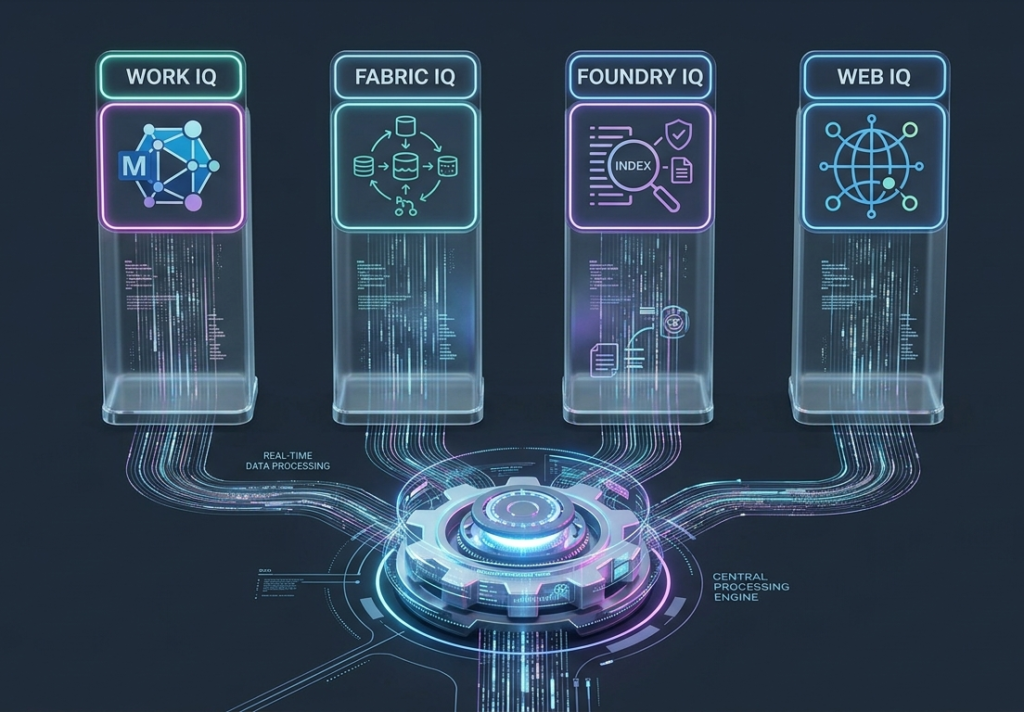
An agent’s reasoning quality depends on the freshness and accuracy of its underlying context. Rather than dumping raw enterprise data into active prompt memory, the Copilot Super App routes context retrieval through four dedicated grounding pillars known collectively as Microsoft IQ.
1. Work IQ
Work IQ maps organizational activity across the Microsoft Graph. It indexes email threads, Teams chats, calendar schedules, meeting transcripts, and project structures. This allows an agent to understand organizational relationships, employee roles, and project context without manual tagging.
2. Fabric IQ
Fabric IQ connects Copilot Studio agents to enterprise data lakes managed in Microsoft Fabric OneLake. By mapping raw data lake tables to Power BI semantic models and business ontologies, Fabric IQ ensures agents query financial numbers, sales metrics, and operational metrics using official corporate math.
3. Foundry IQ
Foundry IQ serves as the policy and knowledge grounding layer. Powered by Azure AI Search and enterprise document repositories, Foundry IQ indexes standard operating procedures (SOPs), compliance rules, technical specifications, and legal guidelines.
4. Web IQ
While internal IQ pillars focus on corporate data, Web IQ handles external context. It uses real-time web search indices to supply agents with live market news, regulatory updates, and public data breaking past static model cutoffs.
4. Multi-Agent Orchestration Patterns
When designing multi-agent systems in Copilot Studio or Azure AI Foundry, enterprise architects generally rely on three foundational orchestration patterns:
Hub-and-Spoke (Central Orchestrator)
A central supervisor agent receives the initial user prompt, performs task decomposition, dispatches sub-tasks to specialized domain agents, and aggregates the results into a single response.
- Primary Use Case: Cross-departmental business processes like employee onboarding, which require coordinated steps across HR, IT, and Facilities.
Sequential Chain
Specialist agents execute tasks in a linear pipeline, where the structured output of Agent A becomes the direct input for Agent B.
- Primary Use Case: Automated code generation workflows where a Specification Agent passes requirements to a Coding Agent, which passes output to a Security Review Agent.
Parallel Swarm
Multiple sub-agents receive sub-tasks simultaneously, executing independent analysis before returning results to a synthesizing node.
- Primary Use Case: High-throughput research tasks, such as querying multiple regional sales databases at once to generate a global quarterly report.
5. Security Guardrails & Governance: Entra Agent ID
Allowing autonomous AI agents to execute actions across internal databases and external APIs creates significant security risks. Human user authentication relies on interactive sign-ins, whereas background agents run asynchronously.
Microsoft addresses this challenge with Microsoft Entra Agent ID and Microsoft Agent 365.
How Agent Security Guardrails Work
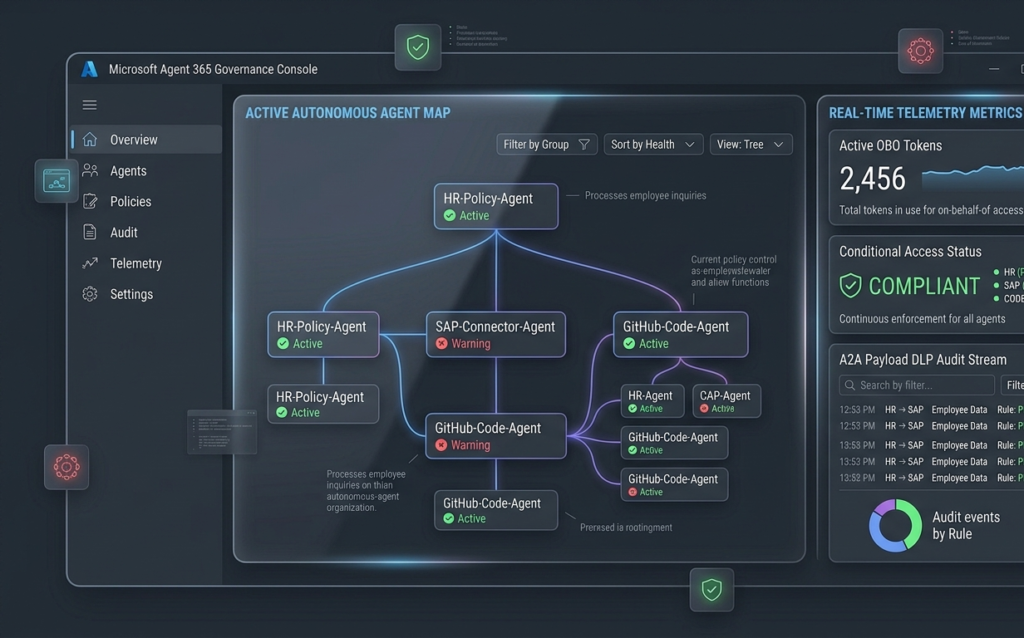
- Non-Human Identity Provisioning: Every autonomous agent is assigned a distinct Entra Agent ID provisioned through an Agent Identity Blueprint. This treats agents as managed principals with explicit lifecycles rather than generic service accounts.
- Double-Key Authorization: When an agent requests data from an enterprise API, the gateway evaluates two authorization vectors:
- User Level: Does the initiating human user have permission to access this data?
- Agent Level: Does the specific Agent ID have the authorized token scope to execute this action?
- On-Behalf-Of (OBO) Token Delegation: As tasks move from the primary orchestrator to worker agents via the A2A protocol, security contexts are passed using OBO tokens. Worker sub-agents cannot escalate privileges beyond the initiating user’s permissions.
- Agent 365 Control Plane: Security teams gain centralized visibility through Microsoft Agent 365, monitoring agent registries, inspecting inter-agent communication logs, and applying Conditional Access policies across Microsoft, AWS, Google Cloud, and third-party agents.
Real-World Enterprise Use Case: Automated Supply Chain Risk Mitigation
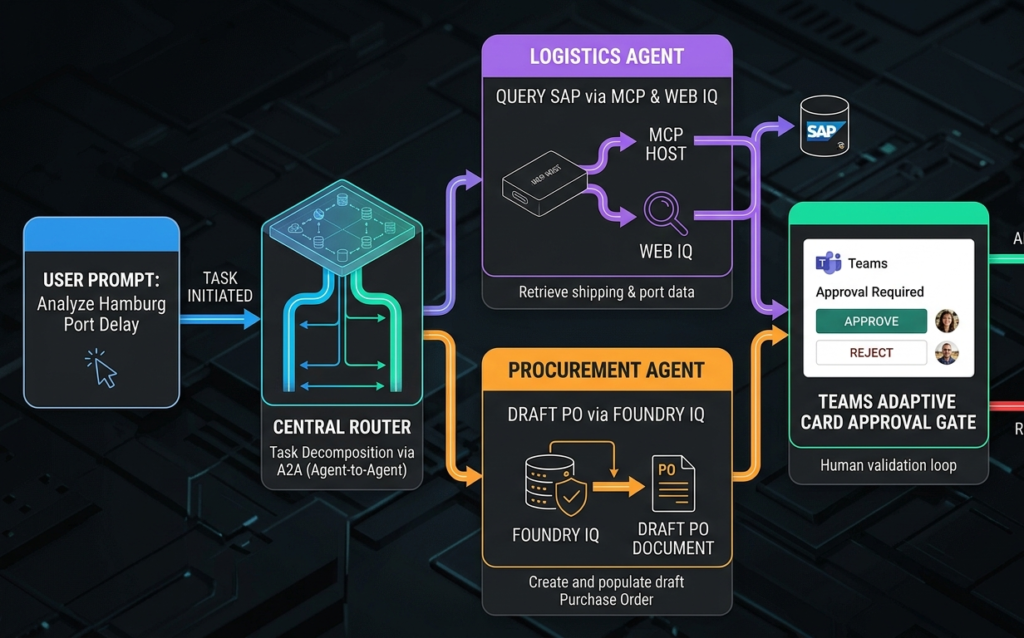
To see the Copilot Super App architecture in action, consider how a global manufacturing enterprise handles a sudden supply disruption:
User Prompt: A logistics director prompts Copilot: “Analyze the port disruption in Hamburg, calculate impact on our production schedule, and submit alternative supplier orders.”
Intent Classification & Routing: The primary orchestrator receives the prompt and breaks it into two goals: impact analysis and procurement execution.
Step 1 Execution (Logistics Analysis):
- The orchestrator uses A2A to dispatch a task to the Logistics Analytics Agent.
- The logistics agent pulls live shipping news using Web IQ and queries active shipment status in OneLake using Fabric IQ.
- It runs an MCP tool call to SAP to identify affected purchase orders and calculates a 4-day delay.
Step 2 Execution (Procurement & Order Submission):
- The logistics agent returns its analysis to the orchestrator via A2A.
- The orchestrator delegates the re-order task to a Procurement Execution Agent via A2A.
- The procurement agent verifies purchasing limit policies via Foundry IQ and drafts an updated purchase order.
Human-in-the-Loop Approval: Because the order exceeds $50,000, the procurement agent triggers an Adaptive Card approval gate in Teams. Once the director approves, the agent calls an external supplier portal API via MCP to complete the transaction.
6. Implementation Blueprint for Enterprise Systems Engineers
Organizations building multi-agent systems with Copilot Studio and Azure AI Foundry can follow this step-by-step implementation plan:
Step 1: Map Domain Boundaries
Divide enterprise tasks into discrete, modular domain agents. Avoid building broad, general-purpose agents that require dozens of tool connections.
Step 2: Establish Grounding Connections via Microsoft IQ
Attach dedicated context sources to each sub-agent:
- Connect M365 Graph data via Work IQ for organizational context.
- Map OneLake semantic models via Fabric IQ for operational queries.
- Index policy document stores via Foundry IQ for compliance enforcement.
Step 3: Build Tool Gateways Using MCP
Standardize API calls, database connections, and external software connections by deploying MCP servers. Register these tool endpoints in Azure AI Foundry or Copilot Studio.
Step 4: Configure Inter-Agent Routing with A2A Protocol
Link specialized worker agents to your primary Copilot Studio orchestrator using the Agent2Agent (A2A) protocol. Define clear JSON schemas for inter-agent task delegation and error handling (such as A2A_DELEGATION_TIMEOUT fallbacks).
Step 5: Secure Identities in Microsoft Agent 365
Assign a dedicated Entra Agent ID to every orchestrator and sub-agent. Configure Conditional Access rules, enforce double-key token scopes, and log activity through the Agent 365 control plane.
7. Risks, Limitations, and Trade-offs
While the Super App architecture solves key scaling challenges, enterprise leaders should evaluate several technical trade-offs:
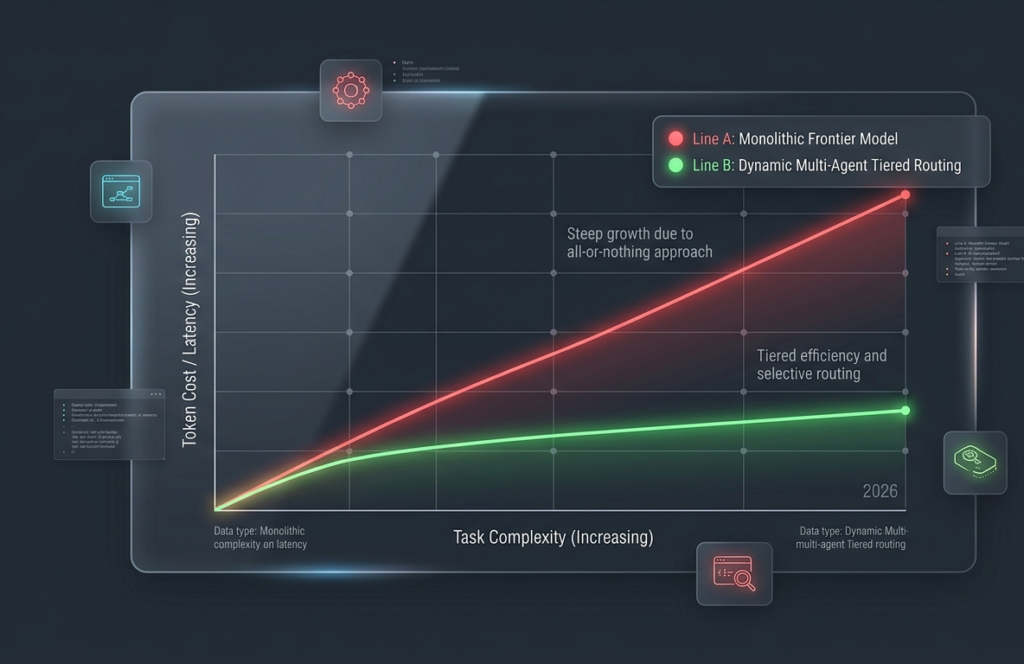
- Compound Network Latency: Multi-hop agent delegation introduces network overhead. Routing a query across three sub-agents in series can add 1.2 to 2.8 seconds of latency compared to single-prompt setups.
- Token Inflation Costs: Context serialization and state transfers between agents introduce a 22–35% token amplification overhead. Organizations must implement model tiering in Azure AI Foundry—using smaller, faster models for intent routing and reserving frontier models for complex reasoning.
- Debugging Complexity: Distributed agent execution makes tracing failure modes difficult. System engineers must rely on detailed trace telemetry within Microsoft Agent 365 to pinpoint whether a failure occurred during intent parsing, A2A state delegation, or MCP tool execution.
Industry Outlook
The transition toward multi-agent convergence marks a fundamental change in enterprise system architecture. As the open A2A and MCP protocol ecosystems mature, enterprise AI environments will increasingly operate like decentralized agent meshes rather than rigid software applications.
Organizations that transition early from isolated chatbots to managed, multi-agent frameworks will gain significant operational advantages. By establishing clear agent domain boundaries, implementing identity-first security through Entra Agent ID, and grounding reasoning in structured enterprise data, tech leaders can build autonomous AI systems that are scalable, secure, and genuinely useful.
8. Summary & Comparison Tables
Protocol Matrix: MCP vs. Agent2Agent (A2A)
| Feature / Dimension | Model Context Protocol (MCP) | Agent2Agent (A2A) Protocol |
| Primary Focus | Agent-to-Tool / Agent-to-Data | Agent-to-Agent (Peer Delegation) |
| Architectural Role | Exposes executable code, functions, and structured data sources to an agent. | Enables independent agents to exchange tasks, share context, and aggregate results. |
| State Handling | Stateless query-response execution against external targets. | Stateful task delegation supporting multi-turn collaboration and progress monitoring. |
| Payload Anatomy | JSON-RPC function definitions, parameters, and database query results. | Semantic goal definitions, execution metadata, and structured task results. |
9. Frequently Asked Questions (FAQ)
1. What is the fundamental difference between a single Copilot assistant and a Super App architecture?
A traditional Copilot operates as a monolithic, single-prompt interface where one model handles system prompts, tool selection, domain context, and generation within a single context window. A Copilot Super App Architecture replaces this with a distributed control plane: a central orchestrator acts as a single “front door” that dynamically delegates sub-tasks to specialized, autonomous background agents based on user intent.
2. How do the Model Context Protocol (MCP) and Agent2Agent (A2A) protocol work together?
MCP and A2A serve complementary roles in the agent stack:
- MCP (Model Context Protocol): Governs Agent-to-Tool/Data interactions, allowing agents to execute functions, query databases, and read structured schemas.
- A2A (Agent2Agent Protocol): Governs Agent-to-Agent delegation, providing a stateful, open protocol for an orchestrator to assign goals, share task history, and receive structured results from peer agents.
3. What is Microsoft Entra Agent ID, and why is it needed for autonomous agents?
Standard service principals and static API keys lack the granular lifecycle control needed for autonomous AI. Microsoft Entra Agent ID provisions non-human identities (NHIs) specifically for AI agents. It enforces double-key authorization, ensures agents cannot elevate privileges beyond the initiating user, and enables conditional access rules for background execution.
4. What are the four pillars of Microsoft IQ grounding?
Microsoft IQ grounds agent reasoning in real-time enterprise context through four distinct channels:
- Work IQ: Indexes organizational structure, emails, chats, and calendar events via the Microsoft Graph.
- Fabric IQ: Connects agents directly to business data and semantic models in Microsoft Fabric OneLake.
- Foundry IQ: Provides policy, SOP, and knowledge index grounding via Azure AI Search.
- Web IQ: Ingests live, public web search data to keep responses current beyond model training cutoffs.
5. How does the Copilot Super App mitigate latency caused by multi-agent handshakes?
To prevent compound delegation latency, orchestrators use parallel execution swarms when sub-tasks are independent and asynchronous A2A handshakes for long-running workflows. System designs also enforce strict delegation depth limits (typically max 3 hops) and strip unnecessary conversation history prior to inter-agent transfers.
References & Primary Technical Sources
1. Protocols & Technical Specifications
- Model Context Protocol (MCP) Open Specification: Anthropic & Linux Foundation AAIC / Open-Source Community. Model Context Protocol Architecture and Schema Specifications. Available at: modelcontextprotocol.io
- Agent2Agent (A2A) Protocol Specification: Open Agent Communications Working Group. A2A Protocol: Inter-Agent Task Delegation, Session Handshakes, and State Propagation.
- JSON-RPC 2.0 Specification: Specialized Protocol Standard for Stateless/Stateful Remote Procedure Calls in Agentic Systems (jsonrpc.org).
2. Microsoft Security, Identity & Infrastructure
- Microsoft Entra ID & Workload Identities: Microsoft Learn. Securing Non-Human Identities (NHIs) with Microsoft Entra Agent ID and Conditional Access Policies.
- Microsoft Agent 365 Architecture: Microsoft Security Community. Centralized Governance, Observability, and Audit Logging for Distributed Agentic Systems.
- OAuth 2.0 On-Behalf-Of (OBO) Flow: Internet Engineering Task Force (IETF) RFC 8693. OAuth 2.0 Token Exchange and Identity Passthrough for Multi-Hop Delegation.
3. Enterprise Data & Grounding Architecture (Microsoft IQ)
- Microsoft Graph & Work IQ Documentation: Microsoft Learn. Mapping Organizational Intelligence, M365 Context, and Graph Signals.
- Microsoft Fabric OneLake & Semantic Link: Microsoft Learn. Fabric IQ: Direct Semantic Layer Grounding and Power BI Model Integration for Copilot Studio.
- Azure AI Search & Foundry IQ: Azure Architecture Center. Enterprise Knowledge Indexing, RAG Pipelines, and Policy Vector Search.
4. Multi-Agent Systems & Academic Research
- Router-Specialist Architectures in LLM Networks: Research Literature on Compound AI Systems (e.g., Berkeley AI Research / Stanford CRFM analysis on agentic decomposition, multi-agent orchestration trade-offs, and token amplification).