

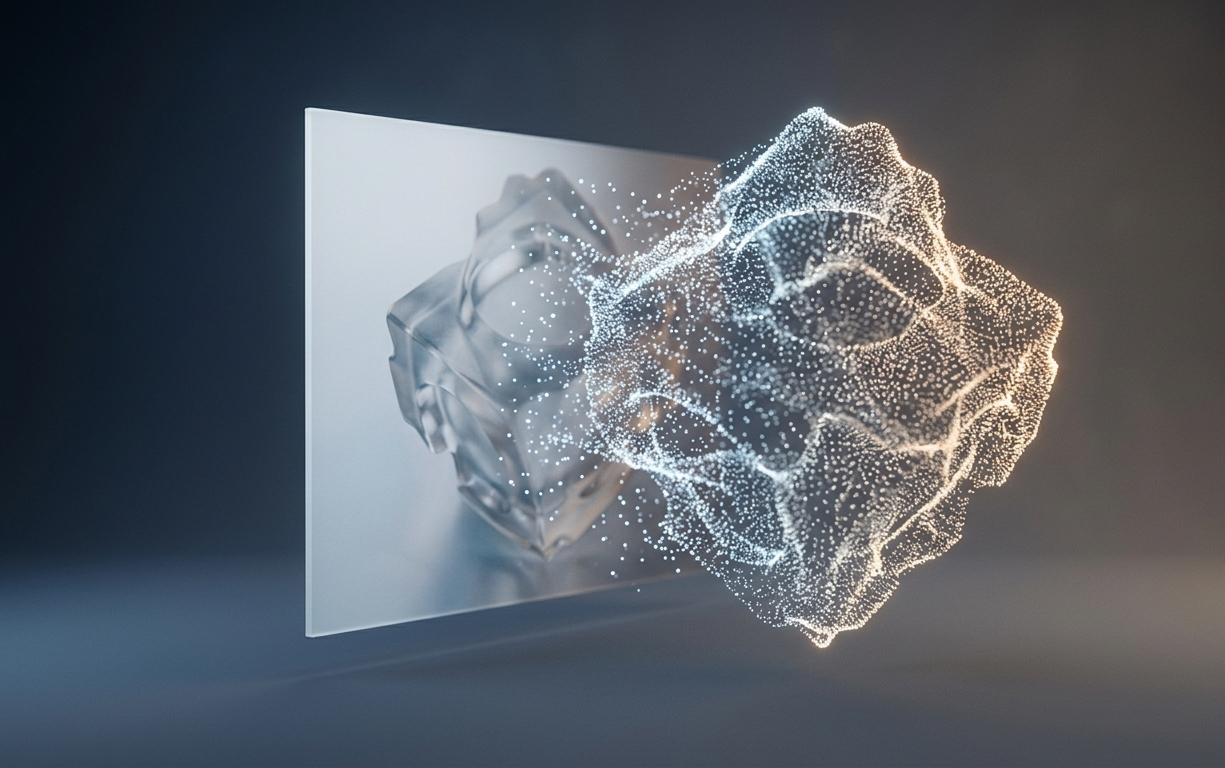
Apple’s machine learning research division has published a new paper describing a way to generate 3D objects from a single photograph that come with realistic, adjustable lighting behavior built in — a persistent weak point in AI-generated 3D content.
The paper, titled “Luce: Relightable Gaussians for 3D Asset Generation,” appeared on Apple’s Machine Learning Research site and on the preprint server arXiv on August 25, 2026. It was authored by a team of ten researchers, including Mayank Singh, Michele Stoppa, and David E. Jacobs, a computational photography researcher whose prior work spans Stanford and Google. There is no indication this is a joint project with any other company — Apple is the sole organization credited across every available source.
That distinction matters because it clears up a discrepancy in how this story first surfaced: some early metadata associated with the announcement referenced Meta AI alongside Apple. No evidence supports a Meta connection. The paper, its authorship, and its hosting all point to Apple Machine Learning Research alone.
It’s worth being clear about what this is and isn’t. Luce is a research paper, not a product announcement. Apple has not said whether or when any version of this technology might appear in a shipping app, developer tool, or device feature. What the company has published is a technical description of a new method, along with benchmark results the researchers say demonstrate its advantages over existing approaches.
Table of Contents
Why Relightable 3D Generation Matters
Generating a 3D object from a single 2D image has become a well-established capability in AI research over the past few years. The harder problem — one the Luce paper addresses directly — is what happens to that object after it’s created.
Most image-to-3D systems produce what researchers call “baked” lighting: the shading and highlights from the original photo get fused permanently into the object’s surface. That looks fine if the object stays under the same lighting it was generated in, but it breaks down the moment someone drops that asset into a game engine, an AR scene, or a design tool with different lighting conditions. Shadows point the wrong way. Highlights don’t shift. The object reads as obviously synthetic.
Apple’s researchers frame Luce as a response to that gap. Instead of baking a single lighting condition into the model, Luce is designed to output the information a rendering engine needs to relight the object naturally — the kind of separation between geometry, material, and light that’s standard in professional 3D pipelines like Unreal Engine and Unity, but has been difficult to reproduce reliably in AI-generated assets. The paper positions this as relevant to gaming, augmented and virtual reality, and industrial design workflows, where assets typically need to move between different lighting environments.
How Luce Works
At a technical level, Luce is built around a representation the researchers call a “voxelized multimodal Gaussian cloud.” That’s a mouthful, but the underlying idea builds on an increasingly common 3D technique called Gaussian splatting, in which a 3D object or scene is represented as a large collection of small, blob-like elements (Gaussians) rather than a traditional mesh of triangles.
What’s different in Luce is that it doesn’t just use Gaussians to represent color and shape. It assigns dedicated Gaussian primitives to each of several distinct properties: the object’s geometry, its albedo (base color), its metallic-roughness characteristics, and its surface normals — the fine-grained information a renderer uses to calculate how light bounces off a surface. Together, these are the ingredients of what’s known as physically based rendering, or PBR, the material model most modern rendering engines rely on.
The system compresses all of that information into what the researchers describe as a “unified material-aware latent space” using a variational autoencoder, a type of neural network commonly used for data compression and generation. From there, a rectified-flow transformer — a newer variant of the diffusion models that power much of today’s generative AI — produces this compressed representation from a single input image. That generation process is guided by features pulled from multiple layers of a pretrained image encoder, which the paper says helps preserve both the overall look of the object and fine spatial detail.
The end result, according to the paper, is a set of relightable PBR Gaussians. Notably, Luce also offers a second output option: a textured mesh with a tangent-space normal map, a more traditional 3D format that’s easier to plug into existing production tools that aren’t built around Gaussian splatting.
What the Benchmarks Show — and Don’t
Apple’s researchers report two sets of results in the paper’s abstract, and both come with important caveats about who measured them.
On Toys4K, an academic benchmark used across many 3D-generation research papers as a standard testing ground for image-to-3D methods, the team reports that Luce improves a measure called FID — Fréchet Inception Distance, a common metric for how closely generated images match real ones — by 28 percent over what they describe as “the strongest baseline.” The paper doesn’t specify which competing method that baseline is in the publicly available abstract.
The team also introduced its own benchmark, built from AI-generated images rather than real photographs, and reports that Luce scores 0.8519 on a CLIP image-alignment metric — a measure of how well a generated 3D object matches its source image — compared to 0.8299 for the best baseline on that same benchmark.
Both figures are company-reported. They come directly from Apple’s own paper, evaluated on benchmarks the company either used as-is (Toys4K, which is independently established in the field) or created itself (the AI-generated image benchmark). No independent lab or third party has yet reproduced or verified these numbers, which isn’t unusual for a paper that’s only days old, but it does mean the results should be read as Apple’s own claims rather than settled, externally confirmed performance.
| Benchmark | Metric | Luce (Apple-reported) | Best Baseline | Verification Status |
|---|---|---|---|---|
| Toys4K | FID (image realism) | 28% improvement over baseline (exact score not disclosed) | Not named in the abstract | Company-reported; not independently verified |
| Apple’s AI-generated image benchmark | CLIP image alignment | 0.8519 | 0.8299 | Company-reported; not independently verified |
The paper describes Toys4K results as state-of-the-art for single-image-to-3D generation on that benchmark — again, a claim tied specifically to that dataset and that comparison, not a broader industry-wide claim.
Where Luce Sits Among Other Approaches
Luce isn’t the only research effort tackling relightable 3D generation. A separate academic paper published in September 2025, describing something called the Large Material Gaussian Model, pursues a similar goal: generating 3D content with PBR materials — albedo, roughness, and metallic properties — using a Gaussian-based representation that supports relighting under different environment maps. The two projects aren’t affiliated, but they reflect a shared direction in the research community: moving Gaussian splatting beyond static appearance toward something that behaves more like traditional, physically-based 3D assets.
Beyond academic research, there’s also a broader commercial landscape of image-to-3D and text-to-3D tools from companies including NVIDIA, Meta, Luma AI, OpenAI, and Meshy. It’s worth being precise here: Apple’s paper does not compare Luce directly against any of these named commercial products. Its benchmark comparisons are against academic baselines on Toys4K and its own newly introduced benchmark. Any comparison between Luce and a specific commercial tool would be speculative at this point.
Availability and Open Questions
As of this writing, there’s no public code repository or downloadable model weights associated with Luce. That’s a meaningful gap for a technique like this: in AI research, especially in computer vision, papers are frequently accompanied by open-source implementations that let outside researchers verify results and build on the work. Luce’s absence from code-hosting platforms doesn’t necessarily mean a release won’t follow, but nothing currently indicates one is planned.
Similarly, the paper’s peer-review status is unclear. It’s currently available as an arXiv preprint and on Apple’s own research site; there’s no public indication of acceptance at a conference such as CVPR or SIGGRAPH, where much of this kind of 3D graphics research is typically presented and formally reviewed.
A number of other technical details also aren’t available in the parts of the paper currently accessible, including how Luce’s inference speed compares to existing Gaussian splatting methods, and what limitations or failure cases the researchers identify — information that’s often included in a paper’s later sections but wasn’t part of the publicly summarized abstract reviewed for this article.
What This Fits Into
- January 2025: Apple publishes DSplats, an earlier Gaussian-based 3D generation paper
- May 2026: Apple publishes HeadsUp, on 3D Gaussian head reconstruction
- August 25, 2026: Luce paper submitted to arXiv
- August 2026: Luce listed on Apple’s Machine Learning Research site
Luce isn’t an isolated project. Apple’s Machine Learning Research site lists it alongside other recent papers from the same general research area, including HeadsUp, focused on reconstructing 3D Gaussian representations of human heads from multi-camera captures, and DSplats, on generating 3D content through Gaussian-based diffusion models. Together, these suggest Luce is part of an ongoing line of internal research into Gaussian-based 3D representation and generation, rather than a standalone experiment.
Conclusion
What’s confirmed here is fairly specific: Apple’s research team has published a technical paper describing a new method for generating relightable, material-aware 3D assets from a single image, and has reported benchmark improvements on an established academic dataset and a newly introduced one. What isn’t confirmed is anything about a product timeline, public code availability, independent verification of the reported numbers, or peer-review status.
For now, Luce is best understood as a data point in Apple’s ongoing 3D graphics research rather than a preview of a specific feature. The more interesting questions — how it performs outside of Apple’s own benchmarks, whether the company releases code that lets others test it, and whether any of this eventually surfaces in a real product — remain open. Those are the developments worth watching next.
Frequently Asked Questions
What is Apple Luce?
Luce is a research method from Apple Machine Learning Research that generates 3D objects from a single photo, with materials and lighting information built in so the object can be realistically relit in different environments.
Is Luce an actual Apple product or just a research paper?
It’s a research paper, published on Apple’s Machine Learning Research site and on arXiv in August 2026. Apple has not announced any product, app, or feature built on Luce.
How is Luce different from previous AI 3D-generation tools?
Rather than baking a single lighting condition into the generated object, Luce separately represents geometry and physically based rendering materials — albedo, metallic-roughness, and surface normals — so the object can react to different lighting once placed in a rendering engine.
What benchmarks did Apple use to test Luce, and how did it perform?
Apple reports a 28 percent improvement in FID score over the strongest baseline on Toys4K, an established academic benchmark for image-to-3D generation, and a higher CLIP image-alignment score (0.8519 versus 0.8299) on a new benchmark built from AI-generated images. Both figures are Apple’s own reported results and haven’t been independently verified.
Can developers access Luce’s code or model weights?
No public code repository or model weights have been found. It’s not currently possible for outside developers or researchers to run or test Luce themselves.
How does Luce compare to tools like Meshy or Luma AI Genie?
Apple’s paper doesn’t include a direct comparison to these or other named commercial tools. Its benchmarks compare Luce against academic baseline methods, not commercial products.
When might Luce become part of an Apple product?
There’s no publicly disclosed timeline or confirmation that Luce is headed toward any specific Apple product or feature.