

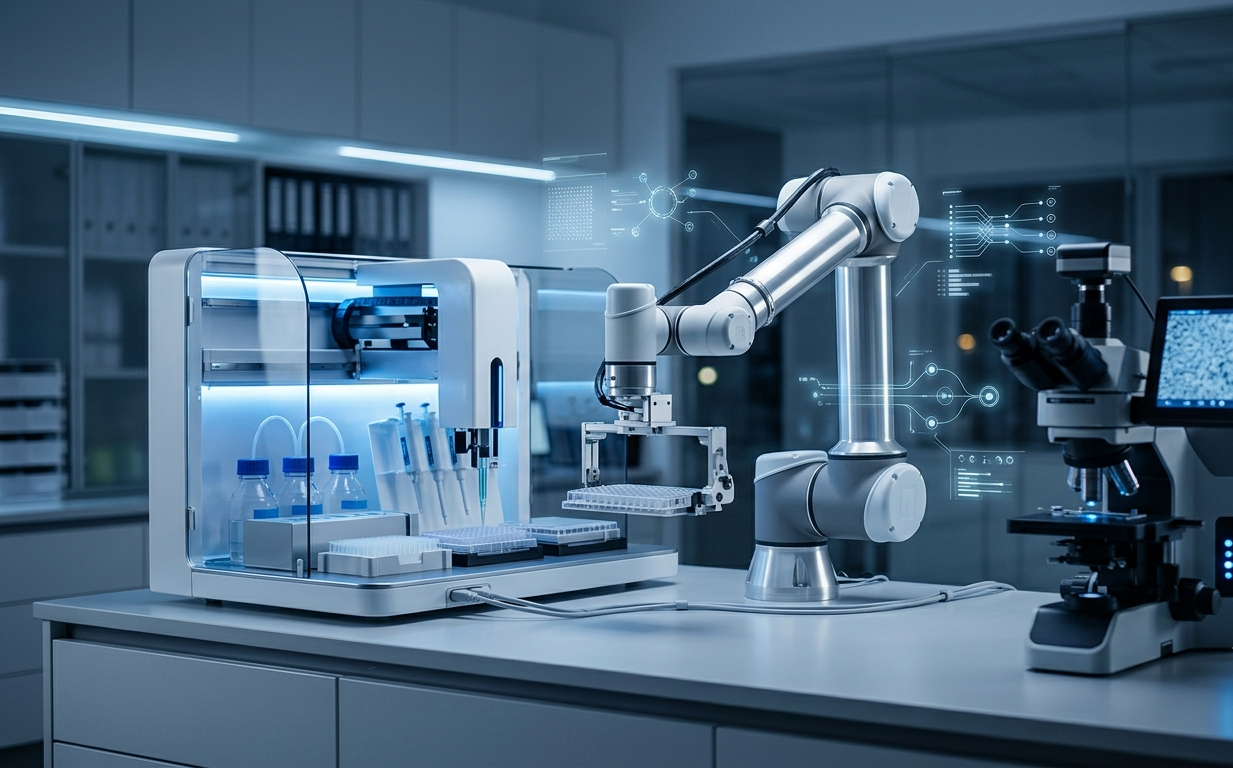
Anthropic has opened a research preview of the Model Hardware Standard, or MHS, a new specification designed to let AI agents like Claude safely operate physical equipment — from microscopes and liquid handlers to robotic arms and laser systems. The announcement, made on August 27, 2026, marks Anthropic’s first significant move beyond software into what the industry has started calling “physical AI.”
MHS is available only to a first group of scientific research labs and advanced manufacturers who apply for access, and Anthropic plans to eventually open-source it — though it hasn’t said when, or under what license. Alongside the announcement, Anthropic published early case studies from partners including Genentech, Carnegie Mellon University, HHMI Janelia Research Campus, and quantum-computing company QuEra, showing what the standard can do — and where it still falls short.
Table of Contents
What Anthropic Announced
At its core, MHS addresses a problem familiar to anyone who has worked in a lab or on a factory floor: hardware doesn’t talk to itself. A liquid handler, a robotic arm, and a microscope typically come from different vendors, each with its own software and control interface, and wiring them together has traditionally taken specialists weeks or months. Anthropic says MHS can cut that integration time to hours or minutes by giving every device a standardized way to describe itself and communicate.
The idea began with Arco Bast, a postdoctoral scientist at HHMI Janelia Research Campus, who built a shared-memory system to let a cobbled-together microscope rig — lasers, cameras, and translation stages from different manufacturers — communicate at high speed. Bast then worked with Anthropic’s Alek Kemeny to bring AI models into that interface, which became the foundation of MHS.
Why It Matters
Anthropic has a track record here worth taking seriously: in 2024, it open-sourced the Model Context Protocol (MCP), now a widely used way to connect AI agents to software tools like email and calendars. Kemeny drew the comparison directly: “What MCP did for software, MHS will do for the hardware world.”
The timing also lines up with a broader industry push into physical AI — Hugging Face unveiled its own robotics product the same day, and Nvidia has a pending deal to acquire Hugging Face for $13 billion. Anthropic isn’t claiming to be first into AI-hardware integration generally — robotics and lab-automation standards have existed for years — but MHS is its first entry into that space, built specifically around how its agents reason and operate.
How MHS Works
MHS introduces a standardized driver: software translating between a computer and a device using simple commands like “read” (get a temperature) or “write” (set a temperature). Any device supporting these primitives becomes discoverable on a network, so an agent — or another device — can find and communicate with it without a custom-built go-between program.
The driver also captures information that has traditionally lived only in paper manuals or in technicians’ heads — such as how much a robotic arm weighs, which matters for handling it safely. Users write this in plain language, either themselves or via an agent interview, producing a reference file describing what a device can measure, adjust, and what safety limits apply.
Once connected, an agent controls devices through three mechanisms — MCP, a command-line interface, and code files — that work together to enable orchestration via a single line of code. For tasks that need to run faster than an agent can reason through step by step, it can chain instructions into a deterministic script; Anthropic describes Claude learning to align a laser by repeatedly nudging it and checking a camera feed, then converting what it learned into a single reusable command.
Safety is partly built into the driver layer rather than left entirely to the agent’s real-time judgment: the reference file records enforceable limits per device. In one test, Carnegie Mellon University researchers induced six fault conditions — a missing plate, a disconnected camera, an active emergency stop, among others — and the system blocked all six before any hardware moved. Anthropic has not, however, published a formal, independently audited safety architecture.
Early Partners and Pilot Projects
The most substantial evidence for MHS comes from a handful of detailed case studies — all pilots or proofs-of-concept, not production deployments.
At Genentech, researchers used MHS and Claude to automate a protein-concentration test called the BCA assay, coordinating a liquid handler, robotic arm, and plate reader. Claude independently worked out optimal liquid-transfer settings for both watery and viscous samples, matching automation experts’ judgment. But when bubbles formed in viscous samples and caused errors, Claude’s first instinct was simply to retry the same action, making the problem worse — researchers had to explicitly teach it the failure was physical, not a software bug.
At Carnegie Mellon University, a team orchestrated a liquid handler, plate reader, robotic arm, and monitoring cameras — three computers with fundamentally incompatible interfaces — to run drug-development dose-response experiments. The full setup, including one autonomous rerun after the agent judged its first result unreliable, took about eight hours versus the multiple weeks a vendor-built setup typically requires, with the resulting experiments running roughly three times faster.
At QuEra Computing, which builds quantum computers based on neutral atoms, engineers tasked Claude with recovering a laser’s precise frequency “lock” after it drifts — normally a five-to-ten-minute job for a trained operator. A prior scripted attempt, built over several months by a team of specialists, succeeded only 58% of the time. After an unattended overnight process where multiple Claude instances proposed, tested, and refined a recovery script, the resulting program — tested in 700 trials with no AI in the loop — succeeded 99.3% of the time, typically in well under 15 seconds.
Other pilots included the University of Washington (remote instrument monitoring and robotic-arm coordination), multiple HHMI Janelia teams (unifying complex microscopy rigs), and Tetsuwan Scientific (citizen-science water-quality testing in a California creek).
Vendors and Hardware Partners Building Support
Beyond the labs piloting MHS, several hardware and software companies are building support into their own products. Amazon Web Services is integrating MHS into its Strands Robots library, providing participants a pre-release version. Doosan Robotics is testing MHS with its robotic arms; Universal Robots has early access with plans to add support. QIAGEN has a proof of concept on its QIAsymphony Connect platform, Tecan is adding support for its Fluent liquid handlers, and MBF Bioscience is building a driver for ScanImage, used in laser-scanning microscopes across neuroscience labs. Danaher says it’s exploring MHS for its instruments — described as exploratory, not committed — while Hugging Face is adding support to its LeRobot library and Raspberry Pi has been testing integration with its hardware.
| Category | Organizations |
|---|---|
| Research pilots (proof-of-concept / academic use) | Genentech, Carnegie Mellon University, University of Washington (Baker & Pinglay labs), HHMI Janelia Research Campus, QuEra Computing, Tetsuwan Scientific |
| Hardware & software vendors (building MHS support) | Amazon Web Services, Automata, Danaher, Doosan Robotics, MBF Bioscience, QIAGEN, Tecan, Universal Robots, Hugging Face, Raspberry Pi |
Performance Claims — What’s Verified, What Isn’t
The QuEra figure was tested across 700 trials with no AI agent in the loop, and cross-checked against an independent specialist retune — the most rigorously tested result of the group. Still, none of the projects has been scaled beyond a single instrument setup or research group, and none should be read as an externally validated benchmark.
How MHS Compares to Existing Standards
MHS isn’t the first attempt to standardize how software controls physical equipment. The Robot Operating System (ROS) has been the de facto robotics standard for years — an open-source framework passing messages between software components, with a large driver library. LabVIEW, a proprietary National Instruments platform, is widely used for the same kind of instrument coordination in labs and industry.
Anthropic hasn’t published a direct technical comparison to either, so this is general context rather than a documented claim. What appears to set MHS apart is that it was designed for AI agents rather than human programmers from the outset: devices describe their own capabilities and safety limits in natural language, and the underlying shared-memory architecture — which grew out of the HHMI Janelia rig — lets many programs, including an AI agent, read and write the same live data at once.
Safety, Limitations, and What Anthropic Acknowledges
Anthropic is candid about where the technology still struggles: “As a large language model, Claude learns about the physical world through text and images,” it wrote, “meaning its spatial and physical reasoning have limitations that still require expert oversight.” The Genentech bubble episode illustrates this, as does QuEra, where engineers noted Claude often couldn’t troubleshoot physical hardware problems — its understanding of the rig was programmatic, not physical — and frequently paused overnight awaiting human approval before any action it judged even slightly risky.
MHS also has structural gaps: it doesn’t yet work with hardware lacking a programmable interface, and running an agent continuously to monitor long experiments carries real computing costs that researchers at the University of Washington noted must be weighed against time saved.
Regulation, Safety, and Legal Context
There’s a genuine regulatory dimension for organizations operating in Europe. The EU’s Machinery Regulation (2023/1230) fully replaces the existing Machinery Directive on January 20, 2027, and for the first time explicitly covers AI-based safety functions and machines with self-evolving behavior. High-risk equipment categories will no longer be able to rely on a manufacturer’s self-declared conformity alone — some may require assessment by an independent notified body.
That matters for MHS because its device-specification files are designed to encode exactly this kind of information — a robotic arm’s safe speed and movement limits, for example. This is general regulatory context, not any specific ruling against Anthropic or MHS; no investigation or enforcement action involving MHS has been reported. But organizations deploying MHS-connected equipment in Europe after January 2027 will need to consider how its safety specifications intersect with these requirements.
Anthropic says it will use the preview period to build additional safety evaluations with launch partners and develop a broader “physical safety roadmap,” and has committed to releasing findings as safety guidance alongside the eventual open-source release — a voluntary commitment, not a regulatory obligation.
What’s Not Yet Known
Several details remain undisclosed: Anthropic hasn’t specified an open-source license or release timeline, there’s no public pricing (MHS isn’t a commercial product yet), the company hasn’t disclosed how many organizations are in the preview beyond its featured partners, and no independent security or safety audit has been published.
What Happens Next
Anthropic says it will keep working with launch partners to refine MHS and build out safety evaluations before releasing it as open source, though it hasn’t committed to a date. It’s also aiming to extend MHS to more hardware categories, including instruments that currently lack a programmable interface, and continues accepting waitlist applicants.
For now, MHS is a promising but early-stage experiment — backed by real, if self-reported, pilot results, but confined to a handful of labs and unproven at scale. Whether it becomes a lasting standard will depend on how it performs once opened beyond hand-picked partners, and how it holds up once Europe’s AI-machinery rules take effect.
Frequently Asked Questions
What is Anthropic’s Model Hardware Standard (MHS)? MHS is a specification that lets AI agents like Claude discover, understand, and safely operate physical devices — such as microscopes, robotic arms, and liquid handlers — through a standardized driver and a shared set of commands, rather than requiring custom-built software for every piece of hardware.
Is MHS available to the public, or only to select partners? It’s currently in a research preview, available only to a first group of scientific research labs and advanced manufacturers who apply for access. Anthropic has opened a waitlist for others interested in joining.
Will MHS be open source, and under what license? Anthropic has said it plans to open-source MHS after the research-preview period, but it has not disclosed a specific license or a release date. That information is not publicly available yet.
How is MHS different from the Model Context Protocol (MCP)? MCP, which Anthropic open-sourced in 2024, connects AI agents to software tools and data sources. MHS is a separate, newer standard focused on physical hardware, and it actually uses MCP as one of three ways an agent can control a connected device — the other two being a command-line interface and code files.
Which companies and labs are using MHS so far? Documented pilots include Genentech, Carnegie Mellon University, the University of Washington’s Baker and Pinglay labs, HHMI Janelia Research Campus, QuEra Computing, and Tetsuwan Scientific. Hardware and software companies building MHS support include Amazon Web Services, Automata, Danaher, Doosan Robotics, MBF Bioscience, QIAGEN, Tecan, Universal Robots, Hugging Face, and Raspberry Pi.
How does MHS handle safety when AI agents control physical equipment? Each device’s MHS reference file records safety limits that are enforced independently of the AI agent’s real-time reasoning, and the system checks device conditions before allowing movement — in one test, it correctly blocked all six artificially induced fault conditions before any hardware moved. However, Anthropic has not published a formal, independently audited safety architecture, and the agents involved still required human oversight and approval for higher-risk actions.
How might EU regulations affect AI-operated machinery like MHS-connected devices? The EU’s Machinery Regulation (2023/1230) takes full effect on January 20, 2027, and for the first time covers AI-based safety functions in machinery. High-risk equipment categories may no longer be able to rely on manufacturer self-declaration of conformity, which could affect how MHS’s safety specifications need to be documented and assessed for European deployments.