

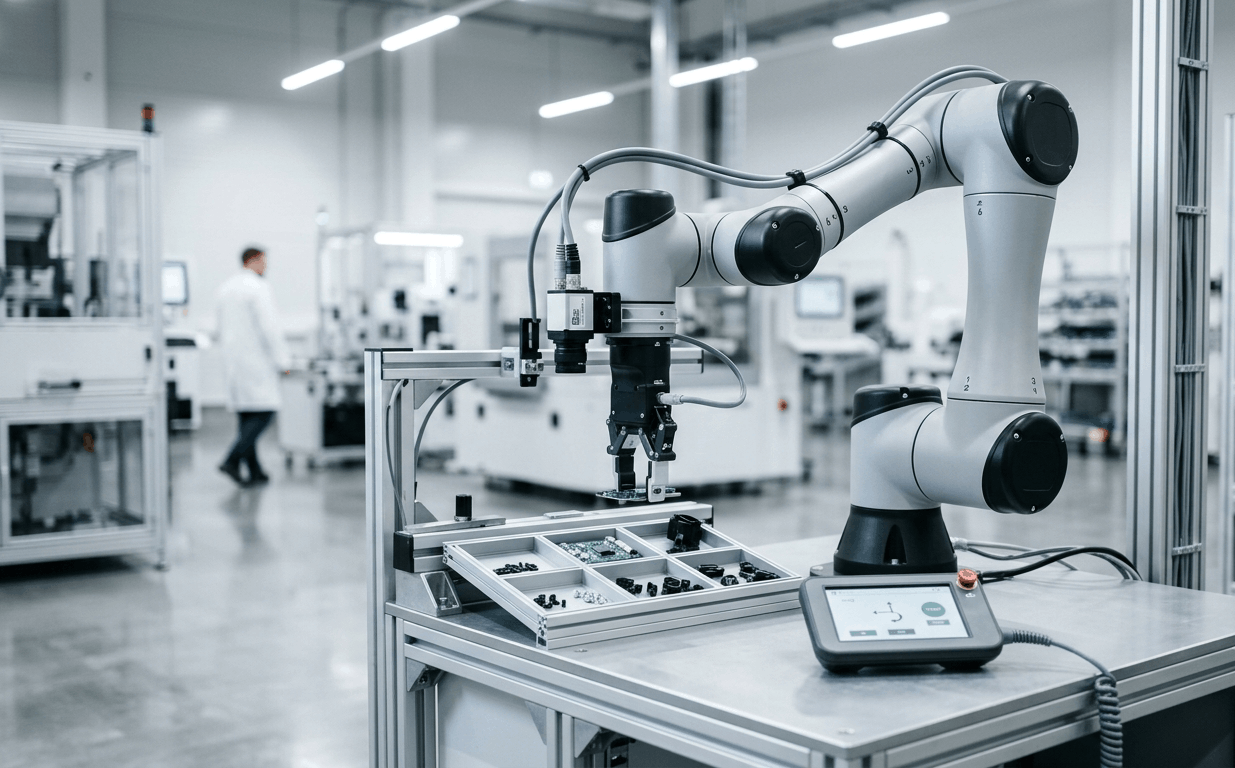
Universal Robots has redesigned its entire collaborative robot platform from the controller out to the tool flange, and it’s betting that the hardest part of deploying AI on a factory floor isn’t the AI model — it’s everything wired around it.
On September 14, 2026, at the IMTS tradeshow in Chicago, the Teradyne Robotics company unveiled Gen 7, its seventh-generation robotics platform. It’s not a single new robot. It’s a coordinated overhaul: three new robot arms, a redesigned controller, a new teach pendant, a new tool-mounted control panel, and updated software, all built around the idea that cameras, sensors, and AI compute should plug in with minimal extra cabling or engineering.
That matters because a lot of industrial AI right now stalls between the demo and the production line. Companies can get computer vision or grasping models working in a lab. Getting that same system running reliably, safely, and cheaply on a factory floor is a different problem — one that’s historically involved external vision computers, extra cabling, and custom integration work. Universal Robots is positioning Gen 7 as its answer to that gap.
Table of Contents
What Was Announced
Gen 7 was introduced as a shipping-class platform, not a preview or a pilot program. Jean-Pierre Hathout, President of the Teradyne Robotics Group, framed it as an end-to-end redesign built on more than 20 years of collaborative robot development and over 100,000 industrial deployments. “The robots of the AI era must be advanced, not complicated,” he said at the launch.
The announcement was corroborated independently by trade outlets including Automation World and Robotics 24/7, which confirmed the date, location, and core components. What hasn’t been independently verified is how the platform performs in practice — the technical claims below come primarily from Universal Robots itself.
The New g-Series Robot Arms
The centerpiece of Gen 7 is a new arm family: the UR10g-1750, UR17g-1300, and UR18g-950. Each is named for its payload in kilograms and reach in millimeters, following Universal Robots’ existing naming convention, and each joins — rather than replaces — the company’s e-Series and UR Series lineups.
| Model | Payload (extended) | Reach | Weight | Repeatability | Max. TCP speed |
|---|---|---|---|---|---|
| UR10g-1750 | 8 kg (10 kg) | 1,750 mm | 44.7 kg | ±0.08 mm | 5 m/s |
| UR17g-1300 | 15 kg (17.5 kg) | 1,300 mm | 40.7 kg | ±0.05 mm | 5 m/s |
| UR18g-950 | 18 kg | 950 mm | 39.2 kg | ±0.05 mm | 4 m/s |
Source: Universal Robots g-Series product page
All three share a 204 mm-diameter base footprint and carry IP65 dust and water protection, aimed at washdown or otherwise dirty industrial environments. They also inherit what Universal Robots describes as an enclosed joint design built on the company’s existing arm architecture — fewer exposed components, in theory, for long-term reliability.
The AI-Ready Tool Flange
The bigger structural change is at the wrist. Universal Robots has rebuilt the tool flange — the mounting point where cameras, grippers, and sensors attach — to carry power, data, and safety signaling directly to that point, rather than routing it back through external cabling to the controller.
Concretely, that means 24/48-volt power (5 amps peak, 3 amps continuous), 1 Gb Ethernet for cameras and sensors, and M8 connectors for digital I/O, analog input, and RS-485 communication, all built into the flange itself. The arms also add built-in force-torque sensing, impedance control, and Real-Time Data Exchange (RTDE), which the company says give the robot a functional sense of touch for tasks like dexterous manipulation or force-sensitive assembly.
The practical pitch is fewer external boxes and cables between the tool and the controller. Whether that translates into meaningfully faster or cheaper integration in real deployments hasn’t been independently measured — it’s a design claim from Universal Robots, not a benchmarked result.
CB7 Core Controller
Sitting behind the arms is a new controller, the CB7 Core, described as the first entry in a new CB7 controller family. Universal Robots says it delivers 40% more compute power than previous-generation controllers, with three 1 Gb Ethernet ports, 16 configurable digital inputs and outputs (some assignable as safety I/O), a 24V DC / 4A power supply, and support for industrial protocols including Modbus, EtherNet/IP, PROFINET, and OPC UA. It carries an IP54 enclosure rating and ships in both a standalone control-box version and a smaller version meant for direct integration into an automation cabinet. Importantly, CB7 Core is backward-compatible with existing e-Series and UR Series arms, not just the new g-Series.
Here’s where things get less tidy. Universal Robots’ own materials disagree on how much smaller the new controller is. The launch press release and the dedicated CB7 Core product page both state a 30% smaller footprint, specifically compared to the prior CB5.6 controller. But the general Gen 7 platform landing page describes the same controller as “reducing footprint by 20%.” Both figures come directly from Universal Robots — there’s no indication which one is the intended, corrected number, and no third-party source resolves the discrepancy. Readers evaluating the CB7 Core’s physical footprint against cabinet space should treat this as an open question rather than a settled spec.
TP7 Core Teach Pendant and SP7 Smart Panel
Two new interface devices round out the physical redesign. The TP7 Core teach pendant — the handheld device operators use to program and control the robot — gets an 11.6-inch Full HD touchscreen, dual three-position enabling (3PE) grips for different hand positions, two configurable “Smart Buttons,” a new virtual joystick for jogging the robot, and a field-replaceable cable rated up to 12 meters.
Universal Robots describes the TP7 as “more than 20% lighter” than earlier pendants, but doesn’t disclose what it’s being compared against, so that percentage can’t be independently checked. There’s also an internal inconsistency on the product’s own weight: the page’s meta description states the pendant weighs “under 1.2 kg,” while the body text gives a specific figure of 1.39 kg and describes it elsewhere as “under 1.4 kg.” Those two numbers don’t match, and nothing in Universal Robots’ public materials explains why.
The SP7 Smart Panel is a new addition rather than an upgrade to an existing part — a detachable control interface that mounts directly at the tool flange. It includes an integrated two-hand freedrive button for guiding the robot by hand, three configurable buttons tied to PolyScope X “Smart Skills,” and an LED status ring. Because it’s removable, Universal Robots says a single panel can be shared across multiple robots and pulled off before dirty or high-heat processes like welding or machining.
PolyScope X Software
All of this hardware runs on PolyScope X, Universal Robots’ robot operating environment. For Gen 7, the company highlights open APIs and a software development kit for building AI applications natively, ROS2 communication for connecting external compute, and onboard logic programs that can handle sequencing tasks without a separate external PLC. Optional add-on packages extend it further with protocols like ProfiSafe and OPC-UA, and third-party developers — including Rocketfarm and Inbolt — already offer applications, such as 3D vision guidance, built to run on it.
It’s worth noting that PolyScope X itself isn’t new to this announcement; Universal Robots has marketed it as a general software platform separately from Gen 7. The launch materials describe how it integrates with the new hardware, but they don’t specify which PolyScope X capabilities are new specifically to this release versus features that existed already.
Safety and Cybersecurity Certifications
On compliance, Universal Robots states that Gen 7’s safety architecture meets Category 3, Performance Level d under ISO 13849-1, with the g-Series arms TÜV-certified to ISO 10218-1 and UL 1740. The company also says Teradyne Robotics holds IEC 62443-4-1 ML3 certification for cybersecurity — a standard covering secure development practices across the software lifecycle. These are certifications reported by the company; this article did not independently verify the underlying test documentation.
Ecosystem and Partner Demonstrations
At IMTS, Universal Robots showcased Gen 7 alongside more than 20 ecosystem partners, including machine-vision company Cognex, gripper maker Schunk, Robotiq, and vision-guidance firm Inbolt. Inbolt’s CEO, Rudy Cohen, said the partnership lets his company’s vision software “run natively on the UR controller itself,” eliminating the need for a separate vision PC. Universal Robots says Gen 7 remains compatible with its existing UR+ marketplace of certified third-party hardware and software. These are promotional statements from the company and its partners, not independent performance evaluations, but they do indicate real integration work has already happened ahead of launch.
What’s Not Yet Known — Availability and Pricing
For all the detail Universal Robots has published about specifications, it has not disclosed when Gen 7 hardware will actually be available to order, in which regions it will roll out first, or what any of it will cost. Every product page directs interested buyers to a “Get pricing” contact form rather than listing a price. No independent source — including financial and trade press covering the launch — has reported a shipping date or price either. For now, anyone evaluating Gen 7 for a near-term project should treat availability and cost as open questions to raise directly with Universal Robots’ sales team, not assumptions to build a budget around.
Conclusion
Gen 7 is a real, launched platform, not a concept or a roadmap teaser — Universal Robots has published detailed specifications across three new arms, a new controller, a new pendant, and a new tool-mounted panel, and independent trade coverage confirms the announcement itself. The redesigned tool flange and controller represent a genuine architectural shift toward reducing the cabling and external hardware that industrial AI deployments have typically required.
At the same time, several of the company’s own numbers don’t agree with each other — the CB7 Core’s footprint reduction and the TP7 pendant’s actual weight are both inconsistently stated across Universal Robots’ own web pages — and neither price nor availability has been disclosed anywhere. What’s confirmed is the platform’s existence and its design intent. What remains to be seen is when it reaches customers, what it costs, and how its performance claims hold up once independent users and reviewers get hands-on access. That last part — real-world deployment data — is the thing worth watching for next.