

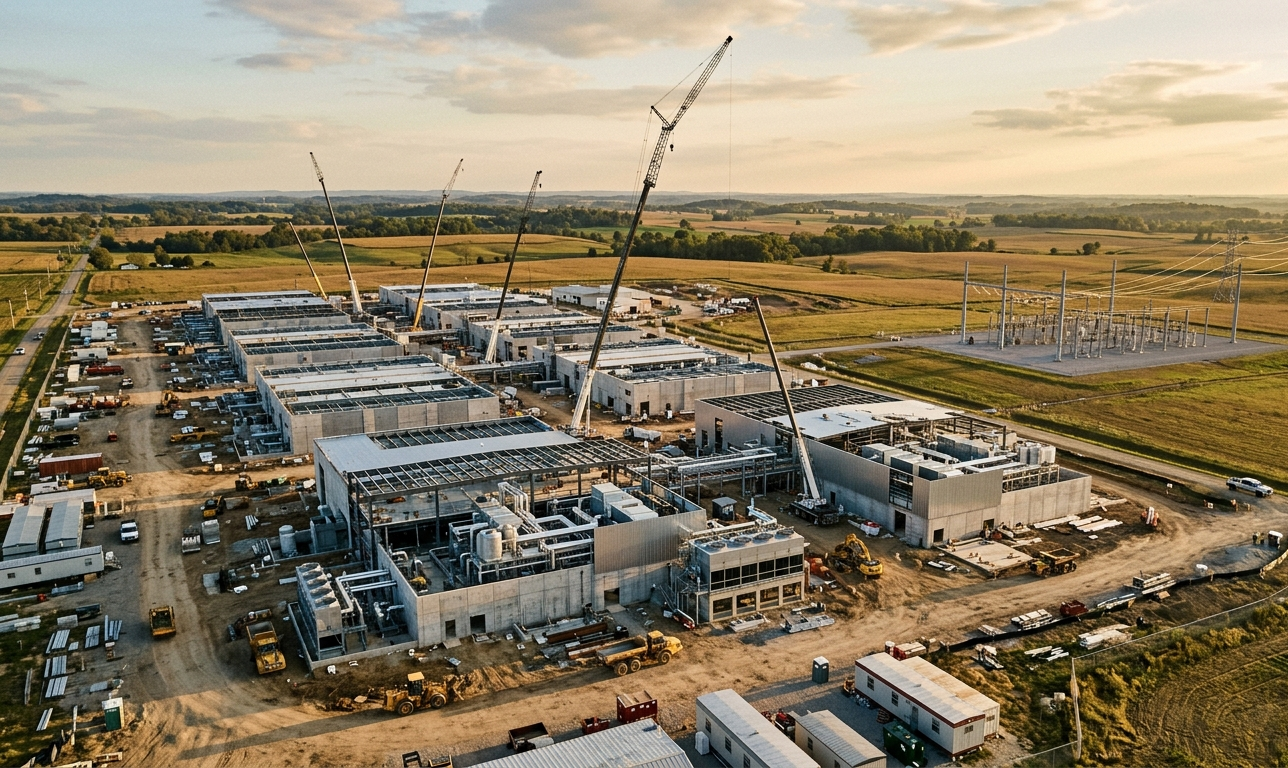
OpenAI has formally confirmed its role as anchor tenant in one of the largest AI data center campuses under development in the United States, securing roughly 8 gigawatts of IT capacity at the PORTS-Pike Technology Campus in Pike County, Ohio. The announcement, published August 17, 2026, arrived alongside a coordinated release from Nvidia detailing up to $105 billion in financing for the project and a direct $1.5 billion equity investment in SB Energy, the SoftBank-owned company building the site.
The deal is notable less for being new — the campus was first unveiled by the Department of Energy and SB Energy back in March 2026 — and more for what it locks in: a 20-year lease, a specific capacity figure, and a financing structure that had been publicly renegotiated just days earlier. It also revives, for AI infrastructure, a stretch of federal land with a very different history: the site of the former Portsmouth Gaseous Diffusion Plant, which once enriched uranium for the United States’ nuclear weapons program.
Table of Contents
What OpenAI Announced
According to OpenAI’s own blog post, the company has entered into an agreement to secure approximately 8 gigawatts-IT (GW-IT) at the PORTS-Pike Technology Campus, spanning private land and remediated federal land in Pike County. Under the arrangement, SB Energy will build, own, and operate the data center, while OpenAI leases capacity from it over a 20-year term. The site will exclusively host Nvidia AI compute infrastructure.
This is a confirmation and formalization of a project that has been in motion for months, not a groundbreaking announcement. Construction reportedly began around March 2026, when DOE and SB Energy first announced the partnership. What’s new on August 17 is OpenAI’s specific capacity commitment and the accompanying financing and community-investment details.
OpenAI says it will begin paying for capacity only as it becomes available for lease, funding those payments through business revenue and cash flow along with capital raised from investors. The company has not disclosed a total dollar figure for its own lease commitment.
| Figure | Value | Source |
|---|---|---|
| OpenAI capacity secured | ~8 GW-IT | OpenAI |
| Nvidia financing (initial phase) | Up to $105 billion | Nvidia |
| Nvidia equity stake in SB Energy | $1.5 billion | Nvidia |
| Projected construction jobs | 35,000 (company estimate) | OpenAI |
| Projected long-term operating jobs | 2,500 (company estimate) | OpenAI |
| OpenAI community investment | $40 million grant fund + up to $84 million in Codex credits | OpenAI |
| First capacity online | ~800 MW, expected 2028 | OpenAI |
The Nvidia Financing Piece
Nvidia’s side of the announcement centers on two numbers: a $1.5 billion direct equity investment in SB Energy, and financing of up to $105 billion tied to the initial 4.25 IT-GW of the buildout, with an option to extend that support to cover an additional 3.75 IT-GW.
That $105 billion figure is itself the product of a rapid renegotiation. Reporting from CNBC in late July, citing the Wall Street Journal, described talks over a Nvidia financial backstop of up to $250 billion that would let OpenAI raise construction and lease debt against Nvidia’s balance sheet rather than its own — a workaround for the fact that OpenAI does not carry an investment-grade credit rating. By mid-August, the Journal reported that figure had been cut to under $120 billion after investors raised concerns about Nvidia’s risk exposure; Nvidia shares reportedly fell around 5% when the original $250 billion number first surfaced. The $105 billion disclosed on August 17 is the figure that emerged from that scaling-back process, corroborated by a securities filing reported by CNBC.
It’s worth being precise about what this money covers. The guarantee applies to the data center lease and construction debt — not to the Nvidia chips that will eventually fill the building, which are the subject of separate, and reportedly much larger, financing discussions. And critically, this is Nvidia’s commitment, not OpenAI’s. OpenAI’s own direct spending on the project remains undisclosed.
A Cold War Site’s Second Act
The land underlying much of the PORTS-Pike campus carries a specific history that shapes both the opportunity and the scrutiny around the project. The Portsmouth Gaseous Diffusion Plant was built between 1952 and 1956 as the third of three federal uranium-enrichment sites in the United States, alongside facilities in Oak Ridge, Tennessee, and Paducah, Kentucky. From 1954 until 2001, it enriched uranium first for the U.S. nuclear weapons program and later for commercial nuclear power. The site, which spans roughly 3,700 to 3,800 acres, has been undergoing decontamination and decommissioning under Department of Energy oversight since 2011.
OpenAI’s announcement leans into this history, framing the project as giving a site once devoted to national security work a new purpose in what the company calls the “Intelligence Era.” The company also credits federal leadership in advancing the site’s redevelopment, tying the project explicitly to executive orders on AI leadership, energy expansion, and accelerated data center permitting.
Because the campus sits partly on DOE-controlled land under a federal lease rather than conventional private property, its permitting pathway runs primarily through the Department of Energy rather than standard local zoning. SB Energy has also committed to helping fund DOE’s ongoing environmental cleanup at the site as part of the arrangement.
Jobs and Community Investment
OpenAI’s release lays out a specific set of local commitments. The company projects that the PORTS-Pike Technology Data Center will generate 35,000 construction jobs over a six-year buildout running through 2032, along with 2,500 long-term operating positions. It says it will prioritize local workers, contractors, and suppliers, and points to a signed memorandum of understanding between the campus and North America’s Building Trades Unions covering construction labor.
On direct investment, OpenAI is committing $40 million to a community grant fund, matching an existing $40 million commitment from SB Energy, for priorities identified by local residents — schools, public safety, health care, workforce training, and similar categories. Separately, OpenAI is making up to $84 million in Codex credits available through ChatGPT to an estimated 844,000 eligible Ohio college, community college, and technical school students during the 2026–2027 academic year. Combined, OpenAI describes its local investment and Codex credits, together with SB Energy’s grant, as representing more than $160 million in benefits for Pike County and Ohio residents.
These figures are OpenAI’s own claims and have not been independently audited. It’s also worth noting that job estimates for the broader project have varied depending on which piece is being counted: reporting from a public open house for the associated power plant cited a poster estimating around 5,000 “craft labor” construction workers, 400 planning and construction staff, and 110 permanent operating employees — figures that appear to describe just the power generation component rather than the full data center campus.
The Power Behind the Compute
A data center of this scale needs an enormous amount of electricity, and that requirement is arguably the most consequential — and most contested — part of the project. SB Energy and SoftBank plan to build at least 10 gigawatts of new power generation to serve the full campus. Independent reporting from outlets including POWER Magazine and Inside Climate News puts roughly 9.2 gigawatts of that generation as natural gas-fired capacity, which several outlets have described as among the largest gas-fired power buildouts tied to a single data center project. That specific figure does not appear in OpenAI’s own release, which focuses instead on cost allocation and grid reliability.
On that point, OpenAI states the project will pay its own energy and infrastructure costs, with SB Energy covering the full cost of grid upgrades and new transmission lines needed to serve the data center — costs the companies say will not be passed on to Ohio ratepayers. Separately, American Electric Power (AEP) Ohio is reported to be investing $4.2 billion in regional transmission infrastructure connected to the project.
On water, OpenAI describes a recirculating cooling design rather than one that continuously draws fresh water, and says that once the system is up and running, day-to-day consumption should land in the same range as a typical office building with a comparable number of people on site. The company says it will publish specific water-use figures once the site design is finalized; those numbers are not yet available.
| OpenAI’s Stated Figures | Independent Reporting |
|---|---|
| 35,000 construction jobs, 2,500 operating jobs | Open-house materials cited roughly 5,000 craft workers, 400 planning/construction staff, and 110 operating employees — for the power-plant component alone |
| Water use “significantly less” than the historic plant, comparable to an office building | Specific figures not yet published; pending final site design |
| Total local benefit “more than $160 million” | Not independently audited |
| Project “pays its own energy and infrastructure costs” | AEP Ohio reported to be investing $4.2 billion in transmission upgrades tied to the project |
| New generation described in general terms | Independent reporting puts roughly 9.2 GW of the 10 GW generation plan as natural gas-fired |
Timeline and Status
Nothing at PORTS-Pike is operational for OpenAI’s use yet. Construction is reported to have started around March 2026, when DOE and SB Energy first announced the partnership. OpenAI’s release indicates the first 800 megawatts of capacity are expected to become available in 2028, largely using existing AEP infrastructure, with further phases requiring new power plants, transmission lines, and associated infrastructure. The full buildout, potentially approaching 10 gigawatts, is expected to continue through 2032.
OpenAI describes this as an evolving relationship rather than a fixed plan, saying it will publish an annual report on local hiring, community investment, water use, and project-related energy use, and that a broader “Ohio Community Compact” will be shaped by ongoing input from residents, officials, and labor groups.
Local and Financial Risk Factors
The project’s scale has drawn both enthusiasm and pointed questions. At a public open house in Waverly, Ohio, in late July, Pike County Commissioner Tony Montgomery was asked whether financial trouble could derail the project and leave the county with unused infrastructure. According to Inside Climate News, Montgomery said the question had come up locally, and raised what would happen years down the line if the project stopped being viable, potentially leaving the community with buildings it couldn’t repurpose. He said he believes the potential for jobs and investment outweighs those risks, but that details would become clearer as development proceeds.
Economists have also flagged the tightly interlocking financial relationships among the companies involved. Columbia Business School’s Stijn Van Nieuwerburgh, commenting on the arrangement to Inside Climate News, described OpenAI, Nvidia, SoftBank, and SB Energy as largely “bankrolling each other.” OpenAI itself remains unprofitable, with reported private valuations ranging from roughly $852 billion to nearly $1 trillion depending on the report, a dynamic that has drawn scrutiny over its capacity to fund large, long-term infrastructure obligations.
As of a spring 2026 snapshot from independent trackers — the most recent available — no formal moratorium or organized opposition group specific to the PORTS-Pike project had been documented, a contrast with several other Ohio counties where local moratoriums and advocacy campaigns have become more common amid statewide concern over data center growth. That status could have shifted in the months since. Independent trackers have also raised open questions about environmental monitoring near the site’s still-contaminated legacy areas, including groundwater management during data center cooling operations and radiological monitoring of any cooling-water discharge. As of that same spring 2026 snapshot, a project-specific state environmental permit for the data center had not yet been published, a function of the site’s federal-land status placing primary regulatory oversight with the Department of Energy rather than state environmental regulators; this status may have changed since.
What’s Still Unknown
Several material details remain undisclosed. OpenAI has not published a total dollar figure for its own lease and capacity commitment at PORTS-Pike, distinct from Nvidia’s financing package. Final water-use projections are pending completion of the site design. The precise state and federal permitting pathway for the data center itself — as opposed to the broader power generation buildout — is not fully documented in public sources. And the current status of earlier-reported interest from other AI companies, including Anthropic, Google, and Microsoft, in the broader Portsmouth site is unclear; it is not known whether those discussions are ongoing, exploratory, or superseded by OpenAI’s confirmed tenancy.
Conclusion
The August 17 announcement doesn’t change the fundamental shape of the PORTS-Pike project so much as it locks specific numbers into place: an 8 GW-IT capacity commitment from OpenAI, a $105 billion financing structure from Nvidia, and a set of community investment pledges totaling more than $160 million by OpenAI’s own accounting. What it also makes clear is how much of this remains provisional. The financing figure changed twice in the weeks before this announcement. The full power buildout — including a natural gas commitment larger than what OpenAI’s own materials describe — is still working through permitting and construction. And the total price tag for OpenAI’s side of the deal has not been made public.
For a project built on a site once dedicated to enriching uranium for national defense, the stakes for Pike County are already tangible: construction is underway, jobs are meant to follow, and a community fund has been pledged. Whether the broader financial structure holds up over a build-out stretching to 2032 — and whether the environmental and regulatory questions raised by independent observers get clear answers — are the things worth watching next.
Frequently Asked Questions
What exactly did OpenAI announce about the PORTS-Pike project? OpenAI confirmed it has secured approximately 8 gigawatts-IT of capacity at the PORTS-Pike Technology Campus in Pike County, Ohio, under a 20-year lease with SB Energy, which will build, own, and operate the data center. The announcement formalizes and expands on a project first revealed by the Department of Energy and SB Energy in March 2026.
How much capacity is OpenAI securing at the Ohio data center? Roughly 8 GW-IT, out of a total planned campus buildout of up to about 10 GW.
How much is Nvidia investing or guaranteeing for the project? Nvidia is investing $1.5 billion directly in SB Energy and providing up to $105 billion in financing for the initial 4.25 IT-GW of the buildout, with an option to extend support to an additional 3.75 IT-GW. This figure was reduced from an earlier reported range of up to $250 billion, and later under $120 billion, before settling at $105 billion.
Why is the data center being built on a former nuclear site? The campus occupies private land alongside remediated federal land at the former Portsmouth Gaseous Diffusion Plant, which enriched uranium for U.S. nuclear weapons and commercial power from 1954 to 2001. The Department of Energy has been decontaminating and decommissioning the site since 2011, and federal officials have framed its redevelopment for AI infrastructure as part of a broader push to expand American AI and energy capacity.
How many jobs will the project create, according to OpenAI? OpenAI projects 35,000 construction jobs over a six-year buildout through 2032 and 2,500 long-term operating jobs. These are the company’s own estimates and have not been independently verified; other reporting on just the associated power plant has cited smaller, differently scoped job figures.
When will the data center actually be operational? The first 800 megawatts of capacity are expected to come online in 2028, with the full buildout continuing through 2032. As of this announcement, no capacity is yet operational.
Are there environmental or community concerns about the project? Yes. Independent reporting has highlighted the scale of the natural gas generation involved (estimated around 9.2 gigawatts) and raised questions about environmental monitoring near the site’s contaminated legacy areas. Local officials have also raised questions about long-term financial viability. As of a spring 2026 snapshot — the most recent available — no formal opposition group or moratorium specific to PORTS-Pike had been documented, unlike in some other Ohio counties, though that status may have changed since.