

Table of Contents
Role Overview
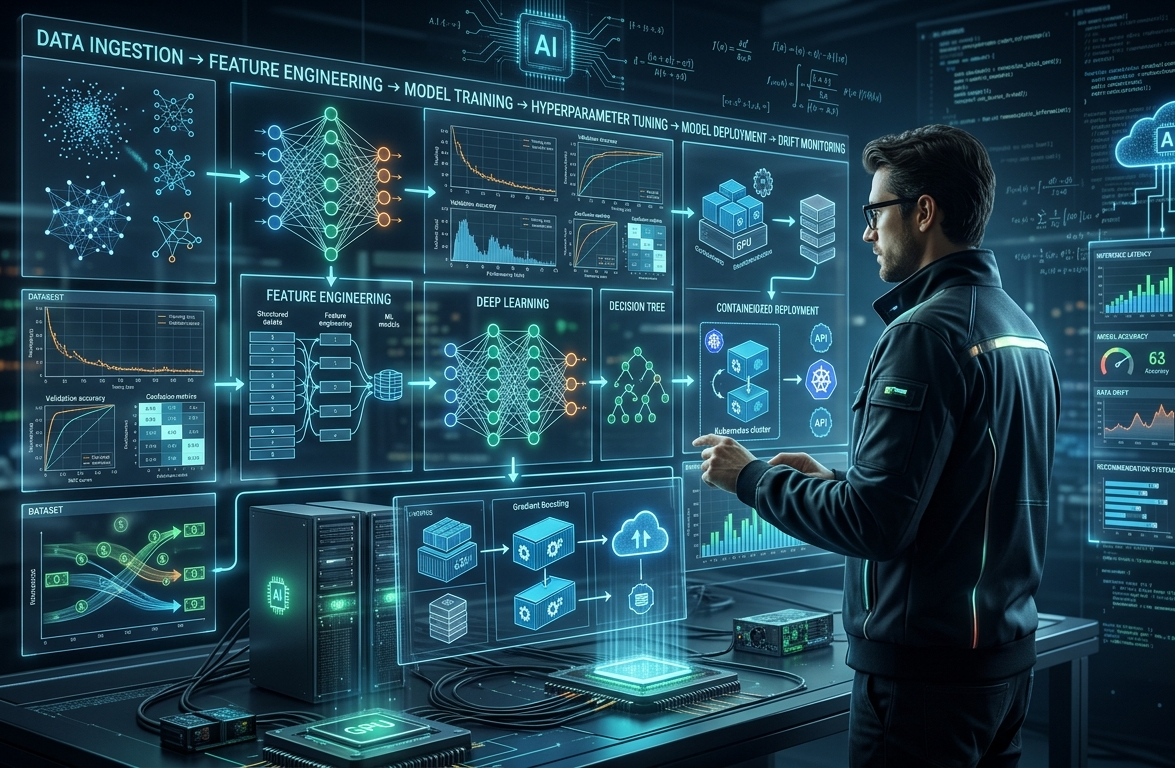
A Machine Learning Engineer bridges data science and software engineering. MLEs design, train, evaluate, and productionize machine learning models capable of serving predictions reliably at enterprise scale.
Daily Responsibilities
- Building feature engineering pipelines and maintaining centralized feature stores (e.g., Feast).
- Selecting, training, and tuning traditional machine learning algorithms (XGBoost, Random Forests) and deep neural networks (PyTorch).
- Converting models into high-performance formats (ONNX, TensorRT) to reduce inference latency.
- Deploying models as microservices behind load balancers and monitoring for performance degradation (data and concept drift).
Technical Requirements
- Languages: Python (expert), C++ (for hardware acceleration and core execution), SQL.
- Mathematics: Multivariate Calculus (partial derivatives, gradients, backpropagation derivations), Linear Algebra (matrix decompositions, eigenvalues, SVD), Probability & Inferential Statistics.
- Frameworks & Libraries: PyTorch, TensorFlow, Scikit-Learn, XGBoost, LightGBM, NumPy, Pandas.
- MLOps Tools: MLflow, Weights & Biases, Docker, Kubernetes, Feast.
Portfolio Projects
- Real-Time Financial Fraud Detection Service: Train an XGBoost model on imbalanced transactional data. Log metrics with MLflow, containerize the serving application with Docker, deploy it via FastAPI, and set up Prometheus/Grafana alerts to detect data drift.
- Distributed Recommendation System: Build a collaborative filtering recommendation engine using PyTorch running across multi-GPU setups on a large public dataset (e.g., MovieLens 25M).
Recommended Free Resources & Books
- Free Courses: Stanford CS229 (Machine Learning) & Fast.ai (Practical Deep Learning for Coders).
- Official Docs: PyTorch Official Tutorials, Scikit-Learn Guide.
- Recommended Book: Hands-On Machine Learning with Scikit-Learn, Keras, and TensorFlow by Aurélien Géron.