

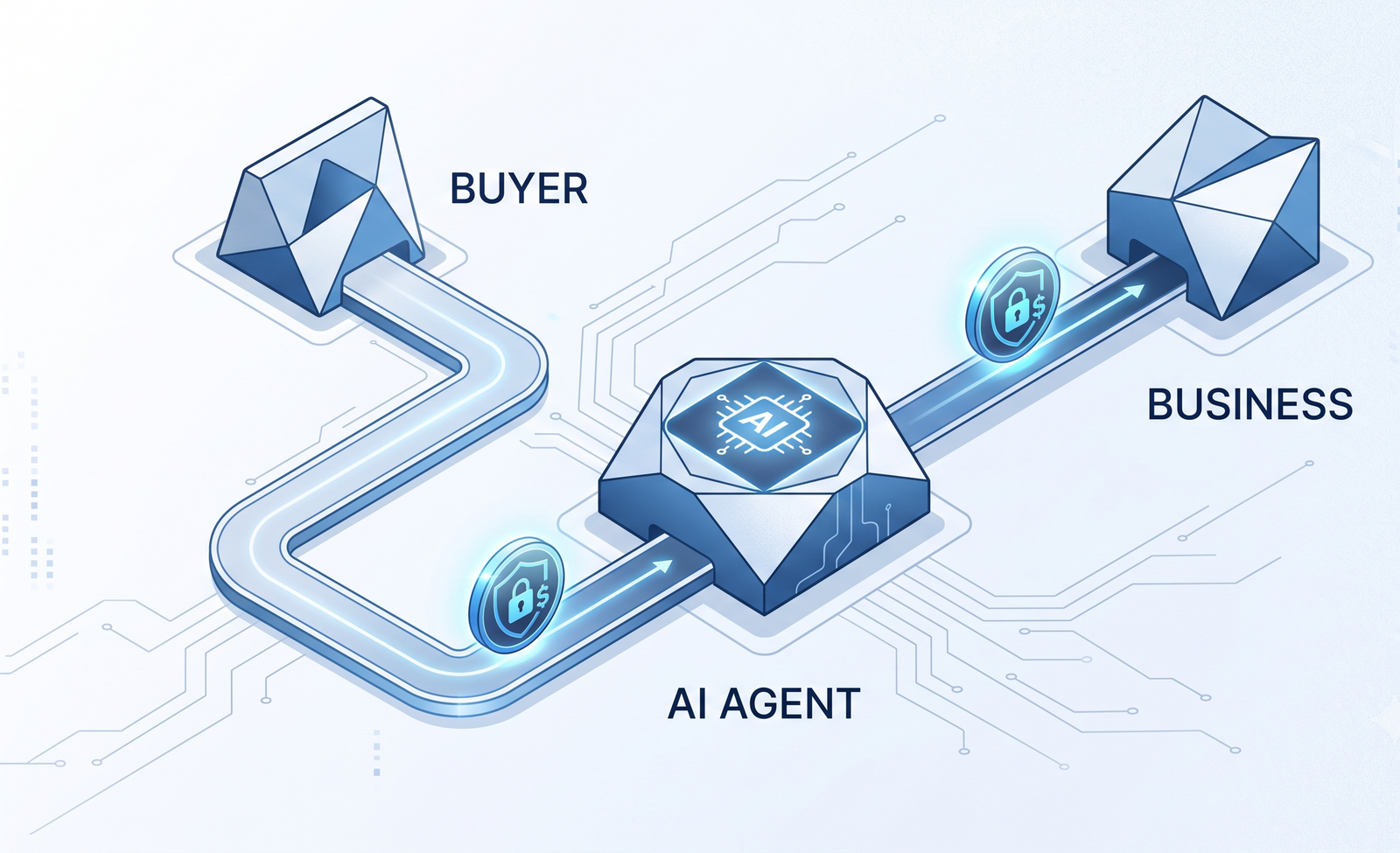
AI agents are starting to do more than answer questions — they’re starting to buy things. That shift has created an obvious, practical problem: how does a business let software it doesn’t control spend money on its platform, safely, at scale? Stripe’s answer is the Agentic Commerce Suite, a set of tools it announced on December 11, 2025, to let businesses sell through AI agents with a single integration. It’s real, it’s shipping, and several of the internet’s biggest retail and e-commerce names are already lined up to use it. But “shipping” and “finished” aren’t the same thing, and a close read of Stripe’s own documentation shows some of the suite’s core pieces are still limited in ways that matter for anyone deciding whether to build on them today.
Table of Contents
What the Agentic Commerce Suite Is
At its core, the Agentic Commerce Suite is a low-code way for a business to make its products discoverable to AI shopping agents and accept payments from them, without building a separate integration for every AI platform that might send it customers. Stripe handles product discovery, checkout, payment processing, and fraud screening; the merchant uploads a catalog once and chooses which agents can sell it.
At launch, Stripe named a substantial roster of businesses and platforms as partners, including Coach, Kate Spade, URBN’s brands (Anthropologie, Free People, Urban Outfitters), Revolve, and Ashley Furniture, alongside e-commerce platforms Squarespace, Wix, Etsy, WooCommerce, commercetools, and BigCommerce. That’s a meaningful list, but it’s worth reading the announcement’s own language carefully: these companies “will use” the suite as it “rolls out,” which is future-tense rollout language, not a claim that millions of transactions are already flowing through it.
Why This Matters Now
The pressure behind this launch is straightforward. As AI agents move from retrieving information to executing tasks — including purchases — payments infrastructure becomes a bottleneck. A business can’t safely expose its catalog and checkout to an autonomous buyer it can’t see or interview, unless something standardizes how permissions, fraud checks, and payment credentials get handled.
That’s also why Stripe isn’t alone here. In roughly the same window, Adyen, PayPal, Airwallex, Visa, and Mastercard have all launched comparable agentic-commerce products of their own. This is an emerging, competitive infrastructure category, not a market Stripe has to itself.
How It’s Built: ACP, Shared Payment Tokens, and Machine Payments Protocol
Underneath the Agentic Commerce Suite sits the Agentic Commerce Protocol, or ACP — an open technical standard, not a Stripe-only product. According to Stripe’s documentation, ACP defines four building blocks: agentic checkout (creating and completing a checkout session, including cart and fulfillment management), cart and feed (letting an agent browse a merchant’s catalog before checkout), delegate payment (passing payment tokens securely between buyer, agent, and business), and delegate authentication (using OAuth 2.0 so an agent can act on a buyer’s behalf).
The payment piece is handled through Shared Payment Tokens, or SPTs — Stripe’s term for a scoped, time-limited credential. Rather than handing an agent a card number, a buyer’s payment method is represented by a token that’s tied to a specific seller, capped at a maximum amount, and set to expire. The seller uses that token to create a standard Stripe PaymentIntent; behind the scenes, Stripe clones a payment method from the customer’s original one, so refunds and reporting work the same way they would for an ordinary card payment.
A related, lower-level protocol called the Machine Payments Protocol (MPP) supports agent-initiated one-time charges more broadly, including a path for stablecoin settlement in addition to card-based SPT payments — useful for agents that hold crypto wallets rather than card credentials.
Who Created ACP — and a Timeline Wrinkle
Here’s a detail that’s easy to get wrong. When Stripe and OpenAI first announced ACP, on September 29, 2025, they described it as a standard the two companies had codeveloped together, releasing it alongside OpenAI’s “Instant Checkout” feature in ChatGPT. Stripe’s documentation today describes ACP differently: as “an open standard created by Stripe, OpenAI, and Meta.”
Both things can be true at different points in time — the standard may simply have picked up a third co-creator after its initial launch — but the exact date and terms of Meta’s addition aren’t documented anywhere in Stripe’s public materials that address this. Readers should treat ACP as a Stripe-and-OpenAI creation that now also credits Meta, rather than assuming all three companies were involved from day one.
Fraud Protection: Stripe Radar and Non-Stripe Processors
One of the more direct reader questions about agentic commerce is whether fraud protection extends beyond Stripe’s own processing. It does, at least on paper. Stripe has expanded its AI-powered fraud tool, Radar, to assign a “bot score” to Checkout payments — a way of telling a legitimate shopping agent apart from a scripted bot trying to snap up limited-availability inventory or abuse a promotion.
Separately, Radar supports what Stripe calls multiprocessor risk signals: businesses that don’t process payments through Stripe at all can still submit externally processed transactions to Radar for real-time risk evaluation. Stripe’s own blog states that Shared Payment Tokens forwarded to a business’s own vault or a different processor still carry “the same programmable trust and fraud protection” as tokens processed on Stripe directly, though the underlying technical documentation doesn’t spell out exactly how that comparison holds up in practice.
Stripe has also published company-reported figures for Radar’s performance on other payment types — a 42% reduction in SEPA fraud and a 20% reduction in ACH fraud, according to its own blog post. Those numbers describe Radar broadly, not agentic transactions specifically, and they’re self-reported rather than independently audited.
Stripe Projects — A Related but Separate Product
A different Stripe product, called Stripe Projects, gets mentioned often in the same breath as the Agentic Commerce Suite, but the two are not the same thing. Projects lets developers — and increasingly, their coding agents — provision and pay for the infrastructure and services needed to ship a product, from hosting to databases to billing.
In June 2026, Stripe expanded Projects with agent-specific controls: per-provider spending caps (so an agent burning through budget on one AI model provider doesn’t drain funds meant for hosting), isolated named environments (agents default to a development environment so a misstep doesn’t touch production), and delegated provisioning for platforms. Stripe also grew the number of connected providers from 32 to 49. It’s a genuinely useful complement to the Agentic Commerce Suite’s mission of making businesses “agent-ready,” but it addresses a different problem — infrastructure provisioning, not customer-facing sales — and shouldn’t be folded into descriptions of ACS itself.
Business Context: The OpenRouter Acquisition
The most recent significant Stripe development connected to this space isn’t part of the Agentic Commerce Suite at all: in mid-August 2026, Stripe agreed to acquire OpenRouter, an AI model-routing platform, in a deal independently reported by Bloomberg and other outlets at somewhere between $7 billion and $8 billion. Stripe’s own newsroom confirmed the agreement, tying it to earlier work on “Token Billing” and a stated goal of helping businesses “optimize their token costs and route tokens efficiently.”
This is a real, confirmed transaction — not a rumor — but it’s a separate strategic move into AI infrastructure economics, not a component of the Agentic Commerce Suite. The exact final terms of the deal, beyond the widely reported price range, haven’t been disclosed by either company.
The Competitive Landscape
Stripe’s timing put it early to market, but not alone in it. Here’s how some of the other major players compare on what’s publicly documented:
| Company | Product | Availability | Protocol support |
|---|---|---|---|
| Stripe | Agentic Commerce Suite | Rolling out to named partners since Dec. 2025; Shared Payment Tokens documented elsewhere as public preview | ACP, MPP |
| Adyen | Adyen Agentic | Limited availability, US enterprise merchants only (announced June 2026) | ACP and others |
| Airwallex | Agentic Commerce Suite | Live product pages; rollout stage not independently confirmed | ACP, UCP, and others |
| PayPal | Agent Ready / Store Sync | Rolling out through partnerships with OpenAI and Google | ACP, Universal Commerce Protocol |
No independent, apples-to-apples benchmarking of these products’ fraud rates, conversion performance, or adoption volume was publicly available at the time of writing, so any claim that one is “leading” or “the standard” should be treated as marketing framing rather than settled fact.
What’s Actually Available Today
Strip away the announcements and a more modest picture emerges. Shared Payment Tokens, the payment mechanism at the center of the whole suite, are documented by at least one third-party integration partner as being in public preview, requiring Stripe to enable a feature flag on a merchant’s account before it can be used — not a feature every Stripe merchant can simply turn on. Geographic availability is also limited: Stripe’s documentation describes SPTs as available to agents, customers, and sellers in the US, with some pages also listing Canada.
It’s also worth being direct about what wasn’t found. One of the original reader questions behind this article asked about a process for verifying technical or financial advice from Stripe’s AI chatbots. No evidence of such a chatbot, or a verification process for it, turned up anywhere in Stripe’s public product documentation or newsroom archive. That doesn’t necessarily mean nothing like it exists — but it means the question can’t be answered from the public record as it stands.
Conclusion
The evidence supports a fairly simple summary: Stripe’s Agentic Commerce Suite is a real, functioning product built on a genuinely open standard, with named commercial partners and working fraud-detection infrastructure behind it. What it isn’t, yet, is finished. Its central payment primitive is still gated behind preview access in places, its geographic reach is limited, and it operates in a field where Adyen, PayPal, Airwallex, and the card networks are all building comparable rails at the same time. The open questions worth watching are whether Shared Payment Tokens exit preview and expand beyond the US and Canada, whether ACP consolidates as the shared standard across competitors or stays one option among several, and how quickly independent (rather than company-reported) data on agentic fraud and adoption starts to appear.
FAQ
What is Stripe’s Agentic Commerce Suite? It’s a set of Stripe tools, announced December 11, 2025, that lets businesses make their products discoverable to AI shopping agents and accept agent-initiated payments through a single integration, handling discovery, checkout, payments, and fraud screening.
How do Shared Payment Tokens work? A Shared Payment Token represents a buyer’s payment method with a scoped, expiring credential — tied to one seller, capped at a set amount, valid until a set time — which the seller uses to create a standard Stripe payment.
Is Stripe’s Agentic Commerce Suite available to all merchants right now? Not entirely. The suite is rolling out to named partners, and its core Shared Payment Token feature is documented by at least one integration partner as public preview, requiring Stripe to enable it per account, with availability currently limited to the US (and, per some documentation, Canada).
Who created the Agentic Commerce Protocol? Stripe and OpenAI announced it together on September 29, 2025. Stripe’s current documentation also credits Meta as a co-creator, though the timing of that addition isn’t publicly detailed.
Does Stripe Radar protect transactions processed by other payment companies? Yes — Radar supports multiprocessor risk signals, letting businesses that use a different payment processor still submit transactions for real-time fraud evaluation.
How is Stripe Projects different from the Agentic Commerce Suite? Stripe Projects is a separate product that helps developers and their coding agents provision infrastructure and services (hosting, databases, billing); the Agentic Commerce Suite is about selling to customers through AI shopping agents. They’re both agent-oriented, but they solve different problems.
What is Stripe’s connection to the OpenRouter acquisition? Stripe agreed in mid-August 2026 to acquire OpenRouter, an AI model-routing company, for a reported $7–8 billion. It’s a separate business development tied to Stripe’s broader AI infrastructure ambitions, not part of the Agentic Commerce Suite itself.